


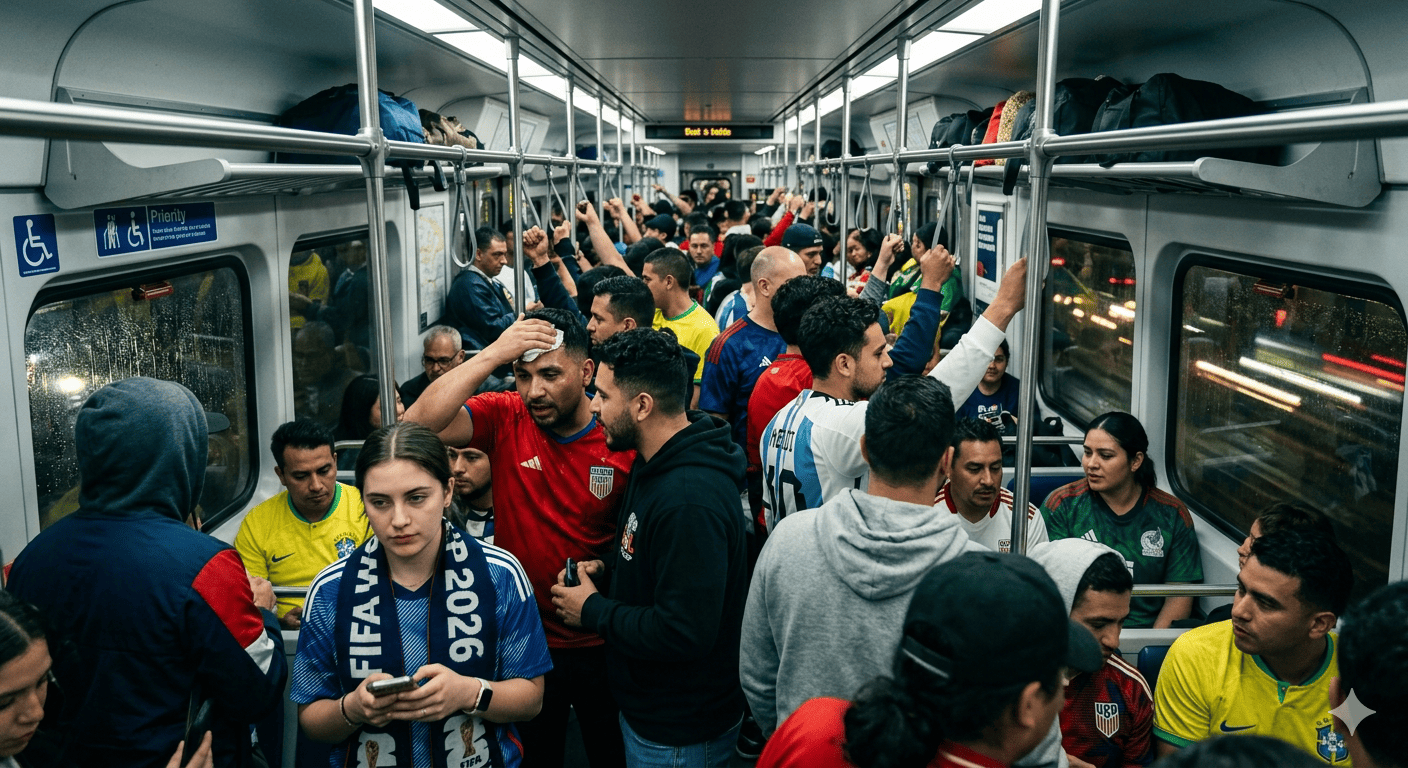
If you’ve taken NJ Transit to a MetLife event before, you already know what happens after the final whistle. The dedicated stadium platform fills up in 10 minutes. The line snakes through the concourse. The first train pulls out fully loaded. The second train arrives 20 minutes later, also fully loaded. By the time you actually board, you’ve stood for 30-90 minutes — sometimes more — in heat, with thousands of other fans, in a holding pattern.
This is the post-match NJ Transit reality at MetLife Stadium. It’s not exaggerated. It’s the actual experience. And for World Cup 2026, with international fan crowds, longer ceremonies, and Final Match-level demand, it’s going to be worse than anything past events have produced.
This guide explains why NJ Transit crowds after MetLife are so brutal, what real wait times look like, and what most fans don’t know about getting home faster.
If you’d rather just skip the platform crush entirely, call +1 (917) 277-3371 or book a pre-staged chauffeur.
The Short Answer
NJ Transit’s MetLife Stadium line operates on a finite capacity. The dedicated stadium platform can accept a few trains per hour. Each train holds approximately 1,000 passengers. When 80,000+ fans exit MetLife at the same moment, the math doesn’t work — most of those fans are headed to a transit system that can move maybe 4,000-6,000 of them per hour.
The result: queueing at the platform of 30-90 minutes for standard matches and 60-150 minutes for Final Match. By the time you actually get home, post-match transit time is 2-3 hours from final whistle to Manhattan.
The longer answer covers the math, the timing curve, what makes Final Match worse, and what your alternatives are.
The Math of MetLife Post-Match Transit
Let’s do the actual math:
Stadium Capacity
- World Cup configuration: ~82,500 attendees
- Exit window after final whistle: roughly 60-90 minutes for most fans to leave the bowl
Transportation Mode Split (Approximate)
- ~30-40% drive their own cars (private vehicles + rideshare)
- ~25-35% take NJ Transit
- ~10-15% take pre-booked chauffeur services
- ~5-10% other (charter buses, walking to local hotels, etc.)
NJ Transit Demand
If 25-35% of 82,500 fans take NJ Transit, that’s 20,500-28,800 passengers all trying to board within 60-90 minutes.
NJ Transit Capacity
- Dedicated MetLife stadium platform serves dedicated event trains
- Each train: ~1,000 passengers
- Train frequency: ~6-8 trains/hour during post-event peak
- Total capacity: ~6,000-8,000 passengers/hour
The Math
20,500-28,800 passengers trying to use a system that handles 6,000-8,000/hour.
That’s 3-4x demand vs. capacity. Even running at maximum frequency, NJ Transit can only move a fraction of fans per hour. The rest wait.
This isn’t a service quality issue — it’s a fundamental capacity constraint. NJ Transit moves a fixed number of people. World Cup demand will exceed it.
What Wait Times Actually Look Like
Real wait times observed at past major MetLife events:
Standard NFL Sold-Out Game
- Walk to platform from your seat: 20-30 minutes
- Platform wait for boarding: 30-60 minutes
- Train ride to Secaucus Junction: 10-15 minutes
- Transfer + wait at Secaucus: 10-25 minutes
- Train to Penn Station NY: 6-10 minutes
- Total post-match time: 75-140 minutes
Taylor Swift Eras Tour at MetLife (3 sold-out nights, 2023)
- Platform wait: 45-90 minutes
- Total post-match time: 90-150 minutes
2024 Copa America Final at MetLife
- Platform wait: 60-90 minutes (sustained for over 2 hours)
- Total post-match time: 120-180 minutes
World Cup 2026 Final Match Projection
- Platform wait: 90-150 minutes (with security perimeter delays)
- Total post-match time: 150-220 minutes
Yes — for the Final Match, plan for 2.5-3.5 hours from final whistle to your Manhattan hotel if you’re using NJ Transit. This is realistic, not pessimistic.
Why It’s Worse Than People Expect
A few factors compound the crowding:
1. Cell Service Saturation
At the platform, 5,000+ people are all trying to use mobile data simultaneously. The cell tower saturates. People can’t update partners, get train apps, or check schedules. Everyone is in a comms blackout zone.
2. Heat
For July matches, the platform is exposed. 80°F+ temperatures with no shade. Long waits in heat make the experience exponentially worse.
3. No Seating
The platform isn’t designed for waiting. There’s no real seating. You stand. For 30-90 minutes.
4. Bathroom Access
Once you’ve queued for the platform, you’re committed. There aren’t accessible bathrooms in the queue. People with bathroom needs face hard choices.
5. Family Splits
Groups get split across trains. You board one train; your friend boards the next. Coordinating reunification at Penn Station is harder than it sounds.
6. Luggage / Bag Stress
The clear bag policy from the stadium creates a population of passengers without easy bag management. Carrying anything you bought at stadium pop-ups (jerseys, scarves) makes the queue worse.
7. Match-Day Delays
Train schedules can shift. Engineering issues. Service alerts. NJ Transit is generally reliable, but on the busiest days, problems compound.
What’s Different About World Cup 2026
World Cup 2026 will be worse than past major events for several specific reasons:
International Fan Concentration
Brazilian, Argentine, English, German, French, Mexican fan delegations. These groups travel in large coordinated waves and often choose NJ Transit for their first MetLife trip. The international fan concentration shifts demand patterns.
Multi-Match Match Days
Some match days will have multi-match scheduling at MetLife (back-to-back events) which compounds demand.
Final Match
The Final Match on July 19, 2026 will be the most extreme single-day transit event at MetLife in history. Plan for the worst case.
Security Perimeter
Final Match security perimeter will extend 2-4 miles, creating additional walk time from stadium to platform. This adds 10-25 minutes to the post-match transit timeline.
What You Can Actually Do About It
Five strategies for getting home faster:
Strategy 1: Pre-Booked Chauffeur (Best)
A pre-booked chauffeur is staged in a reserved post-match return zone. You walk out, walk to them, you’re in the car within 10-25 minutes. Total post-match time: 60-90 minutes to your Manhattan hotel. Half the time of NJ Transit.
Cost is the trade-off: $495-$1,495 round trip vs. $10-15 NJ Transit. For couples and groups, the per-person economics often favor the chauffeur even before factoring in time savings.
For the chauffeur option, see our pricing guide or book here.
Strategy 2: Wait Until the Crowds Thin
If you’re willing to wait an extra 45-60 minutes, the post-match crush moderates. You can have a beer at a stadium concession, sit in your seat for the post-match ceremony, take photos, then walk to the platform when most fans have cleared.
Trade-off: you’re at the stadium 90+ minutes longer than necessary. But you board a less-crowded train and arrive home calmer.
Strategy 3: NJ Transit Express to a Different Stop
Some NJ Transit lines branch off the dedicated MetLife stadium service. If your destination is on a different branch (like Newark), you may be able to take a non-MetLife-dedicated train that’s much less crowded.
This requires NJ Transit knowledge and planning. Not for casual visitors.
Strategy 4: Walk to a Different Transit Station
The dedicated MetLife stadium platform is the worst chokepoint. A 20-30 minute walk to a nearby NJ Transit station (Secaucus Junction direct) lets you skip the dedicated stadium line entirely.
Trade-off: 20-30 minute walk in the dark after the match.
Strategy 5: Drive to a Pickup Point
If you’ve parked your car at MetLife, the parking lot exit takes 60-90 minutes anyway — but you’ve got a car and you’re driving home. Trade-off: parking + tolls + can’t drink.
For comparison vs. other options, see our limo vs Uber vs NJ Transit comparison.
Strategy Comparison
Here’s how each approach compares for post-match return:
| Method | Wait Time | Total Time | Cost (Round Trip) |
| Pre-booked chauffeur | 10-25 min | 60-90 min | $495-$1,495 |
| Drive yourself with parking | 60-90 min exit + 60 min drive | 120-150 min | $200-$400 |
| NJ Transit (peak) | 30-90 min | 75-150 min | $10-15 |
| NJ Transit (after waiting) | 15-30 min | 60-90 min + 60-90 min wait at stadium | $10-15 |
| Rideshare (Uber, Lyft) | Variable surge wait | 60-120 min | $200-$1,200 (surge) |
Pre-booked chauffeur wins on time. NJ Transit wins on cost. The right choice depends on what you value.
For most travelers, the time savings of a pre-booked chauffeur (especially for Final Match) is worth the premium. For solo budget travelers, NJ Transit is the cheapest reliable option even with the wait.
What If Your Group Splits on NJ Transit?
A common scenario: you arrive at the platform with 4 friends. The first train fills before you all fit. Three of you board; two of you wait for the next train.
Plan for this:
Designate a Meeting Point at Penn Station
Don’t try to reunify on the train or platform. Agree before the trip: “If we split, meet at [specific landmark] in Penn Station.” Track 9 entrance. Specific food vendor. Etc.
Carry a Backup Plan
If your friend’s phone dies or they get lost, what’s the recovery? Plan a meeting time too — “Meet at landmark at 11:30 PM” gives you a backup if calls don’t work.
Share Match-Day Schedules
Everyone in the group should have everyone’s phone number, hotel name, and emergency plan saved. Don’t rely on the day-of figuring out.
For broader group coordination, see our group transportation guide — where one Sprinter limo eliminates this problem entirely.
What NJ Transit Doesn’t Tell You
A few things NJ Transit’s official materials don’t emphasize:
The Service Hours Have Limits
Match-day shuttle service runs from 1-2 hours before kickoff until roughly 30-45 minutes after the final regular train. If your match goes to extra time + penalties + ceremonies, you may be cutting it close on the last train. For very late matches, the last NJ Transit option may be inconvenient.
Standing-Room-Only Is Standard
Don’t expect to find seats on a post-match MetLife shuttle train. You stand. For 10-15 minutes. With everyone packed in.
Transfers at Secaucus Are Tricky
The transfer from MetLife shuttle to Penn Station train at Secaucus Junction can be confusing for first-time riders. Signage is okay but not great. International fans especially struggle.
NJ Transit Customer Service Is Limited Post-Match
Don’t expect help from station agents. They’re overwhelmed.
Ticketing Can Be a Bottleneck
If you didn’t buy your return ticket before the match, the post-match ticket purchase at Secaucus or Penn adds time.
How to Use NJ Transit Smartly (If You Choose It)
For travelers committed to NJ Transit, here’s how to minimize the pain:
Buy Round-Trip Tickets in Advance
Buy your return ticket before you leave for the match. Mobile app or kiosk. Skip the post-match line.
Charge Your Phone
You’ll need it for everything — schedules, communicating, getting home.
Bring a Power Bank
Phone will die. Have backup.
Wear Comfortable Shoes
You’ll stand and walk a lot.
Stay Hydrated
Long platform waits in heat = real hydration concerns.
Have a Backup Plan
If NJ Transit experiences major issues, what’s Plan B? Have a backup operator number ready. Our last-minute desk at +1 (917) 277-3371 is one option.
Don’t Rely on Cell Service
Save everything you need offline: hotel address, friend phone numbers, return train info.
When NJ Transit Is Genuinely the Right Choice
For balance — NJ Transit is the right call for:
Solo Budget Travelers
$10-$15 round trip vs. $500+ for a chauffeur. The savings is huge if you can absorb the wait.
Travelers Without Time Constraints
If you don’t need to be anywhere immediately after the match, the wait is just an inconvenience.
Single-Person Travel
Easier to navigate a busy transit system solo than with a group.
Locals Familiar With NJ Transit
You know the system. You handle it.
Travelers Already at Penn Station
You’re staying at a Midtown hotel near Penn. NJ Transit + short walk = clean return.
For all of these, NJ Transit makes sense. For others, the trade-offs accumulate.
Frequently Asked Questions (FAQ)
Q: Why is NJ Transit so crowded after MetLife matches?
A: Demand exceeds capacity. About 20,500-28,800 fans take NJ Transit after a sold-out MetLife event, but the system can only move 6,000-8,000 passengers per hour. The result: 30-90 minute platform waits at peak, 60-150 minutes for Final Match.
Q: How long is the wait for NJ Transit after a MetLife World Cup 2026 match?
A: 30-90 minutes for standard matches, 60-150 minutes for Final Match (July 19, 2026). Total time from final whistle to your Manhattan hotel: 75-150 minutes (standard) or 150-220 minutes (Final Match).
Q: Can I avoid the NJ Transit crowd after a MetLife match?
A: Yes. Options: pre-booked chauffeur (staged for immediate pickup), waiting 45-60 minutes for crowds to thin, walking to a different NJ Transit station, or drive yourself with pre-paid parking. Pre-booked chauffeur is fastest; NJ Transit wait is cheapest.
Q: How long is the train ride from MetLife to Penn Station after a match?
A: The actual train rides total ~25-35 minutes (MetLife shuttle + Penn line). But platform waits add 30-90 minutes pre-match shuttle and 10-25 minutes at Secaucus Junction transfer. Total post-match time: 75-150 minutes (standard match) or 150-220 minutes (Final Match).
Q: Will my NJ Transit train back to Penn Station be standing room only?
A: Yes. Post-match dedicated stadium shuttle trains run at full capacity. Expect to stand for the 10-15 minute ride.
Q: What time does NJ Transit stop running after MetLife events?
A: Match-day shuttle service runs until approximately 30-45 minutes after the last regular train. For late evening matches with extra time + penalties + ceremonies, double-check the last train time. Don’t get stranded.
Q: Is NJ Transit faster than a chauffeur for getting home after a MetLife match?
A: No. A pre-booked chauffeur is dramatically faster (60-90 minutes total) than NJ Transit (75-150 minutes standard, 150-220 minutes Final Match). The chauffeur eliminates the platform wait entirely.
Q: Can groups stay together on NJ Transit after a MetLife match?
A: Often not. Groups frequently get split across trains during peak congestion. Pre-arrange a meeting point at Penn Station for reunification. Or book a single Sprinter limo and stay together throughout.
Q: What if NJ Transit is broken/delayed during my World Cup 2026 match?
A: Have a backup. Pre-booked chauffeur with our last-minute desk at +1 (917) 277-3371 is one option. NJ Transit alternate buses are sometimes available, but during peak congestion, they fill quickly too.
Q: Should I take NJ Transit to the World Cup Final Match (July 19, 2026)?
A: Only if you’re a solo budget traveler willing to absorb the worst transit wait of the tournament. For couples, groups, and time-sensitive travelers, a pre-booked chauffeur is the smarter call for the Final.
Skip the Platform Crush
NJ Transit is reliable, but the post-match wait at MetLife for World Cup 2026 is going to be brutal. A pre-booked chauffeur is staged for immediate pickup — 60-90 minutes door-to-door vs. 75-220 minutes via transit.
Book your post-match ride → 📞 24/7 Live Dispatch: +1 (917) 277-3371