

Hi, How Can We Help You?

Author Archives: William Grant

November 6, 2026

Veterans Day lands on Wednesday, November 11, 2026. If you’re spending the day in New York, the parade on Fifth Avenue is the obvious anchor. The hours around it are where the day really opens up.

We’ve helped visitors plan this day for years. The pattern that works is always the same.

Build your day around the parade. Add one or two meaningful stops before or after. Keep the logistics simple.

That’s it.

This guide walks you through everything worth doing in NYC on November 11, 2026: the morning ceremony at Madison Square Park, where to catch the parade and where to pivot afterward, which memorials carry weight, where to find Veterans Day meal programs, how to spend the afternoon, and how to move through Midtown without losing hours. For the parade itself — full route, timing, viewing spots — see our complete 2026 NYC Veterans Day Parade guide.

Quick Answer: What to Do with Your Day

Short version: Start at Madison Square Park for the wreath-laying ceremony at the Eternal Light Flagstaff around 11 AM. Watch the parade from Bryant Park between 12:30 and 2:30 PM. Visit the Intrepid Sea, Air & Space Museum or the New York City Vietnam Veterans Memorial in the afternoon. Grab dinner at a veteran-owned restaurant or a Midtown spot running Veterans Day meal programs.

That’s the day. Everything below is how to do each piece right.

What Makes Veterans Day in NYC Different

Veterans Day is a federal holiday. New York marks it differently than most cities.

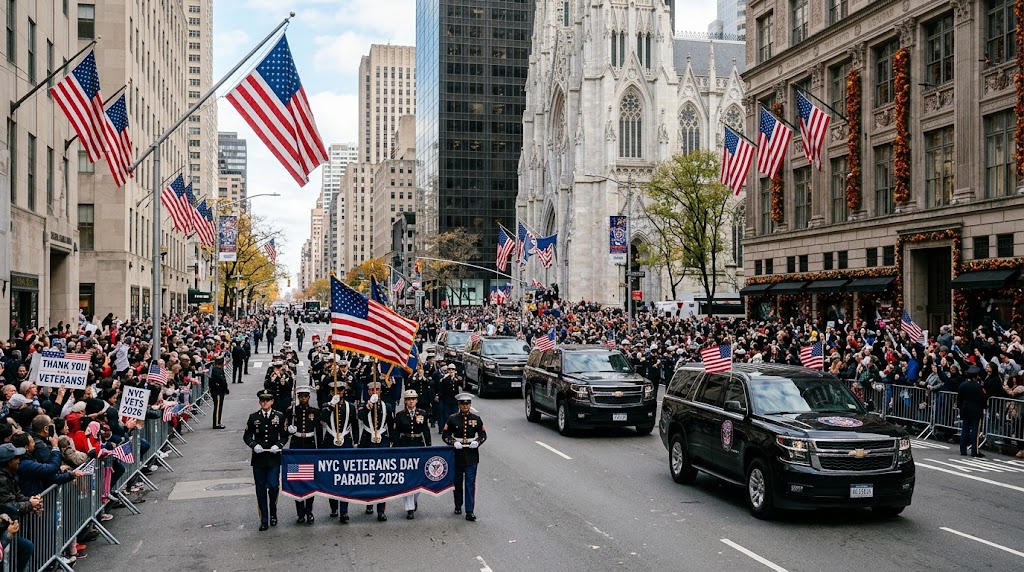
The NYC Veterans Day Parade is the largest in the country. It steps off at approximately 12:30 PM on November 11 and runs until about 3:30 PM, marching north up Fifth Avenue from 26th Street to around 50th Street. The United War Veterans Council has produced it every year since 1986.

Before the parade, there’s a wreath-laying ceremony at the Eternal Light Flagstaff inside Madison Square Park — the city’s central Veterans Day monument since 1923.

After the parade, Midtown stays active with restaurant discounts, museum programming, and quieter moments at memorials across the five boroughs.

Most banks and government offices close. Many museums offer free admission for active-duty military and veterans. Restaurants run meal programs. Bring a military ID if you qualify — it works at more places than you’d expect.

1. Start Your Morning at the Eternal Light Ceremony

Madison Square Park is where the day begins.

The Eternal Light Flagstaff anchors the morning. City officials, veterans groups, and Gold Star Families gather for a brief wreath-laying ceremony before step-off. It’s the ceremonial heart of the day.

Arrive by 10:30 AM to get close. By 11 AM the park is packed.

Here’s what to do:

  • Walk the park’s perimeter before the crowd fills in
  • Stand near the Eternal Light Flagstaff for the ceremony
  • Grab coffee at a café on 23rd or 24th Street before claiming your spot
  • Stay through to the parade step-off at 12:30 PM

Pro tip: The park benches fill up by 11 AM. If someone in your group needs to sit, come earlier or send one person ahead to hold space.

Pro tip: The ceremony is quiet by nature. If you’re bringing kids or want more atmosphere, aim for the parade step-off section near 26th Street instead — louder, more music, more visual energy.
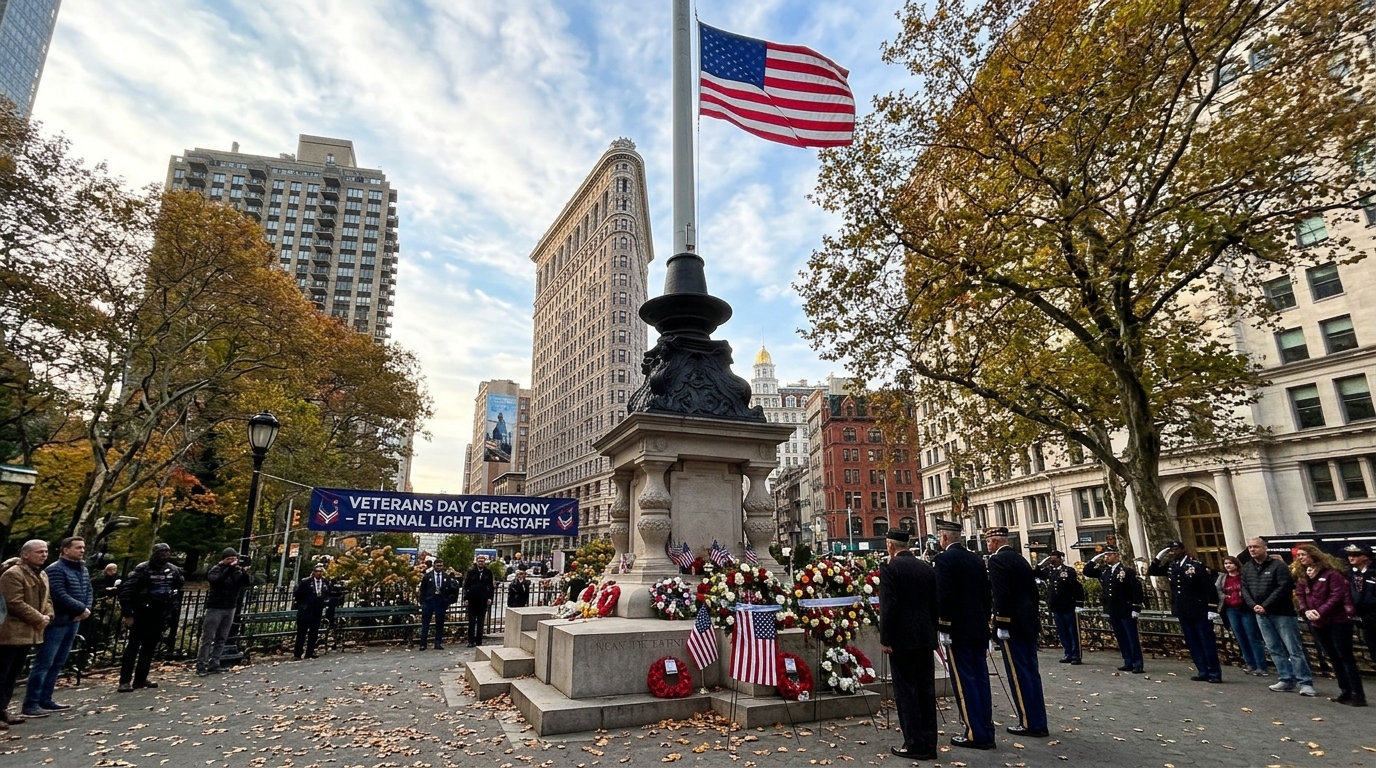
Madison Square Park on Veterans Day morning

The stretch from 23rd to 26th Street gives you both — ceremony first, parade second, same spot.

2. Watch the Parade on Fifth Avenue — Then Pivot

The parade runs for about three hours. You see the whole thing from any single spot on the route — units move continuously, so the only trade-off is which end you see first.

Pick your viewing zone by what you want to do next.

Madison Square Park (23rd–26th Streets): Opening units, maximum atmosphere, slowest exit.

Herald Square (34th Street): Wide sidewalks, subway access, Empire State Building backdrop, mixed crowd.

Bryant Park / New York Public Library (40th–42nd Streets): The sweet spot for most people. Widest sidewalks on the route, library steps as a de facto grandstand, Bryant Park bathrooms, five subway lines within one block.

Rockefeller Center (47th–50th Streets): Thinnest crowds, quickest exit, easy pivot to shopping or an early dinner.

For a full breakdown of each zone, see our where to watch guide.

Bad example: Standing on a side street perpendicular to Fifth Avenue — you’ll see units for 10 seconds and nothing before or after. Nobody who’s done this parade twice makes this mistake.

Good example: The west sidewalk between 40th and 42nd Streets, opposite the library. Wide sidewalk, excellent sightlines, subway access to five lines, public bathrooms behind you.

Once the parade passes, don’t fight the dispersal crowd. Walk a few blocks away from Fifth Avenue before hailing a ride or heading to the subway.
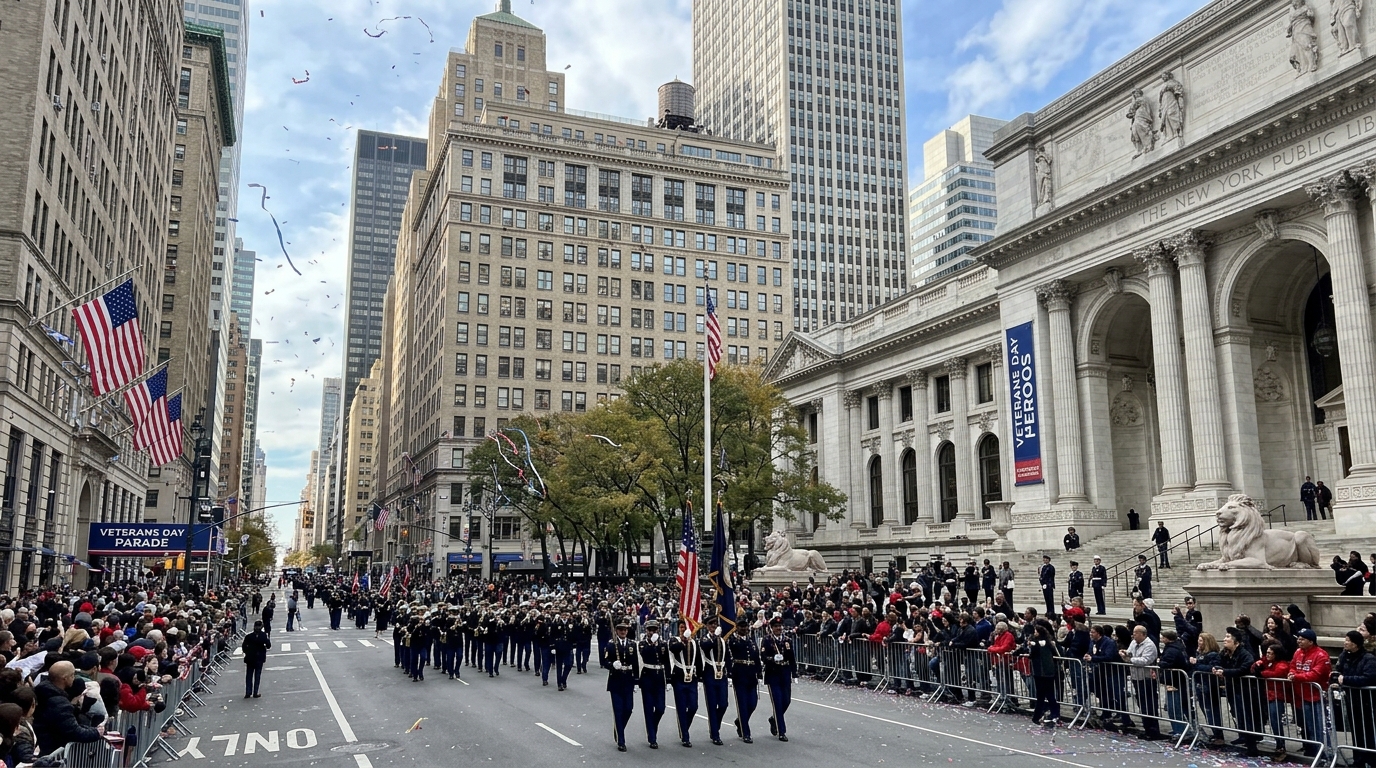
Veterans Day Parade 2026

3. Visit a Military Memorial That Carries Weight

Veterans Day takes on real weight at a memorial. Three stops in New York carry the most meaning. All are reachable by subway, all are open on November 11, and all have special Veterans Day programming (confirm the 2026 schedule on each site).

Intrepid Sea, Air & Space Museum

The USS Intrepid aircraft carrier is a floating museum at Pier 86 on the Hudson River. It served through World War II and Vietnam. The Space Shuttle Pavilion sits on the flight deck. The Intrepid Museum typically includes free admission for active-duty military and veterans with ID on Veterans Day.

Expect ceremonies on the flight deck, special exhibits, and guest speakers. The museum books up on November 11 — buy tickets online ahead of time.

Allow 2-3 hours. The hangar deck alone takes an hour. Bring a jacket — the flight deck is exposed to wind off the Hudson.

New York City Vietnam Veterans Memorial

At 55 Water Street in Lower Manhattan.

The memorial is a translucent wall of green glass bricks, etched with excerpts from letters, journals, poems, and news dispatches from service members during the Vietnam War. Dedicated in 1985.

It’s outdoor, free, and open 24 hours. One of the most moving spots in the city — quiet, personal, designed for reading rather than looking. Allow 30 minutes to walk the wall slowly.

Useful resource: NYC Parks has the full history and visitor info for Vietnam Veterans Plaza.

9/11 Memorial & Museum

At the World Trade Center site.

Honors those who have served since 2001. The outdoor memorial pools are free and open daily. The 9/11 Memorial & Museum (paid admission) typically offers free entry for active-duty military, veterans, and family members on Veterans Day.

Allow 2 hours for the museum.

Smaller Memorials Worth Knowing

Four more spots across the city, each with weight:

  • East Coast Memorial at Battery Park — honors 4,601 service members lost in the Atlantic during World War II
  • Soldiers’ and Sailors’ Monument on Riverside Drive at 89th Street — Civil War memorial, 96 feet tall, opened 1902
  • Castle Clinton at Battery Park — history exhibits with military context, free admission
  • Grant’s Tomb (General Grant National Memorial) in Riverside Park — open on federal holidays, free to enter

Pro tip: If you’re combining memorials with the parade, do one memorial in the morning before Madison Square Park, then a second after the parade ends. Trying to hit three in one day wears people out.

The New-York Historical Society runs permanent and rotating exhibits that include military material. It’s across Central Park from the parade finish — a solid afternoon stop if you’d rather trade a second memorial for a museum.

Governors Island and Fort Wadsworth are both further afield but worth the trip if you have time before or after Veterans Day. Both carry serious military history. Both are quiet escapes from Midtown.

Memorial Comparison

Memorial Admission Allow time Best for
Intrepid Sea, Air & Space Museum Free for veterans on Nov 11 2-3 hours Families, full afternoon stop
NYC Vietnam Veterans Memorial Free, outdoor, 24 hours 30 minutes Quiet, personal reflection
9/11 Memorial & Museum Free for veterans on Nov 11 2 hours Post-2001 service recognition
East Coast Memorial Free, outdoor 15 minutes WWII history, Battery Park walk
Grant’s Tomb Free 45 minutes Civil War history, Upper West Side


4. Thank a Veteran — or Join Them for a Meal

Veterans Day is the one federal day set aside for people who served. The meaningful way to mark it is personal.

If you know a veteran in your life, call them. Visit them. Share a meal.

If you don’t, consider stopping by a local Veterans of Foreign Wars (VFW) post or American Legion hall — both welcome visitors on the day.

Dining options worth knowing in NYC on November 11:

  • Many New York restaurants offer Veterans Day meal programs and restaurant specials for current and former military (bring a military ID)
  • Veteran-owned restaurants are scattered across the five boroughs — worth a Google search for your neighborhood
  • Several Midtown Manhattan dining spots run free meals for veterans on November 11

Pro tip: Chains like Applebee’s, Chili’s, Olive Garden, and Starbucks have historically offered free meals or drinks for veterans and active-duty military on November 11. Confirm the 2026 offer on each chain’s site before showing up — these programs change year to year.

Some of the city’s most beloved veteran-owned spots sell out early. If you want a reservation at a specific veteran-owned restaurant, call the week before.

5. Make the Afternoon Count: Midtown & Rockefeller Center

The parade ends around 3:30 PM. You’ve got afternoon hours left. Here’s what works.

If you watched from Rockefeller Center or Bryant Park, you’re already in the middle of the best afternoon territory in Manhattan.

Walk Fifth Avenue shopping while the crowd thins out. Saks Fifth Avenue is directly across from Rockefeller Center. St. Patrick’s Cathedral — worth stepping inside for the architecture alone — is right next door.

Rockefeller Center itself is worth 45 minutes. Walk through the plaza. See the ice rink setup (opens for the season in late October). Grab a snack at one of the surrounding cafés.

Top of the Rock if you want views. Tickets book in advance on busy days.

Head to Times Square for a Broadway matinee if you planned ahead. Most weekday matinees start at 2 PM, so this works best if you watched the parade from the finish line and left by 2:30.

Central Park is a five-minute walk from the parade finish at 50th Street. The park’s south entrance at 59th Street and Fifth Avenue is right there. The Pond and Wollman Rink (opens for skating in October) are both within a 10-minute walk from the entrance.

Pro tip: If the weather turns, the Empire State Building observation deck is a block south of Herald Square. It opens at 10 AM and runs until midnight. Veterans historically get free admission on November 11 — check the current offer before going.

6. Veterans Day in the Outer Boroughs

The Manhattan parade is the main event. Brooklyn, Queens, Staten Island, and the Bronx each hold their own Veterans Day commemorative ceremony.

If you live outside Manhattan — or you want a quieter alternative — a local event is often more personal than a trip to Fifth Avenue.

  • Brooklyn: Grand Army Plaza and Prospect Park host local ceremonies. Historic Green-Wood Cemetery holds a Veterans Day observance at its Civil War Soldiers’ Monument.
  • Queens: Flushing and Jamaica host commemorations at local veterans parks.
  • Staten Island: The borough has strong veteran traditions. Fort Wadsworth and nearby parks host annual ceremonies.
  • The Bronx: Pelham Bay Park and local veterans memorials host observances.

Check your local borough president’s office or the NYC Parks website for 2026 schedules. These events tend to be smaller — often under 100 people — which is what makes them meaningful.

7. Make the Day Logistically Smooth

Midtown traffic on Veterans Day is heavy. Manhattan street closures on Fifth Avenue start before noon and don’t clear until well after the parade ends. Plan accordingly or you’ll lose hours.

Here’s what to focus on:

  • Use the subway for anything within Manhattan — it’s the only reliable way to move during parade hours
  • Avoid driving your own car anywhere near the parade route
  • Pre-book parking garages east or west of the route (Park Avenue or Eighth Avenue) if you must drive in
  • Budget extra time for anything that crosses Fifth Avenue
  • Build in 15–30 minute buffers between stops

For groups, families with older veterans, visitors arriving by air, or anyone with multiple stops in one day, private transportation is worth the cost. Limo Service in NYC offers chauffeur service, point-to-point transportation, airport transfers from JFK, LaGuardia, and Newark, and group transportation in a luxury SUV, Mercedes-Benz Sprinter van, or stretch limousine.

What a chauffeur can’t do: drive on Fifth Avenue during the parade. No vehicle can — the street is closed.

What a chauffeur can do: drop you at the nearest reachable corner, wait at a staging point, and meet you at a prearranged corner once dispersal clears. For a multi-stop day — ceremony, parade, museum, dinner — that logistic matters.

Pro tip: Book pickup locations two to three avenues east or west of the parade route. Lexington Avenue and Eighth Avenue stay clearer than Sixth Avenue or Madison Avenue during the parade window.

Frequently Asked Questions

Is Veterans Day a federal holiday in 2026?

Yes. Veterans Day is one of the eleven federal holidays recognized by the United States government. Most banks, post offices, and government offices close on November 11.

What time does the NYC Veterans Day Parade start?

The 2026 parade steps off at approximately 12:30 PM on Wednesday, November 11, and runs until about 3:30 PM.

Is the NYC Veterans Day Parade free to attend?

Yes. Watching the parade is free and open to the public. No tickets, no reservations, no entry fees.

Are museums open in NYC on Veterans Day?

Most major NYC museums stay open on Veterans Day. Many offer free admission for active-duty military, veterans, and their family members. Hours may be adjusted — check each museum’s site before visiting.

Do restaurants offer Veterans Day deals in NYC?

Yes. Many New York restaurants run Veterans Day meal programs with free meals or discounts for current and former military. Bring a military ID. Chains like Applebee’s, Chili’s, Olive Garden, and Starbucks have historically participated — confirm the 2026 offer on each chain’s site.

What’s the best memorial to visit on Veterans Day in NYC?

The Intrepid Sea, Air & Space Museum for families and anyone wanting a full afternoon stop. The New York City Vietnam Veterans Memorial at 55 Water Street for a quieter, outdoor, personal experience. The 9/11 Memorial for anyone paying respects to service members from 2001 onward.

Can I bring kids to the Veterans Day Parade?

Yes. The parade is family-friendly. For kids, we recommend viewing from Bryant Park or Rockefeller Center — wider sidewalks, bathrooms nearby, easier exits. Bring layers and snacks.

What should I do in NYC the day before Veterans Day?

November 10 is the Marine Corps Birthday — a meaningful date for Marine veterans. Several NYC events honor it. The Intrepid Museum, VFW posts, and American Legion halls often host events. It’s also a good day to visit memorials before the Veterans Day crowds arrive.

Where can I find Veterans Day events in Brooklyn, Queens, or the Bronx?

Check your local borough president’s office or the NYC Parks website for borough-specific Veterans Day commemorative ceremonies. Grand Army Plaza (Brooklyn), Flushing (Queens), Fort Wadsworth (Staten Island), and Pelham Bay Park (Bronx) all host annual observances.

Do I need a military ID for Veterans Day discounts?

Yes — most Veterans Day free meals, museum discounts, and admission offers require a valid military ID, VA ID card, or proof of service (DD-214). Bring one if you qualify.

What’s the best way to get to the Veterans Day Parade?

The subway, from any borough. Driving is impractical because of street closures. For a full breakdown of subway routes, airport pickups, and parking, see our how to get to the parade guide.

Should I book private transportation for Veterans Day?

For solo visitors or small groups using the subway, no. For families with older veterans, groups of four or more, airport arrivals on November 11, or multi-stop days, private transportation is worth the cost. Call +1 (917) 277-3371 for availability.

Plan Your Day First, Book Logistics Second

Start with the ceremony at Madison Square Park if you want the full weight of the day. Add a memorial stop — Intrepid, Vietnam Veterans Memorial, or 9/11 Memorial — before or after the parade. Plan dinner at a veteran-owned restaurant or a spot running Veterans Day meal programs.

Book private transportation now if you’re traveling with a group or need airport pickup — visit the reservations page or call +1 (917) 277-3371. Reservations fill fast for Veterans Day week.

The parade is the anchor. The hours around it are what make the day yours.
November 5, 2026

The NYC Veterans Day Parade on Wednesday, November 11, 2026 marches 1.4 miles up Fifth Avenue — from 26th Street to 50th Street — and tens of thousands of spectators line that stretch to watch. Not every viewing spot is equal. The south end at Madison Square Park catches the step-off and the pre-parade wreath-laying ceremony but fills up first. The middle of the route gives you the widest sidewalks and the easiest subway access. The north end offers thinner crowds and quicker departure. This guide walks the full route block by block so you can pick the spot that fits your group, your mobility, and what you want to see most.

For the full parade overview — route history, timing, and event background — see our complete 2026 NYC Veterans Day Parade guide. For step-by-step directions to reach the route from each borough, airport, or out-of-town origin, see the companion how to get to the parade post.

Quick Answer: The Best Spot in One Sentence

For first-timers who want a comfortable view and easy exit, stand on Fifth Avenue between 40th and 42nd Streets, on the west sidewalk opposite Bryant Park and the New York Public Library — wide sidewalk, excellent sightlines, subway access to five lines, and shops behind you for warming breaks. For the ceremonial opening, stand near Madison Square Park at 25th or 26th Street and arrive by 10:30 AM. For the smallest crowds, head to the 47th–50th Street finish.

The 1.4-Mile Fifth Avenue Route: Understanding Your Viewing Options

The parade moves north on Fifth Avenue, starting at roughly 26th Street at 12:30 PM and dispersing around 50th Street by 3:30 PM, rain or shine. Spectators can stand on either sidewalk for the full length. The United War Veterans Council confirms the route and marching order; the NYPD sets the specific barrier placement the morning of the event.

Think of the route as five natural viewing zones, each with distinct pros and cons:

Zone Streets Best for Crowd level
Madison Square Park 23rd – 26th Ceremony, step-off, atmosphere Very high
Flatiron & NoMad 26th – 34th Early units, close-up views High
Herald Square 34th – 40th Subway access, families Medium-high
Bryant Park / NYPL 40th – 42nd All-around comfort, exits Medium
Finish line 47th – 50th Thin crowds, quick departure Low-medium


Madison Square Park Area (23rd – 26th Streets): Closest to Step-Off

This is the ceremonial heart of the day. Before step-off at 12:30 PM, UWVC holds a wreath-laying at the Eternal Light Flagstaff inside Madison Square Park, the city’s central Veterans Day monument since 1923. Expect city officials, veterans groups, and press to crowd the park from 10:30 AM onward.

Pros:

  • Watch the opening ceremony before the parade begins.
  • Marching units pass tightly bunched here — great for seeing the leading formations.
  • Park benches and open space give you room to assemble a group.

Cons:

  • Fills up earliest. Arrive by 10:30 AM or you’ll watch from several rows back.
  • The 23rd Street and 28th Street subway stations get packed near step-off time.
  • Dispersal south is slower than at any other point on the route.

Best for:

Serious observers, press, veterans and their families, anyone who wants the full ceremony plus parade.

Flatiron & NoMad (26th – 34th Streets): The Opening Stretch

This six-block stretch catches the parade early, when energy is highest and marching units are still in tight formation. Sidewalks here are narrower than farther north, but the surrounding neighborhood — Flatiron south, NoMad north — has plenty of coffee shops and quick-service restaurants for a warming break before step-off.

Pros:

  • See units at full energy before fatigue sets in.
  • Walk to Madison Square Park if you want a glimpse of the opening ceremony first.
  • Good restaurant density for pre-parade meals.

Cons:

  • Narrower sidewalks than Midtown — less room for chairs or groups.
  • Limited subway choice compared to the Herald Square or Bryant Park zones.

Best for:

Photographers, early-arriving couples, locals who want to see the parade start without fighting the park crowd.

Herald Square Area (34th – 40th Streets): Midpoint Access

The parade passes directly between Macy’s Herald Square and the Empire State Building — iconic Manhattan backdrop, reliable subway access from the busiest station on the route, and wider sidewalks than the Flatiron zone. The one block south of 34th Street (33rd Street) is a sweet spot: fewer rubberneckers than directly at Herald Square itself, but same sightline.

Pros:

  • Subway access to B, D, F, M, N, Q, R, W trains at 34th Street – Herald Square.
  • Wide sidewalks accommodate groups, chairs, and strollers.
  • Easy walk to Penn Station (3 blocks west) for anyone arriving by LIRR, NJ Transit, or Amtrak.

Cons:

  • Street-level Herald Square itself is high-traffic even on normal days; parade day amplifies it.
  • Tourist-heavy — expect to share your spot with sightseers who weren’t specifically there for the parade.

Best for:

Out-of-town visitors already staying near Penn Station or Herald Square; mixed-age groups; families.

Bryant Park & New York Public Library (40th – 42nd Streets): The Classic Spot

For most spectators, this is the best spot on the route. Bryant Park sits directly behind the west sidewalk, and the front steps of the New York Public Library’s Stephen A. Schwarzman Building — guarded by the iconic Patience and Fortitude lion statues — make a natural tiered grandstand. Sightlines are excellent, the sidewalk is Manhattan’s widest at this stretch, and five subway lines land within one block.

Pros:

  • Library steps function as de facto grandstand seating for arrivals by 11:30 AM.
  • Bryant Park bathrooms are open to the public (rare on the route).
  • Subway access to 7, B, D, F, M trains at Bryant Park / 42nd Street.
  • Grand Central Terminal is a 7-minute walk east for Metro-North arrivals.

Cons:

  • Library steps fill fast — claim them before 11:30 AM.
  • Parade is already 20 minutes along by the time it reaches you — units may be slightly less tightly formed than at the start.

Best for:

First-timers, families, photographers wanting an architectural backdrop, anyone wanting bathroom access and the easiest exit.

Rockefeller Center Area (47th – 50th Streets): The Finish Line

The parade’s north end draws the thinnest crowds and clears fastest after dispersal. Marching units reach you later (around 1:00 to 3:30 PM depending on where they fall in the order), and some have begun to dissolve formation — but the trade-off is more breathing room, a better chance at a front-row spot, and the quickest exit back to transit.

Pros:

  • Lowest crowd density on the route.
  • Subway access to B, D, F, M at Rockefeller Center and E, M at Fifth Avenue – 53rd Street.
  • Grand Central and Rockefeller Plaza are both a short walk for post-parade plans.
  • Shops, restaurants, and the famous ice rink nearby for post-parade browsing.

Cons:

  • Later arrivals in the parade order — if you want to see specific units, check UWVC’s published order before choosing this zone.
  • Some units begin loosening formation near dispersal.

Best for:

Late arrivals, groups with young children or older members who need room, anyone planning afternoon shopping or dining in Midtown after the parade.

East Side vs West Side of Fifth Avenue: Which Is Better?

Both sidewalks give you a full view of the parade, but each has its own character. The west side tends to carry heavier crowds — it faces the morning sun angle, puts you closer to Bryant Park and the library, and is where most TV crews set up. The east side carries slightly less density, catches better afternoon light for photography, and offers easier dispersal for subways heading toward Lexington Avenue.

Our recommendation: west side for families and first-timers (wider sidewalk at Bryant Park, nearby bathrooms, better landmarks behind you). East side for photographers, anyone with mobility concerns wanting less jostling, or spectators catching the 4, 5, 6 trains east of the route.

Best Viewing Spots for Families with Kids

For kids, pick a spot with room to shift, a bathroom within reach, and ideally some visual variety if the parade runs long for little attention spans. Three zones work best:

  • Bryant Park / NYPL (40th–42nd Streets): Bryant Park bathrooms, open grass if kids need a break, library steps for elevated sightlines.
  • Herald Square (34th Street): Macy’s and surrounding stores for warming up; subway access right at the viewing spot.
  • Rockefeller Center (47th–50th Streets): Thinner crowds mean less jostling, more room for strollers, and easy pivot to Rockefeller Plaza if kids lose interest.

Avoid the Madison Square Park zone with young children — it fills early, dispersal is slow, and small kids struggle in packed crowds. Bring layers, snacks, and a backup plan for a warm indoor break if November weather turns.

Wheelchair Accessible & Mobility-Friendly Viewing

The Fifth Avenue sidewalks are ADA-accessible with curb cuts at every intersection, but crowd density varies a lot by spot. For wheelchair users or anyone with mobility concerns, three recommendations:

  • Rockefeller Center area (47th–50th Streets): Lowest crowd density, widest clearance, closest to accessible subway stations (47th–50th Streets Rockefeller Center is ADA-accessible with elevators).
  • Bryant Park (west side of 40th–42nd Streets): Wide sidewalks, benches inside the park for seated breaks, accessible bathrooms.
  • East side of Fifth Avenue between 34th and 42nd Streets: Lighter crowds than the west side with equally good sightlines.

Arrive by 11:00 AM for a spot right at the front barricade, where sightlines are unblocked by standing spectators. UWVC publishes updated accessibility information on its parade page as the day approaches; if specific accommodations are needed, their visitor relations contact is listed there.

Best Spots for Photography

Photographers get the best results from spots with interesting backdrops, consistent light, and enough elevation to shoot over the crowd:

  • NYPL steps (41st–42nd & Fifth): Elevated angle, Beaux-Arts building behind, afternoon light on east-side subjects. The classic shot.
  • Flatiron District (east side, ~27th Street): Catches the parade with the Flatiron Building and Madison Square Park behind. Best early in the parade.
  • Empire State Building vicinity (34th & Fifth, west side): The spire makes a signature NYC vertical in your frame.
  • Rockefeller Center (49th & Fifth): Patrick’s Cathedral across the street anchors the composition.

Bring a lens that handles 50mm to 200mm range — wide for context shots, longer for tight unit portraits. Polarizing filter helps with midday glare off Fifth Avenue’s storefronts. Stand at the barricade for the cleanest foreground.

Where to Avoid (And Why)

  • The dispersal area near 50th–52nd Streets: Looks tempting for thin crowds, but units are breaking formation, equipment is being loaded onto trucks, and the atmosphere turns logistical rather than ceremonial.
  • Sidewalks directly in front of hotel entrances or theatre loading zones: Security and hotel staff will move you repeatedly.
  • Side streets perpendicular to Fifth Avenue: You’ll see units for a few seconds as they cross and nothing before or after. Fifth Avenue itself is the only viewing surface that works.
  • Anywhere behind a tall barricade or TV crew setup: Once production trucks or press risers block your sightline, there’s no fix. Scout your spot ahead.

What to Bring (And What’s Not Allowed)

The parade is a NYPD-secured public event. Standard event rules apply — expect bag checks at some entry points and a visible police presence throughout.

Bring:

  • Layers: Manhattan in mid-November swings from the 40s to the 60s Fahrenheit, and standing still is colder than walking.
  • Small folding stool if you want to sit (tolerated on most sidewalk stretches).
  • Reusable water bottle and small snacks.
  • Portable phone charger — a long wait kills battery.
  • Small umbrella if rain is forecast (parade proceeds rain or shine).
  • ID, especially for veterans redeeming Veterans Day benefits elsewhere in the city.

Leave at home:

  • Large folding chairs (blocks sidewalk flow and often moved by NYPD).
  • Large coolers and oversized bags (slow bag-check lines).
  • Pets other than certified service animals (crowds, loud brass, and long waits make it unpleasant for them).
  • Alcohol (open containers are prohibited on NYC sidewalks).

Arrival Timing by Spot

The parade steps off at 12:30 PM and reaches each zone at slightly different times. To get a front-row spot (right at the barricade), arrive earlier. To stand two or three rows back, you can arrive later:

Zone Parade arrives here Arrive by (front row) Arrive by (3rd row)
Madison Square Park (23rd–26th) 12:30 PM 10:30 AM 11:30 AM
Flatiron / NoMad (26th–34th) 12:35 – 12:50 PM 11:00 AM 11:45 AM
Herald Square (34th–40th) 12:50 – 1:10 PM 11:15 AM 12:00 PM
Bryant Park / NYPL (40th–42nd) 1:00 – 1:20 PM 11:30 AM 12:15 PM
Rockefeller Center (47th–50th) 1:15 – 1:45 PM 11:45 AM 12:30 PM


Confirm current street closures on the NYC Department of Transportation closure page before leaving home, and build in a 15-minute buffer for subway crowding near the route.

Private Transportation to Your Viewing Spot

Choosing a viewing spot and getting dropped off there are two different problems. No vehicle — private or otherwise — can drive on Fifth Avenue during the parade window, and most of the cross streets within one block of the route close with it. What a private chauffeur can do is drop you at the nearest reachable corner, wait at a staging point outside the closure zone, and be ready at a pre-arranged corner for pickup once dispersal clears.

For spectators with older family members, mobility concerns, young children, or group logistics, this is where private transportation earns its cost. Point-to-point transportation with a chauffeur who knows which streets reopen in what order means you can pick the Bryant Park zone (ideal viewing) without worrying about a half-mile walk from the nearest reachable subway after the parade.

Practical drop-off points by viewing zone:

  • Madison Square Park: Park Avenue South at 23rd Street (east approach) or Sixth Avenue at 23rd Street (west approach).
  • Herald Square: Sixth Avenue at 34th Street (west) or Lexington Avenue at 34th Street (east).
  • Bryant Park: Sixth Avenue at 42nd Street (west) or Madison Avenue at 42nd Street (east).
  • Rockefeller Center: Sixth Avenue at 50th Street (west) or Madison Avenue at 50th Street (east).

Frequently Asked Questions

Where is the best place to watch the NYC Veterans Day Parade?

For most spectators, the west sidewalk between 40th and 42nd Streets, opposite Bryant Park and the New York Public Library. Wide sidewalks, library steps for elevated sightlines, five subway lines within one block, and public bathrooms in Bryant Park. For the ceremonial step-off and the pre-parade wreath-laying, Madison Square Park (23rd–26th Streets) is the alternative.

What time should I arrive at the NYC Veterans Day Parade?

For a front-row spot at the Madison Square Park end, arrive by 10:30 AM. For the midpoint (Herald Square to Bryant Park), 11:15 to 11:30 AM. For the finish line near Rockefeller Center, 11:45 AM to noon works. Three rows back is tolerable up to 30 minutes later.

Can you see the whole Veterans Day Parade from one spot?

Yes. The parade passes each spot for roughly 2.5 to 3 hours depending on where you stand. Units move continuously, so you see the entire parade from any single location — the only trade-off is which end you see first.

Is there seating at the NYC Veterans Day Parade?

No official seating or bleachers. Spectators stand on the sidewalks. Small folding stools are tolerated at most stretches of the route. The front steps of the New York Public Library at 42nd Street function as de facto grandstand seating for anyone who arrives by 11:30 AM.

Are there bleachers at the NYC Veterans Day Parade?

No public bleachers. Press and some VIP groups may have reserved risers near the start at Madison Square Park, but none are open to general spectators.

Can I bring a chair to the NYC Veterans Day Parade?

Large folding chairs are discouraged because they block sidewalk flow and are often moved by NYPD. Small folding stools are generally tolerated at mid-route stretches where sidewalks are wide. Bryant Park benches are a good alternative for breaks.

Which side of Fifth Avenue is better?

Both sides give you a full view. The west side tends to be more crowded (closer to Bryant Park and the library, better for TV crews). The east side carries slightly less density, catches better afternoon light for photography, and offers easier exits toward Lexington Avenue subways.

Where is the best spot for photos at the Veterans Day Parade?

The steps of the New York Public Library at 41st–42nd Street for the classic elevated shot with the Beaux-Arts building behind. The Flatiron District (east side near 27th Street) catches the parade with the Flatiron Building and Madison Square Park in the background. 34th Street near the Empire State Building gives you an iconic vertical.

Is the NYC Veterans Day Parade wheelchair accessible?

Yes. Fifth Avenue sidewalks are ADA-accessible with curb cuts at every intersection. For the most comfortable experience, the Rockefeller Center zone (47th–50th Streets) has the lowest crowd density and nearby ADA-accessible subway access. Bryant Park also offers accessible bathrooms and wide sidewalks.

Where do VIPs sit at the NYC Veterans Day Parade?

Dignitaries, invited veterans groups, and press cluster near Madison Square Park at the step-off area, where the morning wreath-laying ceremony happens. Reserved VIP seating is by UWVC invitation only and not sold to the public.

How crowded is the NYC Veterans Day Parade?

Roughly 20,000-plus marchers participate, and spectator crowds line the full 1.4-mile route. The Madison Square Park end is densest; the Rockefeller Center end is lightest. Weekday timing means crowds are lighter than for weekend parades but still substantial.

Do I need a ticket to watch the NYC Veterans Day Parade?

No. Watching is free and open to the public. No tickets, no reservations, no entry fees. Stand anywhere on the sidewalks between 26th and 50th Streets on Fifth Avenue.

Pick Your Spot and Honor the Day

The NYC Veterans Day Parade on November 11, 2026 offers spectators 1.4 miles of Fifth Avenue to choose from. First-timers do best at Bryant Park. Ceremony-focused viewers belong at Madison Square Park. Families and anyone wanting room belong at the Rockefeller Center end. Whichever zone you pick, arrive early enough to secure your spot, bring layers for the November weather, and plan your exit route before step-off.

To arrange drop-off at your chosen viewing spot, airport transfers for arriving visitors, or group transportation for a party of veterans and family, visit the reservations page or call +1 (917) 277-3371. Plan early — Veterans Day week books up fast.

November 4, 2026

The NYC Veterans Day Parade on Wednesday, November 11, 2026 draws tens of thousands of spectators to Fifth Avenue — and shuts down a solid chunk of Midtown Manhattan for roughly six hours. Driving your own car to the parade is impractical. The subway works brilliantly from most of the city but demands good timing. Rideshares surge-price into the triple digits by step-off. Getting there without the stress means picking the right mode for where you’re coming from and leaving early enough to clear the closures.

This guide covers every way to reach the parade on November 11: by subway from each borough, from JFK, LaGuardia, and Newark airports, where to park if you must drive, which trains to avoid, when private transportation earns its cost, and how long each route realistically takes. For the parade itself — the full route, step-off time, viewing spots, and history — see our complete 2026 NYC Veterans Day Parade guide.

When Is the NYC Veterans Day Parade 2026 — and Why Logistics Matter

The parade steps off on Wednesday, November 11, 2026 at approximately 12:30 PM and runs until around 3:30 PM, rain or shine. The route moves north up Fifth Avenue from 26th Street to about 50th Street. Street closures begin before step-off and don’t clear until well after the last marching unit disperses — the practical window of disruption runs roughly 10:00 AM to 5:00 PM.

That window matters for planning. A noon arrival on foot or by subway works fine. A noon arrival in a car — or a 12:15 Uber pickup on Fifth Avenue — does not. The best way to reach the parade depends almost entirely on where you’re starting from and how much buffer you give yourself.

Which Manhattan Streets Close on Veterans Day 2026

The exact closure list is published by the NYPD and NYC Department of Transportation the week of the parade — treat anything below as the expected pattern rather than a final list. The closures typically break into three zones:

  • Parade route: Fifth Avenue from roughly 23rd Street to 50th Street. No through-traffic in either direction during the parade window.
  • Formation area: Side streets on the west side of Madison Square Park — 27th and 28th Streets between Madison Avenue and Sixth Avenue — plus the nearby stretches of Broadway and Sixth Avenue used to stage units before they move onto Fifth Avenue.
  • Dispersal area: Cross streets in the upper 40s east and west of Fifth Avenue where marching units break formation.

Cross-town travel through Midtown is slower than usual all morning and afternoon. If you need to cross Fifth Avenue by car on November 11, do it well north of 50th Street or well south of 23rd Street. Check the NYC DOT closure page the morning of the parade for the final street list.

The Subway: The Fastest Way to the NYC Veterans Day Parade

The subway is the single best way to reach the parade for most spectators. The route sits directly over or within one block of eight different subway stations, so you can choose the stop that matches where you want to watch.

For step-off and the Madison Square Park wreath-laying ceremony (23rd to 26th Streets): take the R, W, or 6 to 23rd Street, the F or M to 23rd Street–Sixth Avenue, or the N, Q, R, W to 28th Street. For the middle of the route (33rd to 42nd Streets): the B, D, F, M, N, Q, R, W to Herald Square, or the 7, B, D, F, M to Bryant Park / 42nd Street. For the finish (47th to 50th Streets): the E or M to Fifth Avenue–53rd Street, or the B, D, F, M to 47–50th Streets–Rockefeller Center. MTA service advisories post updates the morning of the parade.

Two tactical tips: the 23rd Street and 28th Street stations fill up fastest as step-off approaches, so if you want the Madison Square Park area, arrive before 11:30 AM. And on the way home, Bryant Park and Rockefeller Center stations handle the exit crowd better than 23rd Street — walk a few blocks north of where you were standing to leave.

How to Get to the NYC Veterans Day Parade by Borough

Every borough has at least one direct train to the parade route. Here’s the fastest option from each.

From Brooklyn

The R and W trains run straight up Fourth Avenue and over to Manhattan, dropping you at 23rd Street for the step-off end of the route — one seat from most of Park Slope, Sunset Park, and Bay Ridge. From Downtown Brooklyn and Fort Greene, the 2, 3, 4, or 5 to Union Square, then walk north along Broadway, is faster than it looks. From Williamsburg or Bushwick, take the L to Union Square or to Sixth Avenue and transfer up. Allow 45 to 60 minutes door-to-parade.

From Queens

The E, M, F, N, Q, R, W trains all cross into Manhattan from Queens and land within walking distance of the parade. From Long Island City, Astoria, or Jackson Heights, the N, W, R, or 7 to Herald Square puts you right at the middle of the route. From Jamaica, Flushing, or Forest Hills, the E or F runs straight into Midtown — get off at Fifth Avenue–53rd Street for the finish end, or transfer to the 6 for the start. Allow 40 to 70 minutes depending on origin.

From the Bronx

The 4, 5, 6, D, and B trains all serve the Bronx with direct service into Manhattan. From the central and eastern Bronx, the 4 or 5 express brings you to Grand Central in 30 minutes, then a 10-minute walk west to the parade. From the west Bronx, the D runs to Rockefeller Center, two blocks from the finish line. Allow 50 to 75 minutes door-to-parade.

From Staten Island

The Staten Island Ferry runs every 30 minutes on weekdays and is free. Board at St. George Terminal and sail to Whitehall in Lower Manhattan (about 25 minutes). From Whitehall, take the R or W train uptown to 23rd or 28th Street — around 20 more minutes. Total trip from St. George: roughly 1 hour 15 minutes door-to-parade, plus whatever time you need to reach the ferry terminal from your home. Give yourself an extra 30-minute buffer for the ferry schedule.

From Westchester and Connecticut

Metro-North runs from Westchester, Fairfield County, and the lower Hudson Valley into Grand Central Terminal. From Grand Central, walk west on 42nd Street — the parade is a half-mile away. A morning express train from White Plains reaches Grand Central in 35 to 40 minutes; from Stamford, about an hour. Buy a round-trip ticket the night before to skip the line at the station.

From Long Island

The Long Island Rail Road (LIRR) runs from across Long Island into Penn Station and into Grand Central Madison. From Penn Station, walk north on Seventh Avenue and east on 34th Street — the parade midpoint is about half a mile. From Grand Central Madison, walk west on 42nd Street. Express trains from Jamaica reach Penn Station in 20 minutes; from Hicksville, about 45.

From New Jersey

NJ Transit runs into Penn Station from across the state, and PATH connects Hoboken, Jersey City, Harrison, and Newark to the World Trade Center or 33rd Street. From Penn Station, you’re a 10-minute walk from the Herald Square section of the parade. From PATH 33rd Street, you’re already at the midpoint. From Newark Penn Station, the NJ Transit Northeast Corridor line reaches Penn Station in 20 minutes.

How to Get to the Parade from JFK, LaGuardia, and Newark Airports

Flying in on November 11 is a special case: holiday traffic patterns, surge pricing on rideshares, and street closures all compound in Midtown. If your flight lands before 10:00 AM, you have time to reach your hotel, drop luggage, and walk to the parade. If you land after 11:00 AM, go directly to the parade with your luggage and check into the hotel after. Airport transfers with a chauffeur who tracks your flight are the one-decision version of this; the public-transit and taxi options below are the budget version.

From JFK

From John F. Kennedy International Airport, the AirTrain connects to the E train at Jamaica Station or to the A train at Howard Beach, each about $8.75 one-way plus the subway fare. The E train from Jamaica is the faster route and drops you at Fifth Avenue–53rd Street, two blocks from the parade finish — about 60 minutes terminal-to-parade. Yellow taxis from JFK charge a flat $70 to Manhattan plus tolls and tip; rideshares often surge to $100+ on parade morning. Budget 60 to 90 minutes.

From LaGuardia

From LaGuardia Airport, the Q70 Select Bus Service runs free from the terminals to Jackson Heights–Roosevelt Avenue, where you transfer to the E, F, M, R, or 7 into Manhattan. Total transit time: about 45 minutes to Midtown. A taxi or rideshare from LGA typically runs $40 to $70 without surge, closer to $90+ during the holiday morning surge. The new LaGuardia Link bus to Woodside is another option. Budget 45 to 75 minutes.

From Newark

From Newark Liberty International Airport, the AirTrain connects to NJ Transit at Newark Liberty Airport Station, which runs trains into Penn Station every 20 to 30 minutes. Total time: about 45 minutes terminal-to-Penn Station, then a 10-minute walk to the parade midpoint. A taxi or rideshare runs $75 to $120 depending on the hour. Budget 60 to 90 minutes.

Driving and Parking: Where to Leave Your Car

If you must drive, don’t try to reach the parade itself. Park once, well east or west of the route, and walk the last half-mile. The practical zones are Park Avenue and the streets east of it (29th through 50th Streets) or Eighth Avenue and the streets west of it. Both put you a 10-minute walk from the parade route without crossing a closed street.

Pre-book a garage through SpotHero or ParkWhiz for a guaranteed spot and a published rate — walk-up rates on November 11 run high, and “lot full” signs appear fast. Expect $30 to $65 for a four-hour parking stay in Midtown. Street parking is close to impossible within a mile of the route, and holiday-parking rules can leave you with an unexpected ticket.

A smarter alternative: park at a Metro-North, LIRR, or NJ Transit station outside the city and take the train in. Yonkers, White Plains, Stamford, Hicksville, Newark, and Secaucus Junction all have large park-and-ride lots with daily rates well under what a Midtown garage charges.

Uber, Lyft, and Taxis: What to Expect

Rideshares work until they don’t. Before 10:00 AM the ride into Midtown is usually priced normally. By 11:00 AM surge pricing kicks in, and by step-off at 12:30 PM trips that would ordinarily cost $30 can easily hit $80 to $120. After the parade, you’ll share the crowd with everyone else trying to leave Midtown at once, and wait times stretch to 20 to 40 minutes.

Two tactical tips: set your pickup and drop-off points two to three avenues east or west of Fifth Avenue — First, Second, Lexington, or Sixth Avenue parallel streets stay clearer. And a yellow taxi from Lexington Avenue is often faster to hail than an Uber on Fifth: no surge, no app matching, just raise your arm.

Private Transportation: When a Chauffeur Beats the Alternatives

Private ground transportation is worth the cost in specific situations, not every situation. Most spectators are fine on the subway. But private wins when any of the following apply:

  • You’re arriving by air on November 11 and want flight-tracked pickup with no rideshare surge.
  • You’re traveling with older veterans, family members with mobility needs, or anyone who can’t manage a long walk from the subway or stand in weather for a rideshare queue.
  • You’re a group of four to ten — one vehicle, one pickup time, one driver who knows the city beats coordinating multiple rides.
  • You have multiple stops: hotel to the Madison Square Park ceremony, ceremony to a parade viewing spot, parade to lunch, lunch to an afternoon museum.
  • You’re hosting corporate guests or sponsored veterans and need the day to look as considered as the invitation did.

What private transportation can’t do is bypass the street closures — nobody drives on Fifth Avenue during the parade. What it can do is drop you at the closest reachable corner, wait at a staging point, and meet you at a prearranged corner that reopens first after dispersal. For multi-stop days, point-to-point transportation with a chauffeur who knows which streets reopen in what order makes the difference between a smooth day and a frustrating one.

Walking Routes: Nearby Train Stations You Can Walk From

If you’re already in Midtown or arriving at a major train hub, walking is often faster than switching to another subway. Approximate distances to the parade route:

From To parade Walk time
Penn Station (34th & 7th) Herald Square section 10 minutes (0.5 mi)
Grand Central Terminal (42nd & Park) Bryant Park section 15 minutes (0.7 mi)
Port Authority Bus Terminal (42nd & 8th) Bryant Park section 8 minutes (0.4 mi)
Rockefeller Center Parade finish 2 minutes (0.1 mi)
Times Square Bryant Park section 10 minutes (0.5 mi)
Herald Square (34th & Broadway) Herald Square section 2 minutes (0.1 mi)


If you’re walking from Port Authority Bus Terminal with luggage, take 42nd Street east — it’s the flattest and widest crosstown route. From Grand Central, walk west on 42nd and cut south on Fifth Avenue once you’re past the parade dispersal zone.

What Time to Leave: A Timing Guide by Origin

The parade steps off at 12:30 PM. Add a 30-minute buffer if you want a comfortable viewing spot south of 34th Street, or a 15-minute buffer if you’re content watching from the midpoint or finish end. Approximate departure times to arrive by 12:15 PM:

Origin Mode Depart by
Brooklyn (Park Slope / Downtown) Subway 11:00 AM
Queens (Astoria / Long Island City) Subway 11:00 AM
Queens (Jamaica / Flushing) Subway 10:30 AM
The Bronx (South / Central) Subway 10:45 AM
Staten Island (St. George) Ferry + subway 10:15 AM
Westchester (White Plains) Metro-North 10:30 AM
Long Island (Hicksville) LIRR 10:45 AM
New Jersey (Hoboken / Jersey City) PATH 11:15 AM
JFK Airport AirTrain + subway 10:00 AM
LaGuardia Airport Bus + subway 10:15 AM
Newark Airport AirTrain + NJ Transit 10:00 AM

Frequently Asked Questions

What is the fastest way to get to the NYC Veterans Day Parade?

The subway. Eight different lines serve the parade route within one block, with no risk of traffic delays. From most of the five boroughs, subway door-to-parade time is 40 to 70 minutes.

What is the closest subway to the Veterans Day Parade?

It depends on which part of the route you want. For the step-off, the R and W to 23rd Street or the 6 to 23rd Street. For the midpoint, Herald Square (B, D, F, M, N, Q, R, W) or Bryant Park (7, B, D, F, M). For the finish, Fifth Avenue–53rd Street (E, M) or Rockefeller Center (B, D, F, M).

Can I drive to the NYC Veterans Day Parade?

You can drive into Midtown but not to the parade itself. Fifth Avenue and several surrounding cross streets close from roughly 10:00 AM to 5:00 PM. Park once at a garage east or west of the route and walk the last half-mile.

Where can I park for the NYC Veterans Day Parade?

The practical parking zones are on Park Avenue and the streets east of it, or on Eighth Avenue and the streets west of it. Pre-book a garage through SpotHero or ParkWhiz — expect $30 to $65 for four hours. Street parking is close to impossible within a mile of the route.

How early should I arrive at the NYC Veterans Day Parade?

Arrive 45 to 60 minutes before the 12:30 PM step-off if you want a clear view near the south end at Madison Square Park. For the midpoint or finish, 15 to 30 minutes is enough. Arrive earlier if you have a group, mobility needs, or a specific viewing spot in mind.

Can Uber or Lyft drop me at the parade?

Not on Fifth Avenue. Set your drop-off two to three avenues east or west of the route — Lexington, Sixth, or Eighth Avenue parallel streets stay clearer. Expect heavy surge pricing from about 11:00 AM through the end of the parade.

How do I get to the NYC Veterans Day Parade from JFK?

Take the AirTrain to Jamaica Station, then the E train into Manhattan. Get off at Fifth Avenue–53rd Street for the parade finish. Total time: about 60 minutes terminal-to-parade. A taxi runs $70 flat plus tolls and tip.

How do I get to the NYC Veterans Day Parade from LaGuardia?

Take the Q70 Select Bus Service free to Jackson Heights–Roosevelt Avenue, then transfer to the E, F, M, R, or 7 into Manhattan. Total transit time: about 45 minutes. A taxi runs $40 to $70 without surge.

How do I get to the NYC Veterans Day Parade from Newark?

Take the AirTrain to Newark Liberty Airport Station, then NJ Transit into Penn Station. From Penn Station, walk north and east about 10 minutes to the Herald Square section of the parade. Total time: about 55 minutes.

Is the Veterans Day Parade walkable from Penn Station?

Yes — the Herald Square section of the route is a 10-minute walk from Penn Station. Walk north on Seventh Avenue and east on 34th Street.

Is the Veterans Day Parade walkable from Grand Central?

Yes — the Bryant Park and Rockefeller Center sections of the route are a 10 to 15-minute walk from Grand Central. Walk west on 42nd Street.

Do I need to book private transportation for the Veterans Day Parade?

Most spectators don’t. Private transportation is worth the cost if you’re arriving by air on parade morning, traveling with older veterans or mobility-limited passengers, moving as a group of four or more, or planning a multi-stop day. Call +1 (917) 277-3371 to discuss a booking.

Plan Your Route and Honor the Day

Getting to the NYC Veterans Day Parade on November 11, 2026 isn’t complicated — it’s just a question of picking the right mode for where you’re starting from and leaving early enough to clear the closures. The subway handles most spectators brilliantly. Private transportation handles everything else: airport arrivals, groups, mobility needs, multi-stop days.

To book a chauffeur, airport transfer, or group vehicle for Veterans Day in New York, visit the reservations page or call +1 (917) 277-3371. Plan early — Veterans Day week books up fast.

May 25, 2026

Uber surge pricing after MetLife Stadium events routinely hits 4x to 6x the normal fare, and in extreme cases — like Eras Tour Saturday nights or NFL Sunday late-window playoff games — we’ve seen riders report 7x to 8x multipliers with quotes touching $1,000-$1,400 one-way. For World Cup 2026, those numbers are about to look conservative. A regular $80 UberX from MetLife to Times Square becomes $400-$650 post-match. A regular $220 Uber Black becomes $900-$1,200+. Wait times stretch from “the usual 5 minutes” to 45-90 minutes, and many drivers cancel the trip once they see the post-event traffic. This isn’t speculation — it’s the exact pattern we’ve watched for years at major MetLife events. Here’s the real data and what to do about it.

Why MetLife Has Some of the Worst Surge in the Country

Most sports venues sit inside a major city with multiple transit options and a large standing inventory of rideshare drivers. MetLife is different in three ways that make it a surge nightmare:

It’s across a state line. MetLife sits in East Rutherford, NJ. To get back to Manhattan, you cross the Hudson River through the Lincoln Tunnel, the Holland Tunnel, or over the GW Bridge. All three become parking lots after big events. Drivers know this and price accordingly — or they refuse the trip.

Transit options are weak. NJ Transit runs the Meadowlands train line, but it’s a single track in and out, and it gets overwhelmed by even modest crowds. We’ve covered this in our Penn Station to MetLife Stadium World Cup 2026 guide. Most fans default to rideshare because the train scares them.

82,500 people leaving at once. MetLife’s full capacity creates an egress problem unlike anything in U.S. sports outside a Super Bowl. When the whistle blows, tens of thousands of people open the Uber app within a 15-minute window. The surge algorithm has no choice but to climb fast.

Stack those three factors and you get the worst post-event surge in the NYC metro area, hands down. Worse than Madison Square Garden, worse than Citi Field, worse than Barclays Center. MetLife is in a category of its own.

Real Numbers From Past MetLife Events

Let’s get specific. Here’s what fans have actually paid leaving MetLife after major events:

Taylor Swift Eras Tour, May 2023 (Saturday night): – UberX surge multiplier: 5.2x – Manhattan-bound quotes: $380-$520 – Uber Black quotes: $850-$1,150 – Average wait time: 52 minutes

NFL Playoff game, January 2024: – Surge multiplier: 4.1x – Manhattan-bound quotes: $290-$410 – Uber Black quotes: $680-$880 – Average wait: 38 minutes

WrestleMania weekend, April 2024: – Saturday night peak surge: 6.8x – Outbound quotes climbed past $600 for UberX – Uber Black hit $1,300+ in extreme cases – Wait times over 75 minutes for many riders

Beyoncé Renaissance Tour, July 2023: – Surge multiplier: 5.9x – Manhattan quotes: $420-$580 – Uber Black: $950-$1,200 – Driver cancellation rate: spiked above 40% post-event

Mexico vs Brazil friendly at MetLife, 2024: – Soccer-specific demand surge — international fans defaulted to rideshare – Surge multiplier: 4.4x at peak – This is the closest comparable to a World Cup match – Wait times averaged 55+ minutes

The pattern is consistent. The bigger the event, the higher the multiplier, and the longer the wait. World Cup matches at MetLife in 2026 will exceed every one of these benchmarks.

What World Cup 2026 Surge Will Probably Look Like

Based on past data and the unique scale of World Cup, here’s our honest prediction for post-match surge at MetLife in 2026:

Group stage matches (June 12 through late June): – Expected surge: 4x-6x – UberX Manhattan-bound: $350-$550 – Uber Black Manhattan-bound: $800-$1,100 – Wait times: 45-75 minutes – Driver cancellation rate: elevated

Round of 16 / Quarterfinals at MetLife (early July): – Expected surge: 5x-7x – UberX Manhattan-bound: $450-$650 – Uber Black: $950-$1,300 – Wait times: 60-90 minutes

Final (July 19, 2026) — if scheduled at MetLife: – Expected surge: 6x-8x+ – This will be the worst surge in MetLife’s history – UberX could push $700-$900 – Uber Black: $1,200-$1,800+ – Wait times: 90+ minutes – Many drivers will refuse the trip entirely

These numbers feel insane on paper. They are. They’re also predictable, because the algorithm is just doing math. 82,500 fans + a finite driver pool + a chokepoint into Manhattan = surge.

For comparison, see our breakdown on why Uber is so expensive on World Cup 2026 match days at MetLife Stadium. The pre-game surge is bad too, but post-event is where the real damage happens.

The Surge Timeline: What Happens After the Final Whistle

If you want to understand surge, you have to understand the timeline. Here’s exactly what happens at MetLife after a big event:

Minute 0 (final whistle): Surge is sitting at maybe 1.5x-2x. Demand is low because everyone’s still in the stadium.

Minutes 0-5: Fans start opening their phones. Surge climbs to 2.5x-3x.

Minutes 5-15: The first wave hits the parking lots and pickup zones. Surge spikes to 3.5x-4.5x. Quotes are now showing genuinely scary numbers for the first time.

Minutes 15-30: Peak demand. Surge hits 4x-6x for UberX and Uber Black combined. Lincoln Tunnel approaches start backing up. Drivers see the traffic forming and start declining trips.

Minutes 30-60: Surge stays high. Some drivers who accepted earlier trips are stuck in traffic and not arriving. Riders cancel and re-request, paying even higher surge on the second attempt. This is when fans get into bidding wars with themselves.

Minutes 60-90: Surge plateaus or slightly drops. Most peak-anxiety riders have either paid the price or given up. Wait times still 45+ minutes for new requests.

Minutes 90-150: Surge gradually descends. Multipliers come back down to 2x-3x. Many fans are now walking to nearby diners or hotels just to wait it out.

+2.5 hours post-event: Surge approaches normal. By this point, most fans have left or settled in for a long wait.

The big lesson: there’s no “smart minute” to open the app post-event. Surge is bad for the entire 90-120 minute window after the final whistle. The only way to avoid it is to not use Uber.

The Cancellation Problem

This is the part of post-MetLife Uber that fans don’t talk about enough. Surge prices are visible, but the cancellation problem is invisible until it happens to you.

Here’s the cycle:

  1. You request a ride at $480 with 8-minute ETA
  2. The driver accepts because the surge price is appealing
  3. The driver tries to get into MetLife’s pickup zone
  4. Traffic is gridlocked. The driver realizes they’re going to spend an hour just reaching you.
  5. The driver cancels.
  6. You re-request. Surge has climbed in the meantime. New quote: $580.
  7. Cycle repeats.

We’ve talked to fans who went through three or four cancellations before connecting with a driver, by which point the surge had climbed another 30-40%. Cancellation rates at major MetLife events have been reported at 35-50% during peak post-event windows. That’s nearly half of all accepted trips falling through.

With a pre-booked chauffeur service, this doesn’t happen. Your driver is contractually obligated to be there. They’re staged in advance. They know the back routes out of MetLife. No cancellation, no re-request, no climbing surge.

We’ve laid out the contrast in detail in our Limo vs Uber vs NJ Transit MetLife World Cup 2026 guide. The reliability gap matters more than the price gap for most fans.

How to Avoid the Post-Match Uber Trap

Here’s the playbook. Real talk, no fluff.

Option 1: Pre-book a chauffeur service for round-trip or hourly. This is what experienced MetLife event-goers do. Hourly rates for a sedan run $90-$130 per hour, SUVs run $110-$160. For a typical 6-hour booking (pickup at hotel, pre-game, match, post-game), you’re looking at $540-$960 total — typically less than two surge-priced Uber rides. Plus you have a staged driver waiting when you walk out.

Option 2: Pre-book one-way for the return trip only. If you don’t mind taking Uber into the stadium (pre-game surge is milder), you can save by pre-booking only the return. We offer one-way flat-rate pickups from MetLife back to Manhattan at $400-$550 for sedans, $500-$700 for SUVs — substantially less than peak post-event Uber.

Option 3: Stay near MetLife. A few hotels in East Rutherford, Secaucus, and Lyndhurst put you within walking distance or a quick 5-minute ride. You skip the cross-river surge entirely. The downside: you’re not in Manhattan. For some fans this is fine, for others it ruins the trip.

Option 4: Take the NJ Transit train. Cheap ($5.50 one-way) but slow and crowded. The line gets overwhelmed and you can wait 60-90 minutes just to board a train. For a deeper look, see our Penn Station to MetLife Stadium World Cup 2026 guide.

Option 5: Walk away from the venue first. Some fans walk 15-20 minutes north or east out of the immediate stadium zone, then request Uber from there. The surge zone is geographically defined — once you’re outside it, prices drop fast. This works if the weather is good and you don’t mind walking after a long day. Not recommended for groups with kids or anyone tired.

For our money, Option 1 is the winner for World Cup matches. Hourly chauffeur service gives you a stress-free match day at a price point that’s almost always less than surge Uber.

What Pre-Booking Actually Saves You (Real Math)

Let me do the math on a typical World Cup match day for a group of two fans staying in Times Square.

Scenario A — Uber for everything: – UberX to MetLife at 4pm (pre-game surge 2x): $160 – UberX back to Times Square post-match (surge 5x): $400 – Total: $560 – Time waiting: 45-60 minutes on the return – Risk of cancellation: high

Scenario B — Pre-booked sedan, round trip flat: – Times Square to MetLife round trip with chauffeur: $480-$580 – Total: $480-$580 – Wait time on return: 10-15 minutes – Risk of cancellation: zero

Scenario C — Pre-booked 6-hour hourly sedan: – 6 hours at $100/hr: $600 – Driver waits with you, takes you to pre-game dinner, post-game stop, hotel – Total: $600 – Continuity: same driver and vehicle all night

You’re looking at near-parity on price between Scenarios A and B, with much better service in Scenario B. Scenario C costs slightly more but gives you a private driver for the whole match day. Most experienced groups go with C.

For a deeper price breakdown, see our limo cost guide for World Cup 2026 NYC pricing and our full-time driver cost guide.

What About Smaller Match Days?

Not every World Cup match at MetLife will draw the same crowd. Group stage games featuring smaller nations may not sell out at peak demand levels. Will surge still be bad?

Short answer: yes. Even half-capacity MetLife events generate enough demand to push surge multipliers to 3x-4x. The driver pool doesn’t grow just because the event is “smaller.” And international fans default to rideshare regardless of which teams are playing. Surge will be elevated for every single World Cup match at MetLife, not just the marquee games.

When to Lock In Your Booking

If you’re already worried about surge, the answer is “now.”

The NYC chauffeur fleet is finite. We have a fixed number of late-model black sedans, SUVs, and stretch limos in our fleet, and we have a fixed number of professional chauffeurs licensed for commercial passenger service. As World Cup approaches, that capacity gets booked up.

Here’s the booking timeline as we see it:

May 2026 (now): All vehicle types available. Standard lead-time pricing. Early June 2026: Sedan availability tightening for opener weeks. SUV availability still strong. Hourly bookings need 1-2 week lead time. Mid-June 2026: Match-day sedan inventory will be 40-60% booked. Premium SUVs starting to fill. Late June / Knockout rounds: Most match-day premium vehicles booked. Last-minute availability will exist but at premium pricing. Final weekend: Expect 90%+ of the NYC premium fleet booked. Last-minute fans will struggle.

Lock in early. Call us at +1 (917) 277-3371 or book through the reservations page to confirm a vehicle and lock the flat rate.

Final Take

Uber surge after MetLife events is going to be brutal during World Cup 2026 — 4x to 8x multipliers, $400-$1,400 quotes, 45-90 minute waits, and a 35-50% cancellation rate during peak windows. This isn’t a guess. It’s exactly what’s happened at every major MetLife event in the past five years, and World Cup is bigger than all of them.

The smart play is to skip the Uber game entirely and pre-book a chauffeur service with flat-rate pricing. You’ll spend roughly the same money you’d spend on surge Uber — sometimes less — and you’ll get a professional driver, a guaranteed pickup, and zero anxiety about the post-match scramble.

Lock it in early. Call +1 (917) 277-3371 or book at our reservations page.

Frequently Asked Questions

Q: How much does Uber surge after MetLife events?

A: Surge multipliers commonly hit 4x-6x at major MetLife events, with peak windows reaching 7x-8x. A regular $80 UberX becomes $400-$650 post-match. Uber Black goes from $220 to $900-$1,200+.

Q: How long is the Uber wait after MetLife events?

A: 45-90 minutes is normal at major events. Peak surge windows push wait times past 90 minutes, with cancellation rates climbing to 35-50% during the first hour after the final whistle.

Q: Will World Cup 2026 surge be worse than past events?

A: Yes. World Cup will exceed every past MetLife event in scale. Expect surge multipliers of 5x-8x, especially for knockout rounds and the Final.

Q: How long does post-event Uber surge last at MetLife?

A: The peak surge window lasts about 90-120 minutes after the final whistle. Surge gradually drops over the following hour but doesn’t return to normal until roughly 2.5-3 hours post-event.

Q: Is Uber Black cheaper than UberX during surge?

A: No. Uber Black surges at the same multiplier as UberX, and its base fare is already 2-3x higher. Uber Black post-event quotes routinely hit $900-$1,300+ at MetLife.

Q: Can I avoid surge by walking away from MetLife first?

A: Partially. The surge zone is geographically defined. Walking 15-20 minutes north or east out of the stadium can drop surge multipliers significantly, but it’s only practical in good weather and for fans without kids or mobility issues.

Q: How much does a chauffeur service cost for MetLife World Cup 2026?

A: Flat-rate one-way trips run $400-$550 for sedans and $500-$700 for SUVs, Manhattan to MetLife or vice versa. Hourly bookings run $90-$160 per hour depending on vehicle type.

Q: Do chauffeur services use surge pricing?

A: No. Professional chauffeur services quote you a flat rate at booking and that price doesn’t change. No surge, no multiplier, no surprise charges on match day.

Q: How early should I book a chauffeur for World Cup 2026 MetLife?

A: 4-8 weeks ahead minimum. By June 2026, premium vehicle availability will tighten significantly. Knockout-round and Final match transport should be booked by early June at the latest.

Q: Will Uber drivers actually show up after a MetLife match?

A: Some will, many won’t. Cancellation rates at peak surge windows have hit 35-50%. Drivers see the traffic forming and decline trips. Pre-booked chauffeurs are contractually obligated to complete the trip — no cancellation, guaranteed pickup.

Related Reading

May 22, 2026

The Short Answer Up Front

Uber Black is going to be brutally expensive for World Cup 2026 at MetLife Stadium, and the reason isn’t complicated. On a normal weeknight, a one-way ride from Manhattan to MetLife on Uber Black runs about $180-$260. On a World Cup match day, expect that same ride to land somewhere between $400 and $700+ one-way, sometimes higher in the 90 minutes before kickoff. After the final whistle, when 82,500 fans pour out of the stadium and try to leave at the same time, surge multipliers of 4x to 6x are normal at major MetLife events. We’ve watched it happen during NFL playoffs, Taylor Swift nights, and WrestleMania weekend. World Cup is bigger than all of those put together.

If you want the math, the booking math, and the way to avoid the pain, keep reading. We’ve been driving fans to MetLife for nearly two decades and we’re going to tell you exactly what’s coming.

Why Uber Black Specifically Gets Hammered on Match Days

Uber Black isn’t just the regular Uber. It’s a separate tier with its own driver pool. Drivers need a black sedan or SUV, commercial insurance, a TLC license in New York City, and they pay higher fees to be on the platform. There are fewer of them. A lot fewer.

On a typical Saturday night in Manhattan, Uber has thousands of regular UberX drivers on the road. The Uber Black pool? It’s a small fraction of that. Some estimates put it at 5-10% of the total active driver pool depending on the time of day.

Now think about what happens on a World Cup match day at MetLife. You have:

  • 82,500 fans trying to get to the stadium
  • A huge chunk of them international visitors with expense accounts or simply not knowing the cheaper alternatives
  • A spike in “Uber Black” searches because foreign fans think it’s “the safe, premium option”
  • A finite pool of Uber Black drivers who suddenly have 10x normal demand
  • Many of those drivers refusing trips into New Jersey because they don’t want to deadhead back empty across the GW Bridge

The result is predictable. Surge pricing kicks in, multipliers climb, and the price you see at 5pm is not the price you’ll see at 7pm. We’ve seen Uber Black quotes hit $750 one-way for a Manhattan-to-MetLife trip during a heavy demand window. Coming home after the match, the prices get worse because the surge zone is contained to a 2-mile radius around the stadium and every fan in that zone is hitting the app at the same time.

For comparison, on a standard limo service like ours, that same one-way trip is a flat rate you lock in days or weeks ahead. Even on World Cup days, our pricing is fixed at booking — no surge, no multiplier, no surprise.

How Uber Black’s Surge Algorithm Actually Works at MetLife

This is the part most fans don’t understand, and it’s the reason your wallet gets destroyed.

Uber uses dynamic pricing zones around event venues. MetLife Stadium sits in one of the most aggressive zones in the entire Uber network because of three factors: it’s across state lines from Manhattan, it has terrible alternative transit options (a single NJ Transit line that gets overwhelmed), and post-event egress is concentrated into about a 90-minute window.

When demand exceeds supply, the algorithm multiplies the base fare. The multipliers aren’t capped in any meaningful way during major events. Riders have reported 4x-7x surges after Taylor Swift’s Eras Tour shows at MetLife. Post-Super Bowl style surges have hit 8x in extreme cases.

Apply that to Uber Black’s already-high base fare and you get numbers that look like a typo. A $220 ride at 3x is $660. At 5x it’s $1,100. We’ve seen screenshots from fans who quoted us after the fact, saying they paid $900-$1,400 one-way after a major MetLife event. They thought they were getting “luxury” service. They paid limo rates without the limo experience.

The deeper issue is that the surge isn’t visible until you open the app. Fans who walked out of MetLife at 11pm assuming Uber would be there found themselves staring at $1,200 quotes with a 30-minute pickup ETA. That’s the trap. Once you’re at the stadium with no Plan B, you take whatever price you can get.

If you’ve read our breakdown on why Uber is so expensive on World Cup 2026 match days at MetLife Stadium, you already know surge dynamics are brutal at regular Uber level. Uber Black just stacks higher-tier base pricing on top of the same surge engine.

What Uber Black Actually Costs During World Cup 2026 (Real Numbers)

Let me give you the real expected ranges. These are based on past event surge patterns, current Uber Black base rates in the NYC market, and what we’ve seen during NFL playoffs and major MetLife events.

Manhattan to MetLife Stadium, pre-game (afternoon, 3-5 hours before kickoff): – Normal Uber Black: $180-$260 – Match-day expected: $300-$500

Manhattan to MetLife Stadium, 90 minutes before kickoff: – Surge multiplier window — expect $450-$750 – Last-minute riders have reported $800+

MetLife Stadium back to Manhattan, immediately post-match: – Worst surge window — $600-$1,200+ – Wait times for actual pickup: 30-75 minutes – Many drivers cancel trips into Manhattan after MetLife events to avoid Lincoln Tunnel traffic

JFK to MetLife Stadium, match day: – Normal: $200-$280 – Match-day: $400-$650

LGA to MetLife Stadium, match day: – Normal: $160-$220 – Match-day: $350-$550

EWR Newark to MetLife Stadium, match day: – Normal: $90-$130 (this one’s actually short) – Match-day: $200-$400

For our flat-rate breakdown, see our guide on limo costs to MetLife Stadium for World Cup 2026. The short version: we charge less than peak Uber Black on match days, with no surge, no surprise, and an actual professional chauffeur instead of a guy in his second week on the platform.

Why International Fans Get Hit Hardest

This is something we see every major event at MetLife. International fans default to Uber Black because they think it’s “the premium ride” and they don’t know New York’s local alternatives. They’re flying in from London, São Paulo, Mexico City, Munich — places where Uber Black is a reasonable luxury option not totally insane on price.

In NYC during World Cup, that assumption is going to cost them dearly. We’ve already had inquiries from international fans who tried to budget $200-$300 round-trip on “premium ride share” and discovered they need closer to $1,000-$1,500 round-trip on actual match days. The shock is real.

If you’re flying in for the tournament, especially from outside the US, do yourself a favor: don’t use Uber Black for stadium trips. Use a flat-rate chauffeur service or pre-book a black car company. Our team has worked with international fans for years and we understand the pickup logistics for international flights at JFK, LaGuardia, and Newark. We watch your flight, we know if customs is backed up, and the price doesn’t change because you happen to land during a surge window.

The Hidden Cost That Nobody Talks About: Time

Money isn’t the only thing Uber Black costs you on a World Cup match day. The other cost is time, and time at MetLife on a match day is brutal.

Here’s what happens after a major event:

  1. You walk out of the stadium with 82,499 other people
  2. You open the Uber app and see a $900 quote with a 45-minute ETA
  3. You wait. Other fans wait. Everyone refreshes constantly.
  4. Your driver gets stuck in the post-event traffic spiral around MetLife
  5. You finally connect at the designated pickup zone, which is chaos
  6. Your driver hits Lincoln Tunnel traffic that’s not moving
  7. Your 30-minute ride home becomes 90-120 minutes

We’ve watched fans spend 2.5-3 hours just getting home after MetLife events. Some leave the stadium at 11pm and don’t walk into their hotel until 1:30am.

With a pre-booked chauffeur service like ours, your driver is staged near MetLife before the match ends. We know the designated lots, the off-stadium pickup points, and the back roads out of East Rutherford that avoid the worst congestion. You’re typically in the vehicle within 10-15 minutes of leaving your seat, and on the road home within 25-30 minutes. The difference is night and day.

We covered the timing problem in detail in our breakdown of how long it takes to get to MetLife Stadium from NYC for World Cup 2026. Match-day logistics are not the same as regular-day logistics.

What Smart Fans Are Doing Instead

The fans who’ve done this before — NFL season ticket holders, Eras Tour veterans, WrestleMania regulars — they don’t use Uber Black on event nights. They pre-book chauffeur service. Here’s the playbook:

Book 4-8 weeks ahead. The closer you get to a match day, the harder it gets to find any chauffeur service with availability. Big games sell out limo fleets weeks in advance. Right now (May 2026) you can still get premium vehicles for the opener. By mid-June, the available fleet across NYC will be 30-50% of normal.

Lock in a flat rate. Real chauffeur services quote you a fixed price at booking. That number doesn’t change because of weather, demand, or surge windows. Our reservations page lets you book and lock in pricing right now.

Use a dedicated vehicle for the night. Instead of one-way pricing, hourly bookings give you the same vehicle and driver for the whole match-day experience. Pre-game tailgate, the match itself, post-game dinner in Manhattan. One driver, one rate, no surge math.

Plan post-match exit early. Tell your driver in advance which gate you’re exiting from. Pro chauffeurs know the back routes. Your driver should be staged within 10 minutes of your exit, not arriving 45 minutes later.

Group up. If you’re traveling with 3-5 friends, split a single SUV. Cheaper per person than four separate Uber Blacks, and you all arrive together.

For pre-game logistics, our Pre-Game, Tailgate & Post-Game Limo for MetLife World Cup 2026 guide walks through how to structure a full match day.

Uber Black vs Professional Chauffeur: The Honest Comparison

Let’s compare straight-up, no fluff:

Uber Black on a World Cup match day: – Price: $400-$1,200+ one-way (varies with surge) – Vehicle: Whatever shows up. Could be a 2018 sedan with 200K miles. – Driver: Has Uber Black classification, no specific event training, may have never driven to MetLife before – Pickup at MetLife: 30-75 minute wait, may cancel last minute – Cancellation: Driver can cancel on you with no penalty to them – Service: It’s still rideshare — they pull up, you get in, no door, no real chauffeur experience – Payment: Charges to your card automatically, no negotiating after the fact

Professional chauffeur service (like ours): – Price: Flat, locked at booking, usually $350-$550 one-way for a sedan, $450-$700 for SUV – Vehicle: Late-model black sedan or SUV, professionally maintained – Driver: Background-checked, trained on MetLife logistics, knows the venue – Pickup at MetLife: Pre-staged, typically 10-15 minute pickup – Cancellation: We don’t cancel — we’re contractually obligated to show – Service: Door opened, luggage handled, water in the vehicle, route optimized – Payment: Pre-booked, no surge, no surprise charges

The kicker is the price point. On a normal day, Uber Black is cheaper than us. On a World Cup match day, we’re significantly cheaper than peak Uber Black — and we deliver actual chauffeur service. The market flips during high-demand events. Most fans don’t realize this until they get burned once.

For more comparison, our Limo vs Uber vs NJ Transit guide for MetLife World Cup 2026 breaks down all four options across cost, time, and reliability.

When Does Uber Black Surge Start on World Cup Days?

Based on past major MetLife events, here’s the surge timeline you should expect on World Cup 2026 match days:

4-6 hours before kickoff: Surge starts building, but mildly. Quotes are 1.2x-1.5x of normal.

2-3 hours before kickoff: Surge climbs to 2x-3x as fans realize they need to leave Manhattan to make warm-ups.

60-90 minutes before kickoff: Peak surge for inbound trips. 3x-5x multipliers are common. Drivers refuse trips because they don’t want to deadhead.

During the match: Surge calms because demand for inbound trips drops. Outbound traffic is also low because everyone’s in the stadium.

Final whistle through +30 minutes: The danger zone. Surge climbs fast. Quotes can hit 4x-6x within 15 minutes of the match ending.

+30 to +90 minutes post-match: Maximum surge. This is where the $1,000+ quotes happen. Drivers are scarce because of pre-event positioning, traffic is gridlocked, and 82,500 fans are hitting the app simultaneously.

+2 hours post-match: Surge starts dropping. By 2.5-3 hours after the final whistle it’s back to mild surge.

The takeaway: if you’re using Uber Black, you’re paying surge from arrival prep through your post-game ride home. You’re paying surge for about 5-7 hours of the day. A pre-booked chauffeur with a 6-hour hourly minimum is almost always cheaper than two surge-priced Uber Black trips.

How to Book Smart for World Cup 2026

If you’re reading this and starting to do the math, here’s what to do:

  1. Lock in your match-day chauffeur service now. Don’t wait until June. Premium vehicles sell out.
  2. Choose hourly over one-way for match days. You’ll save and get continuity.
  3. Get the driver’s direct contact info at booking. On match day, you’ll want to coordinate post-game pickup directly, not through a dispatch line.
  4. Confirm gas/tolls/gratuity policy at booking. Reputable services tell you up front. Sketchy ones spring it on you.
  5. Get the cancellation policy in writing.

Our reservations page is the fastest way to lock in match-day pricing. You can also call us directly at +1 (917) 277-3371 to talk through your specific match, group size, and pickup point. We’ve been doing MetLife transport for years and we know exactly what World Cup demand is going to look like.

For trip planning specific questions, drop us a line via the contact page. Tell us your match date, your hotel, and group size and we’ll quote you flat within an hour.

The Bottom Line

Uber Black is going to be wildly expensive at MetLife for World Cup 2026 because the algorithm is designed to extract maximum value from peak demand events, and MetLife on World Cup match days is the definition of peak demand. Surge multipliers will hit 4x-6x routinely. Wait times will stretch past an hour. The Uber Black driver pool is too small to handle 82,500 fans trying to leave a stadium in a 90-minute window.

The smart move is to skip Uber Black entirely for World Cup days. Pre-book a chauffeur service with a flat rate, get a professional driver who knows MetLife logistics, and pay less than peak Uber Black would have charged you anyway. You’ll spend less, wait less, and the experience will actually be premium.

Call us at +1 (917) 277-3371 to lock in your match-day transport. Or visit our reservations page to get a flat-rate quote right now.

Frequently Asked Questions

Q:Will Uber Black surge during World Cup 2026 matches?

A: Yes, heavily. Based on past major MetLife events, expect 3x-6x surge multipliers from 90 minutes before kickoff through 90 minutes after the final whistle. Quotes of $700-$1,200+ for Manhattan-to-MetLife are realistic on match nights.

Q:How much does Uber Black cost from Manhattan to MetLife on a normal day?

A: $180-$260 one-way, depending on time of day and starting point in Manhattan. World Cup match days will be 2x-4x that.

Q: Is Uber Black cheaper than a chauffeur service for MetLife?

A: On a normal day, sometimes. On a World Cup match day, almost never. A pre-booked chauffeur service is typically 30-50% cheaper than peak surge Uber Black during MetLife events.

Q: Can I lock in an Uber Black flat rate for World Cup?

A: No. Uber doesn’t offer flat-rate pre-booking for surge events. You’ll see the surge price the moment you request the ride. Only traditional chauffeur services like ours offer locked-in flat rates.

Q: How early should I book a chauffeur for World Cup 2026 MetLife matches?

A:4-8 weeks ahead minimum for premium vehicles. The opener (June 12-13, 2026) is already filling up. By June 1, expect 50%+ of the NYC premium vehicle fleet to be booked for match nights.

Q:What’s the cheapest reliable alternative to Uber Black for MetLife?

A: A pre-booked black car or SUV chauffeur service. Flat rates from Manhattan to MetLife typically run $350-$550 for a sedan and $450-$700 for an SUV, no surge, no surprise.

Q:Do Uber Black drivers refuse trips to MetLife on event days?

A: Frequently. Drivers don’t want to deadhead back to Manhattan empty across the GW Bridge or Lincoln Tunnel. Many cancel after accepting. Pre-booked chauffeurs are contractually obligated to complete the trip.

Q: How long is the Uber Black wait after a MetLife match?

A: 30-75 minutes is normal. During peak post-event surge, some fans report waits over 90 minutes. With a pre-booked chauffeur staged near the stadium, pickup is typically within 10-15 minutes of leaving your seat.

Q: Is Uber Black the same as a limo?

A:Not really. Uber Black is rideshare with a black sedan and a slightly higher base rate. It’s not a true chauffeur service — the driver doesn’t open doors, doesn’t handle luggage formally, and has no specific event training. A real limo service uses professionally trained chauffeurs and dedicated commercial fleets.

Q: Can I just take Uber X instead and save money?

A:Sure, but you’ll surge just as badly. UberX surge multipliers at MetLife events have hit 5x-7x. The savings disappear on match days. A pre-booked chauffeur ends up cheaper than surged UberX for World Cup matches once you factor in round-trip pricing.

Related Reading

May 21, 2026

You went to book a Sprinter limo for your group’s FIFA World Cup 2026 match at MetLife Stadium and either: every operator is showing limited availability, premium pricing has kicked in, or the date you want is already sold out across multiple operators.

This isn’t a glitch or a sales tactic. NYC Sprinter limousine inventory for World Cup 2026 is genuinely tight. The 14-passenger vehicle that perfectly fits most groups (8-14 people) is the single hottest fleet category for the tournament.

This guide explains exactly why Sprinter vans are booked out, what inventory is still available, and how to lock yours before the door closes entirely.

After 20 years of operating in this market, here’s the real explanation.

If you want to check live Sprinter availability for your match date, call +1 (917) 277-3371 or request a quote.

The Short Answer

NYC Sprinter limos are booked out because demand for the 12-14 passenger vehicle category has exploded while operator fleets are finite. Groups of 8-14 (bachelor parties, family groups, corporate hospitality, fan delegations) all default to Sprinter as the right-sized vehicle. The Sprinter is the most popular vehicle in the entire fleet across operators.

For World Cup 2026 specifically, Sprinter inventory has been booking since January-February. As of mid-May 2026, Final Match Sprinter availability is largely gone. Group-stage match Sprinter availability is tightening but still bookable for many dates.

The longer answer covers the math, what’s still available, and why pre-booking now matters.

The Capacity Math

Let me explain why Sprinters specifically are tight:

Why Sprinters Are the Most Popular Vehicle

A Sprinter limo fits 12-14 passengers — covering 95% of group-trip use cases: – Bachelor parties (8-14 people) – Bachelorette parties (similar size) – Family reunions (8-12 multi-generation) – Corporate hospitality (10-14 clients) – Fan delegations (12-14 internationals) – Birthday celebrations (8-14) – Wedding parties (multi-vehicle, Sprinter fits primary group)

Smaller vehicles (Cadillac Escalade ESV) fit 6 max. Larger vehicles (Motor coach) are overkill for 14 people. Sprinter is the sweet spot.

Operator Fleet Reality

A typical NYC limo operator owns 3-10 Sprinter limos. Industry-wide, maybe 100-200 Sprinter limos in the entire NYC metro luxury transportation market.

For a 38-day tournament with 8 MetLife matches plus the entire month of June-July activity (Manhattan events, airport pickups, sightseeing tours), demand far exceeds the fixed supply.

Day-by-Day Math

On a single MetLife match day, demand for Sprinter limos in NYC: roughly 80-150 group bookings competing for ~150 vehicles across all operators. Supply technically matches demand on paper. But:

  • 30-40% of vehicles are pre-allocated to corporate clients with full-tournament contracts
  • 20-30% are pre-allocated to wedding bookings (June is peak wedding season)
  • 10-15% are pre-allocated to airport/sightseeing tours

Net available for new match-day bookings: maybe 50-80 Sprinters per match day across the entire NYC market.

Demand Pressure

For Final Match: roughly 200-300 group bookings competing for 80-100 vehicles. The math doesn’t work for everyone.

What’s Still Available Right Now

Group Stage Matches (Late June)

  • Sprinter availability: Tightening but bookable for most dates
  • Premium-configured Sprinter: Going faster
  • Standard Sprinter: Generally available

Round of 32 / Round of 16

  • Sprinter availability: Limited
  • Premium-configured: Mostly gone
  • Standard: Still bookable in some cases

Quarterfinal Match

  • Sprinter availability: Very limited
  • Premium-configured: Largely gone
  • Standard: Selling fast

Final Match (July 19, 2026)

  • Sprinter availability: Largely gone
  • Premium-configured: Sold out at most operators
  • Standard: A handful of slots may remain at select operators

For full vehicle availability, see our Sprinter rental guide.

Why Pre-Booking 60+ Days Ahead Matters

Sprinters specifically benefit from early booking for several reasons:

1. Limited Fleet vs. High Demand

The Sprinter is the most-booked vehicle class. First-bookers get vehicles. Last-bookers get rejected.

2. Premium Configuration Sells First

Sprinter limos with leather wrap-around, mood lighting, premium bar setups go fastest. Standard Sprinters last longer.

3. Multi-Day Wedding/Bachelor Bookings Lock Fleet

A 3-day wedding weekend Sprinter booking locks one vehicle for 3 days. Multi-day contracts ate into single-day match availability earlier in the cycle.

4. Corporate Contracts Take Long Windows

Full-tournament corporate hospitality contracts (covering all 8 MetLife matches) lock Sprinters for months. These were signed by January-February.

5. International Fan Delegations Buy Early

Brazilian, Argentinian, English, Mexican fan groups often book through travel agents 4-6 months ahead. They’ve already taken their share.

For Sprinter pricing context, see our pricing guide.

Sprinter Pricing for What’s Left

For Sprinters still available:

Group Stage Sprinters (Round Trip)

  • Standard: $1,095-$1,495
  • Premium config: $1,395-$1,795
  • With premium add-ons (bar, mood lighting): $1,595-$1,995

Round of 32 / 16 Sprinters

  • Standard: $1,395-$1,795
  • Premium config: $1,695-$2,295

Quarterfinal Sprinters

  • Standard: $1,695-$2,195
  • Premium config: $2,095-$2,795

Final Match Sprinters (if available)

  • Standard: $2,495-$2,995
  • Premium config: $2,895-$3,995

These are real available pricing ranges. Below this, suspicious. Above this, premium add-ons or specialty configurations.

For more, see our pricing guide.

What Happens If You Can’t Get a Sprinter

If Sprinters for your match are sold out:

Alternative 1: Two Cadillac Escalade ESVs

  • 6 passengers each × 2 vehicles = 12 passengers total
  • Round-trip cost: ~$1,190-$1,590 combined
  • Group cohesion: Compromised (group splits across vehicles)
  • Cost: Similar to a single Sprinter

Alternative 2: One Stretch Limo + One SUV

  • 8-10 passengers in stretch + 4-6 in SUV
  • Total: $1,690-$2,090 combined
  • Slightly more expensive than Sprinter but adds the celebration vibe

Alternative 3: Motor Coach for 16+ Passengers

  • If your group is 14+, a motor coach makes more sense
  • Pricing: $2,795-$3,995 round trip
  • Better per-passenger economics for larger groups

Alternative 4: Multi-Day Sprinter Package

  • Sometimes operators have Sprinter availability inside multi-day packages even when single-day match is sold out
  • Worth asking

Alternative 5: Last-Minute Booking

For full group vehicle options, see our group transportation guide.

Why Sprinters Are Worth Pre-Booking Now

A few real reasons to lock Sprinter availability:

Reason 1: Sprinter Inventory Closes Earliest

For your match date, Sprinter availability will close before sedan or SUV availability. Smaller vehicles have larger relative fleet.

Reason 2: Pricing Goes Up From Here

Within 14 days of your match: 15-25% premium typical. Within 7 days: 25-35% premium. Within 48 hours: 35-50%+ premium if available at all.

Reason 3: Premium Configurations Vanish First

The Sprinter with the celebration vibe (mood lighting, premium audio, bar setup) goes faster than the standard configuration.

Reason 4: No Substitute Vehicle Class

A Sprinter cannot be easily substituted. You’d need to split into multiple vehicles, which compromises group cohesion. Or upgrade to motor coach, which is overkill.

Reason 5: Group Decisions Take Time

Your group needs to confirm dates and headcount before booking. Don’t wait until the group is fully decided — lock the vehicle and adjust headcount within reason.

For Sprinter specifically, see our group transportation guide.

Common Sprinter Booking Mistakes

A few patterns that consistently burn groups:

Mistake 1: “We’ll Figure Out the Group First, Then Book”

By the time your group decides, the Sprinter is gone. Lock the vehicle, then collect from the group.

Mistake 2: “We’ll Book When We Get Closer”

Closer to the match = no Sprinters available. The opposite of when you should book.

Mistake 3: Assuming Brokers Have Available Sprinters

Brokers can’t conjure inventory. They depend on third-party operators. If real operators are sold out, brokers can’t deliver.

Mistake 4: Looking at Cheap Quotes

Suspiciously cheap Sprinter quotes for prime dates are red flags. Real operator Sprinters can’t be priced 30-50% below market — see our piece on why cheap quotes are wrong.

Mistake 5: Not Specifying Configuration

Standard Sprinter vs. premium-configured Sprinter are different vehicles. Specify what you want at booking.

Mistake 6: Booking the Wrong Date

Your match date is determined by FIFA. Don’t book for a flexible date — confirm with FIFA’s official schedule before booking your Sprinter.

The Real Sprinter Timeline (For Your Match)

If you’re booking now (mid-May 2026):

If Your Match Is in 7 Days or Less

  • Limited availability across all Sprinter configurations
  • Premium pricing applies
  • Call our last-minute desk immediately
  • Be flexible on configuration (standard vs. premium)

If Your Match Is 1-2 Weeks Away

  • Tightening availability
  • Standard Sprinter still bookable for many dates
  • Premium configurations going fast
  • Book this week

If Your Match Is 3-4 Weeks Away

  • More availability remaining
  • Pricing still at standard rates
  • Premium configurations available
  • Book within the next week

If Your Match Is 4+ Weeks Away

  • Standard availability windows
  • Best pricing
  • Full configuration choice
  • Book at your convenience but don’t delay weeks

For Final Match specifically (July 19, 2026), Sprinter availability is largely gone. If you have a Final Match Sprinter need, call within the next 24-48 hours.

How to Lock a Sprinter Now

Booking process:

Step 1: Confirm Group Size and Date

You need to know how many passengers and which match. Don’t book for a flexible date.

Step 2: Decide Configuration Preference

  • Standard Sprinter: Sleeker, more business-feel
  • Premium Sprinter: Mood lighting, leather wrap-around, bar setup
  • Tell us preferences at booking

Step 3: Request Quote

Submit quote request or call +1 (917) 277-3371. We respond within 1 hour during business hours.

Step 4: Receive Written Quote

Specific vehicle, total cost (no hidden fees), what’s included, cancellation terms.

Step 5: Confirm With Deposit

Deposit locks the vehicle for your date. Final payment typically 14-30 days before match.

Step 6: Pre-Match Coordination

We call 7 days before the match to walk through pickup, routing, special requests.

Total time from initial quote to locked booking: 24-48 hours typical.

Sprinter Add-Ons Worth Considering

For premium Sprinter bookings, add-ons elevate the experience:

Beverage Service

  • Champagne (Veuve Clicquot, Moët, Dom Pérignon): $100-$300 per bottle
  • Premium spirits + mixers: $200-$400
  • Full bar setup with cocktails: $300-$600

Custom Decoration

  • Bachelor/Bachelorette signage: $100-$200
  • Birthday decorations: $100-$200
  • Branded vehicle wrap (corporate): Custom quote
  • Floral arrangements: $200-$400

Match-Day Specific

  • Pre-match tailgate base coordination
  • Post-match celebration ride extension
  • Custom playlist preparation

International Fan Add-Ons

  • Multilingual chauffeur (Portuguese, Spanish, French, German)
  • International fan group coordination
  • Welcome materials in client language

Mention add-ons at booking.

For full Sprinter options, see our group transportation guide.

Frequently Asked Questions (FAQ)

Q: Why are NYC Sprinter vans booked out for World Cup 2026?

A: Demand exceeds supply. Sprinter limos (12-14 passenger) are the most popular vehicle class because they fit nearly every group size. Industry-wide, there are ~100-200 Sprinters in the NYC market. For Final Match, ~200-300 group bookings compete for ~80-100 available vehicles. Final Match Sprinter availability is largely gone. Group-stage and knockout matches still have availability but tightening.

Q: How many Sprinter limos does a typical NYC operator own?

A: 3-10. Even large operators have a finite fleet. The entire NYC luxury transportation market has ~100-200 Sprinter limos combined. For 8 MetLife matches plus tournament-related demand, supply is constrained.

Q: Can I still book a Sprinter limo for the World Cup 2026 Final Match (July 19)?

A: Sprinter availability for July 19, 2026 is largely gone as of mid-May 2026. A handful of slots may remain at select operators at premium pricing. Call our last-minute desk at +1 (917) 277-3371 to check live availability.

Q: How much does a Sprinter limo for a World Cup 2026 match cost?

A: Round-trip flat rates: Standard $1,095-$1,495 (group stage); $1,395-$1,795 (Round of 32); $1,695-$2,195 (Quarterfinal); $2,495-$2,995 (Final Match). Premium-configured Sprinters add $200-$600.

Q: What if Sprinters are sold out for my World Cup match?

A: Alternatives: Two Cadillac Escalade ESVs combined (~$1,190-$1,590), stretch limo + SUV combo ($1,690-$2,090), motor coach for groups of 16+ ($2,795-$3,995), or last-minute Sprinter through our emergency desk.

Q: How early should I have booked a Sprinter for World Cup 2026?

A: Final Match: should have booked by January-February 2026. Knockout matches: by March 2026. Group-stage matches: by April 2026. As of mid-May 2026, group-stage Sprinters are tightening but still available for many dates.

Q: Are there different types of Sprinter limos available?

A: Yes. Standard Sprinter (executive seating) and Premium Sprinter (party-style interior with mood lighting, leather wrap-around, bar setup). Premium configurations book first.

Q: Can I book a Sprinter limo for a multi-day weekend?

A: Yes — multi-day packages (Friday-Sunday) often have Sprinter availability even when single-day match is sold out. Typically $7,000-$12,000 for the full weekend.

Q: How many passengers fit in a Sprinter limo?

A: 12-14 passengers in our premium configurations. Some Sprinters are configured for 10-12. Confirm capacity at booking based on your specific group size and luggage.

Q: What’s the difference between a Sprinter van and Sprinter limousine?

A: Standard Sprinter van: utility vehicle with bench seating, no luxury upgrades. Sprinter limousine: stretched or upfitted interior with leather, mood lighting, premium audio, bar setup. For World Cup match days, you want the limousine version, not the van.

Lock Your Sprinter Today

Sprinter availability is finite and getting tighter every week. If your group is heading to a World Cup match, don’t wait — call today.

Check Sprinter availability → 📞 24/7 Live Dispatch: +1 (917) 277-3371

Related Reading

May 21, 2026

You’re planning your FIFA World Cup 2026 NYC trip and you’re considering hiring a private driver for the entire day. A chauffeur on call for 8, 10, 12 hours. Hotel pickup, sightseeing, dining, match, post-match dinner, hotel return — all handled by one driver in one vehicle. No surge pricing. No multiple bookings.

The question is what this actually costs. Operators quote it in different ways. Some price per hour. Some price by service window. Some bundle into multi-day packages. The numbers feel wildly different until you understand the structure.

This guide breaks down the real cost of hiring a driver for a full day in NYC during World Cup 2026, by vehicle type, by hours, and by trip type. After 20 years of doing this, here’s the actual answer.

If you’d rather just lock a flat-rate quote for your specific day, call +1 (917) 277-3371 or request one.

The Short Answer

Hiring a driver for a full day in NYC during World Cup 2026 costs:

  • Mercedes S-Class (1-3 passengers): $175/hour, 8-hour minimum = $1,400 base for 8 hours
  • Cadillac Escalade ESV (1-6 passengers): $195/hour, 8-hour minimum = $1,560 base for 8 hours
  • Sprinter Limo (8-14 passengers): $295/hour, 8-hour minimum = $2,360 base for 8 hours
  • Maybach S-Class (premium): $250-$295/hour, 8-hour minimum = $2,000-$2,360 base for 8 hours

Add 18-20% gratuity. Match day pricing is typically the same hourly but with a 10-hour minimum.

Real all-in total for a full match day with Mercedes S-Class: approximately $1,800-$2,000 including gratuity.

The longer answer covers what’s included, when this pricing makes sense, and how it compares to alternatives.

The Hourly As-Directed Model Explained

“Hourly as-directed” is the standard pricing structure for full-day chauffeur service:

How It Works

  • You contract for a minimum number of hours (typically 8 for match days)
  • You direct the chauffeur to wherever you need to go during those hours
  • One flat hourly rate covers the vehicle, chauffeur, fuel, tolls, and standard amenities
  • You can stop anywhere (restaurant, hotel, attraction) and the chauffeur waits

What’s Included in the Hourly Rate

  • Professional chauffeur (TLC + DOT licensed)
  • Vehicle (your chosen class)
  • Fuel
  • Tolls
  • Standard wait time
  • Bottled water
  • Climate control
  • WiFi (newer vehicles)

What’s Not Included

  • Gratuity (18-20% standard, separate)
  • Premium amenities (champagne, custom catering, branded materials)
  • Hourly overage beyond contracted time
  • Damage / cleaning fees if applicable

Why “As-Directed”

You decide where the chauffeur goes — they don’t have a pre-set route. You can change plans mid-day, add stops, change order. The chauffeur handles whatever you need.

For more on this service structure, see our pricing guide.

Hourly Pricing by Vehicle Class

Mercedes S-Class Executive Sedan

  • Hourly rate: $175/hour
  • Match-day minimum: 8 hours
  • 8-hour cost: $1,400 base + 18-20% gratuity = ~$1,680-$1,720 all-in
  • 10-hour cost: $1,750 + gratuity = ~$2,100 all-in
  • Best for: Solo, couples, executive travel

Cadillac Escalade ESV (Luxury SUV)

  • Hourly rate: $195/hour
  • Match-day minimum: 8 hours
  • 8-hour cost: $1,560 base + gratuity = ~$1,870-$1,910 all-in
  • 10-hour cost: $1,950 + gratuity = ~$2,340 all-in
  • Best for: Families, small groups, professional groups

Mercedes-Maybach S-Class (Premium Executive)

  • Hourly rate: $250-$295/hour
  • Match-day minimum: 8 hours
  • 8-hour cost: $2,000-$2,360 base + gratuity = ~$2,400-$2,830 all-in
  • 10-hour cost: $2,500-$2,950 + gratuity = ~$3,000-$3,540 all-in
  • Best for: Principal guests, UHNW clients, milestone events

Lincoln Stretch Limousine (6-8 passengers)

  • Hourly rate: $250/hour
  • Match-day minimum: 8 hours
  • 8-hour cost: $2,000 + gratuity = ~$2,400 all-in
  • Best for: Celebration groups, bachelor parties

Cadillac Escalade Stretch (8-10 passengers)

  • Hourly rate: $275-$325/hour
  • Match-day minimum: 8 hours
  • 8-hour cost: $2,200-$2,600 + gratuity = ~$2,640-$3,120 all-in
  • Best for: Larger celebration groups

Sprinter Limo (12-14 passengers)

  • Hourly rate: $295-$325/hour
  • Match-day minimum: 8 hours
  • 8-hour cost: $2,360-$2,600 + gratuity = ~$2,830-$3,120 all-in
  • 10-hour cost: $2,950-$3,250 + gratuity = ~$3,540-$3,900 all-in
  • Best for: Large groups, fan delegations, bachelor parties

Party Bus (20-32 passengers)

  • Hourly rate: $395/hour
  • Match-day minimum: 10 hours
  • 10-hour cost: $3,950 + gratuity = ~$4,740 all-in

Motor Coach (32-56 passengers)

  • Hourly rate: $495/hour
  • Match-day minimum: 10 hours
  • 10-hour cost: $4,950 + gratuity = ~$5,940 all-in

For Final Match (July 19, 2026), add 25-50% premium across all vehicle classes.

When Hourly Beats Flat Rate

Different scenarios make sense for different pricing structures:

Hourly As-Directed Makes Sense For:

  • Match-day full coverage (hotel → restaurant → match → post-match dining → hotel)
  • Multi-stop itineraries with 4+ stops
  • Group bachelor parties or celebrations
  • Multi-day trips with unpredictable schedules
  • Anniversaries and special occasions
  • Corporate hospitality with client itineraries

Flat Rate Round Trip Makes Sense For:

  • Single-purpose trips (hotel → MetLife → hotel only)
  • Airport transfers
  • One-way trips
  • Solo or couple travelers without multi-stop needs

Math Tip

If you’d take more than 2-3 separate flat-rate rides on one day, hourly is often cheaper. The 8-hour minimum hourly works out to ~$175-$295/hour. Multiple separate flat-rate rides quickly exceed that.

For full pricing comparison, see our pricing guide.

What a Full-Day Booking Actually Looks Like

Here’s a real match-day itinerary with hourly as-directed service:

Example: Couple’s Full Match Day With Mercedes S-Class (10 hours)

11:00 AM — Chauffeur arrives at hotel 11:15 AM — Brunch reservation at Sadelle’s. Chauffeur waits. 1:30 PM — Quick walk through Soho. Chauffeur drops at start, picks up at end. 2:30 PM — Hotel return for rest/change. 4:30 PM — Departure for MetLife. 5:45 PM — Stadium drop-off at credentialed close zone. 7:00 PM — Match kicks off. Chauffeur parks in pre-staged return zone. 9:30 PM — Match ends. You walk to chauffeur. 9:45 PM — Drive to post-match dinner reservation at Polo Bar. 11:30 PM — Post-match dinner ends. Drive to hotel. 12:00 AM — Hotel arrival. Chauffeur ends service.

Total contracted hours: 10 Hourly rate: $175 Base cost: $1,750 Gratuity (18%): $315 Total: ~$2,065 all-in

For comparison: trying to do this with rideshare (4-5 separate Uber rides during the day): easily $1,500-$3,000 in surge pricing, plus 90+ minutes of waiting in queues. Plus chauffeur is sober the whole day.

For sample match-day itineraries, see our itineraries guide.

Multi-Day Packages

For trips longer than one day, multi-day packages offer better economics:

2-Day Package (Friday-Saturday or Saturday-Sunday)

  • 16-20 hours total (8-10 per day)
  • Mercedes S-Class: $2,800-$3,500 base
  • Cadillac Escalade ESV: $3,120-$3,900 base
  • Sprinter Limo: $4,720-$5,900 base

3-Day Package (Friday-Sunday)

  • 24-30 hours total
  • Mercedes S-Class: $4,200-$5,250 base
  • Cadillac Escalade ESV: $4,680-$5,850 base
  • Sprinter Limo: $7,080-$8,850 base

Full Tournament (Multi-Match) Packages

  • 5-10+ days, multiple matches, custom pricing
  • Mercedes S-Class: $8,000-$15,000+
  • Cadillac Escalade ESV: $9,000-$18,000+
  • Sprinter Limo: $14,000-$28,000+

Multi-day packages typically include 10-15% discount vs. equivalent daily hourly rates.

For full multi-day options, see our multi-day tour packages guide.

Match-Day vs. Non-Match Day Pricing

Same vehicle, different pricing based on what’s happening:

Non-Match Day (Sightseeing, Dining, Routine NYC Movement)

  • Standard hourly rate
  • 4-6 hour minimum typical (some operators 8 hour minimum)
  • No specific routing constraints

Match Day at MetLife

  • Same hourly rate (typically)
  • 8-10 hour minimum (because match-day logistics need full coverage)
  • Includes match-day routing, credentialed drop-off, post-match return staging
  • Final Match: 25-50% premium

Most operators price the same hourly rate regardless of day type — the difference is in the minimum hours and the routing complexity.

What “Whole Day” Actually Means

Buyer expectations vary on what “whole day” includes:

“Whole Day” Typically Means

  • 8-12 hour service window
  • Pickup at start, drop-off at end
  • Chauffeur available throughout for any stop

Many Travelers Mean “All Day Long”

  • Pickup at hotel at 8 AM
  • Service throughout day until midnight
  • 16+ hour window

For 16+ hour days, pricing scales up: – Mercedes S-Class for 16 hours: $2,800 base + gratuity = ~$3,360 all-in – Cadillac Escalade ESV for 16 hours: $3,120 base + gratuity = ~$3,740 all-in

Most clients realize they don’t actually need 16 hours. A typical match day fits in 10-12 hours.

Why Hourly Pricing Stays the Same Regardless of Where You Go

Common question: “Why isn’t it cheaper to just drive to MetLife and back if I’m only there 10 hours?”

Two reasons hourly pricing applies regardless of where you go:

1. Chauffeur Time Has Value

Whether your chauffeur is sitting in MetLife parking for 3 hours or driving you through Manhattan, you’re paying for their time. They can’t take another booking during your service window.

2. Vehicle Allocation

We’re holding a vehicle for your service. Even if it’s parked, it’s not available for another booking.

This is why hourly pricing is the right model for full-day chauffeur service. You’re buying the resource, not just the movement.

What’s the Cheapest Way to Have a Driver All Day?

If you want a driver all day on the absolute lowest budget:

Tip 1: Use Mercedes S-Class (Lowest Hourly Rate)

At $175/hour, 8 hours = $1,400 base. Cheapest single-vehicle option.

Tip 2: Cap at Match Minimum (8 Hours)

Don’t overscope. Most match days fit in 8-10 hours.

Tip 3: Pre-Include Gratuity to Avoid Confusion

20% on $1,400 = $280. Built into booking, you pay $1,680.

Tip 4: Don’t Use Multiple Drivers

One chauffeur all day vs. multiple separate flat-rate rides. Cheaper.

Tip 5: Avoid Premium Tier Vehicles for All-Day

Use Mercedes S-Class instead of Maybach. The Maybach is great for arrivals but the all-day overhead doesn’t justify the upgrade.

Tip 6: Book in Advance

Standard rates available 60+ days out. Last-minute hourly bookings carry premium.

For full vehicle and pricing options, see our pricing guide.

Hourly Driver Cost Compared to Alternatives

Hourly Chauffeur (8 hours, Mercedes S-Class)

  • $1,400 base + $280 gratuity = $1,680 all-in

Multiple Separate Uber Rides (Same Day, Match-Day Surge)

  • 4-5 rides at $200-$700 each with surge = $1,500-$3,500

Drive Yourself + Multiple Parking Spots

  • Hotel valet, MetLife parking, restaurant parking = $400-$800 for the day + driving stress

NJ Transit + Multiple Local Rides

  • $20-$30 in transit + $100-$200 in local rides = $120-$230, but adds 2-3 hours of waiting

For couples and groups, hourly chauffeur is competitive with rideshare on price + dramatically better on time + experience.

For full comparison, see our limo vs. Uber comparison.

What Should I Tell the Operator at Booking?

For accurate hourly quote: – Date and pickup time – Pickup location – Anticipated hours (be realistic — 8-10 typical for match day) – Number of passengers – Vehicle preference – Match date (if it’s a match day) – Anticipated itinerary (rough — chauffeur flexes) – Special requests (kids, mobility needs, etc.)

We respond with hourly rate, vehicle assignment, and full all-in cost within an hour.

Frequently Asked Questions (FAQ)

Q: How much does it cost to hire a driver for the whole day in NYC during World Cup 2026?

A: Hourly as-directed pricing: $175/hour (Mercedes S-Class) to $325/hour (Sprinter limo). 8-hour minimum on match days. Typical match day: $1,400-$2,360 base + 18-20% gratuity = $1,680-$2,830 all-in.

Q: What’s the hourly rate for a chauffeur in NYC?

A: $175/hour (Mercedes S-Class), $195/hour (Cadillac Escalade ESV), $250-$295/hour (Maybach), $295-$325/hour (Sprinter limo). 8-hour minimum for match days. Daily minimums may be 4-6 hours for non-match days.

Q: Is it cheaper to hire a chauffeur hourly or book separate flat-rate rides?

A: For multi-stop itineraries (3+ stops), hourly is almost always cheaper. For single trips (hotel → match → hotel), flat-rate round trip is cheaper.

Q: What’s included in the hourly chauffeur rate?

A: Vehicle, professional chauffeur, fuel, tolls, standard wait time, bottled water, climate control. Gratuity (18-20%) is separate.

Q: How many hours does a typical World Cup match day chauffeur booking cover?

A: 8-12 hours, depending on whether you’re doing pre-match dining, sightseeing, and post-match celebration. Most clients book 8-10 hours.

Q: Can I book a chauffeur for less than 8 hours on match day?

A: Match-day minimums are typically 8 hours. For shorter needs, a flat-rate round trip might be the better structure.

Q: How much does it cost to hire a chauffeur for an entire World Cup weekend?

A: 3-day weekend with Mercedes S-Class: $4,200-$5,250 base + gratuity. Cadillac Escalade ESV: $4,680-$5,850 base. Sprinter limo: $7,080-$8,850. Multi-day discounts often available.

Q: Is hourly chauffeur cheaper than Uber Black for a full day?

A: For multi-stop itineraries, yes. For single-purpose trips, Uber Black might be slightly cheaper (off-peak). For match-day full coverage with surge pricing, hourly chauffeur is dramatically cheaper.

Q: What’s the difference between hiring an hourly chauffeur and booking flat-rate trips?

A: Hourly is “as-directed” — you control the schedule, the chauffeur waits between stops, you can change plans. Flat-rate is “point-to-point” — specific origin and destination, limited stops included.

Q: How early should I book an hourly chauffeur for World Cup 2026?

A: 60-90 days out is ideal. Inside 30 days, availability tightens. Inside 14 days, premium pricing typically applies.

Lock Your Hourly Chauffeur Now

Full-day chauffeur service is the smartest way to manage a World Cup match day. One vehicle, one chauffeur, no surge, no logistics stress.

Get a custom hourly quote → 📞 24/7 Live Dispatch: +1 (917) 277-3371

Related Reading

May 21, 2026

You went to check on MetLife Stadium parking for your World Cup 2026 match and either everything is sold out, or what’s left is going for 3-4x normal pricing, or the lots that are available are 20 minutes away. You’re staring at the screen wondering what happened — and now you’re trying to figure out your next move.

This guide explains exactly why MetLife parking sells out so fast for World Cup 2026, what’s still available, and what to actually do if you couldn’t grab a spot.

After 20 years moving fans in and out of MetLife events, I can tell you the real mechanics — not the marketing version. Here’s the honest answer.

If you’ve already decided parking is hopeless and want a chauffeur instead, call +1 (917) 277-3371 or book online.

The Short Answer

MetLife Stadium parking sells out because demand massively exceeds supply for World Cup matches. The stadium has ~28,000 parking spots, but 82,000+ fans attend each match. Many spots are pre-allocated to suite holders, sponsors, hospitality groups, and corporate clients. Only a fraction of the parking inventory hits the public market — and that fraction gets bought within days or weeks of release.

For World Cup 2026 specifically, premium parking sold out by early March. General parking is now selling out for prime match dates. Final Match parking is largely gone. The lots that have availability are typically off-site shuttle lots that add 30-60 minutes to your match day.

The longer answer covers the math, what’s actually still available, and what to do about it.

The Parking Capacity Math

Let me walk through the actual numbers:

MetLife Stadium Total Capacity

  • ~82,500 attendees per match (World Cup configuration)
  • ~28,000 total parking spaces in stadium-controlled lots

That’s roughly 1 parking spot per 3 fans.

Where the Spots Go

  • ~7,000 spots pre-allocated to suite holders, premium ticket package buyers, and season ticket holder equivalents
  • ~5,000 spots for corporate hospitality, sponsors, FIFA officials, broadcast media, and credentialed personnel
  • ~3,000 spots reserved for ADA accessibility, family-care, and event staff
  • ~3,000 spots for ride-share / drop-off coordination (not actual parking)
  • ~2,000 spots for service vehicles, charter buses, motor coaches
  • ~8,000 spots available to the general public

General Public Demand

  • ~80% of fans want to park (rest take transit, walk from hotels, or get dropped off)
  • That’s ~66,000 fans who want a parking spot
  • Against ~8,000 publicly available spots
  • Ratio: 8 fans want each available spot

That’s why parking sells out fast. The math doesn’t work for everyone wanting one.

Why Parking Is Pre-Sold (Not Drive-Up)

MetLife sells World Cup parking online in advance for several real reasons:

1. Crowd Management

80,000+ fans arriving in 2-hour windows requires controlled parking flow. Pre-sold tickets let stadium operations route fans to specific lots, avoiding gridlock.

2. Security Coordination

World Cup security includes vehicle screening. Pre-sold parking lets security teams know who’s coming, what license plates to expect, and pre-clear most vehicles.

3. Capacity Management

Without pre-sold, fans would show up assuming spots are available. Once the 8,000 public spots fill, the rest get turned away — creating massive traffic backups around the stadium.

4. Revenue

Premium pricing for prime parking generates significant revenue for the stadium. Pre-selling captures it.

5. Industry Standard

Major sporting venues across the U.S. (Mercedes-Benz Stadium, AT&T Stadium, etc.) all pre-sell for big events.

For full parking guidance, see our parking guide.

What’s Selling Out First

Already Gone (For Most Match Dates)

  • Premium parking (closest to stadium): Mostly sold by March
  • VIP lots: Largely allocated to sponsors and hospitality groups
  • Family-friendly lots: Limited capacity, sells fast
  • ADA-accessible spots (limited beyond stadium-controlled allocation)

Going Fast

  • General parking for Final Match (July 19, 2026): Largely sold
  • General parking for quarterfinal matches: Limited availability
  • General parking for prime group-stage matches: Still bookable but tightening
  • Off-site shuttle parking: Cheapest option, available but adds time

Generally Still Available

  • Off-site shuttle parking (Carlstadt, Secaucus): Cheaper option, adds 30-60 minute walking/shuttle time
  • Walking-distance parking at nearby commercial lots: Limited capacity, varies by lot operator

For specific availability, check MetLife’s parking site at the time of your booking.

What Final Match Parking Looks Like Right Now

Premium Lots for July 19, 2026

Status: Functionally sold out. What’s posted as “available” online is overflow or shuttle lots, not actual premium spots near the stadium.

General Parking for Final Match

Status: Limited. May still be bookable through specific resale channels but pricing is at premium levels ($300-$500+ per spot).

Off-Site Shuttle for Final Match

Status: Generally available. Pricing $80-$150. Shuttle waits both ways will be substantial.

What This Means

For Final Match attendees, driving and parking is almost certainly not your best option at this point. The math doesn’t work — either parking is gone, or what’s left adds significant time and stress to your day.

For Final Match transportation specifically, see our Final Match limo guide.

When Specific Parking Sold Out

Timeline of parking sales for major matches:

Premium Parking

  • Released: Early February 2026
  • First wave sold out: 2-4 weeks
  • All gone: Mid-March 2026

General Parking for Final Match

  • Released: Early March 2026
  • 50% sold: April 2026
  • 80% sold: Late April 2026
  • ~95% sold: Mid-May 2026 (now)

General Parking for Group-Stage Matches

  • Released: Mid-March 2026
  • Selling at varying rates by match
  • Final Match-adjacent dates: Already mostly sold
  • Lower-demand group-stage dates: Still bookable

Off-Site Shuttle Lots

  • Released later in cycle
  • Still bookable for most matches but pricing has increased 20-40%

What Most Fans Get Wrong About MetLife Parking

A few common misconceptions:

Misconception 1: “I’ll Just Pay Higher to Get a Premium Spot”

You can’t. Premium spots are sold first and aren’t reopened at higher prices. Once they’re allocated, they’re gone.

Misconception 2: “I’ll Show Up Match Day and Find Something”

You won’t. There’s no drive-up parking on match day. Lots are credentialed and require pre-purchase.

Misconception 3: “Off-Site Lots Are Just as Good”

They’re cheaper, but they add 30-60 minutes to your day in shuttle waits both ways. For solo travelers, off-site can work. For groups, the time cost compounds.

Misconception 4: “Resale Tickets Will Be Available Cheaper”

Some resale exists, but Final Match resale parking is going for 2-3x face value at best. There’s no “discount” market.

Misconception 5: “Local Restaurants Have Lots”

Local restaurants near MetLife have parking, but it’s limited and not designed for match-day overflow. Don’t rely on it.

What to Do If You Can’t Get Parking

You have several real options if MetLife parking is unavailable:

Option 1: Pre-Booked Chauffeur Service (Best for Most)

A chauffeur picks you up, drops you at the stadium drop-off zone, parks elsewhere during the match, and meets you at a pre-arranged spot post-match. You skip parking entirely. Pricing $495-$1,495 round trip depending on vehicle.

This is what most of our clients do who couldn’t get premium parking. The math actually works out close to (or better than) general parking + driving stress.

Option 2: NJ Transit

Penn Station NY to Secaucus Junction to MetLife shuttle. ~$10-15 round trip per person. Crowded post-match but reliable. See our Penn Station guide.

Option 3: Rideshare (With Caution)

Uber/Lyft to MetLife works for the outbound, but post-match rideshare is the disaster I’ve described in our piece on Uber surge. Not recommended for Final Match.

Option 4: Park Off-Site Then Shuttle

Park at Secaucus Junction, take NJ Transit dedicated shuttle in. Combines walking distance + transit but works for cost-conscious travelers.

Option 5: Park at a Nearby Hotel

Stay at a hotel walking distance from MetLife (Hilton Meadowlands, Hyatt Place Secaucus, Embassy Suites). Park at hotel, walk or take hotel shuttle. Adds hotel cost but eliminates match-day parking stress. See our NJ-side hotels guide.

Option 6: Driver Service + Park

Have a designated driver drop you, then drive home. Pick up post-match. Requires logistics but eliminates parking cost.

For full comparison, see our limo vs. Uber vs. NJ Transit comparison.

Why Pre-Booked Chauffeur Often Wins When Parking Fails

When parking is sold out, the math shifts in favor of pre-booked chauffeur:

Cost Comparison

  • General parking (if available): $80-$200 per match, plus the indirect costs of driving
  • Pre-booked Cadillac Escalade ESV round trip: $595-$795 for a group of 4
  • Per-person chauffeur cost: $149-$199

For a couple or group of 4, the chauffeur is comparable to parking + driving total cost (when you factor in tolls, gas, valet, etc.).

Time Comparison

  • Parking + driving total time: 8 hours+ for match day
  • Chauffeur total time: 5-6 hours
  • Time savings: 2-3 hours per match day

For couples and groups, the chauffeur math beats parking on cost-equivalence + time-saving.

What This Means for Your World Cup Match Day

If you’re still trying to figure out parking and you’re inside 30 days of the match, the parking ship is mostly sailed. Here’s what to do:

Step 1: Check What’s Still Available Online

Visit MetLife Stadium’s official parking site. See what’s left for your specific match. Be realistic about whether it’s premium or just shuttle lots.

Step 2: Compare to Chauffeur Pricing

A pre-booked Mercedes S-Class for $495-$595 round trip is often cheaper or comparable to general MetLife parking + driving costs (including tolls, hotel valet, etc.). Run the real math.

Step 3: Factor in Time

A chauffeur saves 2-3 hours per match day vs. driving and parking. If your time is worth $50/hour, that’s $100-$150 of opportunity cost just in time.

Step 4: Consider Group Economics

For groups of 4+, pre-booked chauffeur is dramatically better per-person than driving in multiple vehicles + multiple parking spots.

Step 5: Make the Decision

For most travelers (especially those without premium parking), pre-booked chauffeur is the right answer once parking is gone.

For full pricing comparison, see our pricing guide.

Frequently Asked Questions (FAQ)

Q: Why does MetLife Stadium parking sell out so fast for FIFA World Cup 2026?

A: Demand massively exceeds supply. ~80,000+ fans attend each match, but only ~8,000 parking spots are available to the general public. Premium parking sells out within weeks of release; general parking for prime matches (Final Match, knockouts) sells out within 60-90 days.

Q: When did MetLife parking sell out for the World Cup 2026 Final Match?

A: Premium lots were largely sold by mid-March 2026. General parking was 80% sold by late April. As of mid-May 2026, ~95% of Final Match parking inventory is gone.

Q: Is there any MetLife Stadium parking still available for the Final Match (July 19, 2026)?

A: Limited. Off-site shuttle parking is generally still available. Some resale through verified channels exists at premium pricing ($300-$500+). What’s posted as “available” online is often shuttle lots, not premium parking.

Q: Can I park at MetLife on match day without pre-buying?

A: No. World Cup parking requires pre-purchased credentials. There’s no drive-up parking on match day.

Q: What can I do if MetLife parking is sold out for my match?

A: Multiple options: pre-booked chauffeur (best for most), NJ Transit (cheapest), off-site shuttle parking (cheaper but adds time), or park at a nearby hotel and walk. See our limo vs. NJ Transit comparison for the full breakdown.

Q: How much is MetLife parking for the World Cup 2026 Final Match?

A: Premium lots (mostly gone): $300-$500+ if available. General parking: $200-$350. Off-site shuttle lots: $80-$150 plus shuttle time.

Q: Is it better to pre-book a chauffeur than try to find MetLife parking last-minute?

A: For most travelers, yes. Pre-booked chauffeur eliminates parking stress entirely. The cost ($495-$1,495 round trip) is often comparable to parking + driving total cost for groups of 2+.

Q: Are off-site shuttle lots a good alternative to MetLife parking?

A: They’re cheaper ($25-$50 less than premium parking) but add 30-60 minutes to your day in shuttle waits both ways. Best for solo budget travelers. Worse for groups that value time.

Q: Can I park at a hotel near MetLife and walk to the stadium?

A: Yes — several NJ-side hotels (Hilton Meadowlands, Hyatt Place Secaucus, Embassy Suites by Hilton Secaucus) are 5-15 minute walks. See our NJ-side hotels guide.

Q: How early should I book MetLife parking for future World Cup matches?

A: Premium parking: book within 7-14 days of release (typically 60-90 days before the match). General parking: book within 30 days of release. Final Match-level events: book the first day parking is available.

Don’t Wait — Decide About Parking Today

If you’re still trying to figure out MetLife parking and you’re inside 30 days of your match, the realistic choice is between off-site shuttle lots (cheap but time-costly) or skipping parking entirely and pre-booking a chauffeur.

Skip parking with a chauffeur → 📞 24/7 Dispatch: +1 (917) 277-3371

Related Reading

May 21, 2026

You’re a group of 8 friends planning to attend a FIFA World Cup 2026 match at MetLife Stadium. You decide a stretch limousine makes sense — bigger than an SUV, more party energy, classic “we’re going to the match” vibe. Then you go to price it and the numbers come back wildly different across operators. $795? $1,500? $2,200? Why is everyone quoting differently?

This guide answers it directly. Real stretch limo pricing for NYC during World Cup 2026, broken down by vehicle, match tier, and group size. No hidden fees. No vague ranges.

After 20 years of running NYC stretch limousine bookings, I can tell you exactly what the math looks like — and what’s a fair price vs. what’s overpriced or suspiciously cheap.

If you’d rather just lock a flat-rate quote, call +1 (917) 277-3371 or request one online.

The Short Answer

A stretch limousine for a World Cup 2026 match at MetLife Stadium in NYC costs:

  • Lincoln Stretch (6-8 passengers): $695-$995 round trip (group stage)
  • Cadillac Escalade Stretch (8-10 passengers): $895-$1,295 round trip (group stage)
  • Premium Stretch / Vintage (special configs): $1,295-$1,995 round trip (group stage)

For Final Match (July 19, 2026), add 25-50% premium across all classes.

Per-person economics work out to $87-$199 depending on vehicle and group size. Roughly competitive with rideshare for small groups, dramatically better than rideshare for groups of 6+.

The longer answer covers why pricing varies, what’s included, and how to know if a quote is fair.

Stretch Limo Pricing By Vehicle

Real flat-rate pricing for World Cup 2026 round trips from Manhattan to MetLife Stadium:

Lincoln Stretch (6-8 passengers)

The Classic Limo – Group Stage: $695-$995 – Round of 32 / 16: $895-$1,195 – Quarterfinal: $995-$1,395 – Final Match: $1,295-$1,795

Lincoln stretches are the traditional limo look — sleek, professional, “going somewhere important” vibe. They’re the most popular stretch choice for couples on a date night or small celebration groups.

Cadillac Escalade Stretch (8-10 passengers)

The Premium Stretch – Group Stage: $895-$1,295 – Round of 32 / 16: $1,195-$1,595 – Quarterfinal: $1,395-$1,795 – Final Match: $1,795-$2,395

Cadillac Escalade stretches are larger, more spacious, and have more amenities. Mood lighting, bar setup, leather wrap-around seating, premium audio. Better for groups of 8-10 going out for a celebration.

Premium Stretch (Hummer Limo, Specialty Configs)

The Statement Vehicle – Group Stage: $1,295-$1,995 – Round of 32 / 16: $1,595-$2,495 – Quarterfinal: $1,995-$2,795 – Final Match: $2,495-$3,495

Premium stretches are larger and more ornate. Best for bachelor parties, milestone birthdays, and groups making a statement. Less common for typical match-day bookings.

Vintage / Specialty Stretches (Rolls-Royce, Bentley)

Custom Quote For wedding-tier vehicles or vintage classics, custom pricing applies. Limited availability. Typically book 60-90 days out.

For full vehicle and pricing options across our fleet, see our pricing guide.

What’s Included in the Flat Rate

Standard inclusions: – Professional licensed chauffeur (TLC + DOT licensed) – Vehicle (stretch limousine, fully fueled, detailed) – All tolls – Standard wait time – Bottled water – Climate control – Premium sound system – Mood lighting – Onboard mini-fridge (Lincoln Stretch and up) – Bar setup (optional on most vehicles) – WiFi (newer vehicles)

What’s typically extra: – Gratuity (18-20% standard) – Premium beverage service (champagne, spirits) – Custom decorations (anniversary, bachelor banner, etc.) – Hourly overage if exceeding contracted time – Specific make/model upgrades

For our bookings, gratuity is excluded by default unless you specifically request to pre-include it.

Per-Person Math (When Stretch Makes Sense)

Here’s the per-person economics:

Lincoln Stretch (6 passengers max)

  • $695-$995 round trip
  • Per-person: $116-$166
  • Comparable to: Mercedes S-Class for 2 passengers ($248-$298/person)
  • Significantly cheaper than 2 SUVs

Lincoln Stretch (8 passengers)

  • $695-$995 round trip
  • Per-person: $87-$124
  • Cheaper than 2 Mercedes S-Class for 8 people

Cadillac Escalade Stretch (10 passengers)

  • $895-$1,295 round trip
  • Per-person: $89-$129
  • Comparable per-person to Cadillac Escalade ESV for 6 people

Premium Stretch (10 passengers)

  • $1,295-$1,995 round trip
  • Per-person: $130-$199
  • The premium pays for the experience

For groups of 6+, a stretch limousine is almost always the right choice for celebration trips. The vibe + the math both work.

For comparison with other group vehicle options, see our group transportation guide.

When a Stretch Limo Makes Sense (And When It Doesn’t)

Stretch Limo Is the Right Call For:

  • Bachelor parties — The celebration vibe is unbeatable. See our bachelor party guide.
  • Milestone birthdays — 30th, 40th, 50th — stretches make memorable nights.
  • Anniversary or honeymoon couples (smaller stretches with the right configuration). See our couples/anniversary guide.
  • Group celebration trips where the vehicle is part of the experience
  • Wedding parties — Bridal party photos and transportation
  • VIP fan groups — Making a statement arrival

Stretch Limo Isn’t the Right Call For:

  • Solo travelers — Overkill. Use Mercedes S-Class.
  • Quick airport runs — Stretches are oversized for routine airport pickups.
  • Family with kids — A Cadillac Escalade ESV is more practical (better car seat configuration).
  • Groups of 14+ — A Sprinter limo is more efficient than a stretch for larger groups. See our Sprinter van guide.
  • Corporate hospitality — Sprinter limos and SUVs are more standard for corporate bookings.
  • Daily commuting — Stretches aren’t designed for routine transit.

Why Stretch Limo Quotes Vary So Much

When you price a stretch limo and get wildly different quotes ($795 to $2,200 for the same trip), several real factors explain the spread:

Quote Factor 1: Vehicle Class

A 2018 base-model Lincoln stretch costs an operator less to maintain than a 2024 Cadillac Escalade stretch. The price difference reflects vehicle quality.

Quote Factor 2: Operator Type

Real licensed operators (TLC + DOT + insurance) have minimum costs they must cover. Cheap quotes from brokers or unlicensed operators are cutting corners somewhere. See our piece on why cheap quotes are suspicious.

Quote Factor 3: Match Tier

Final Match pricing carries a 25-50% premium. Some quotes you see don’t account for this and surprise you at confirmation.

Quote Factor 4: Hidden Fees

Some operators show low base quotes but add fees at confirmation: fuel surcharge, gratuity, wait time, distance. Real total can exceed legitimate operator quotes.

Quote Factor 5: What’s Actually Included

A $795 quote that includes only the basic ride vs. an $895 quote that includes meet & greet, premium amenities, post-match coordination — these aren’t apples-to-apples comparisons.

The lowest quote isn’t necessarily the right one. Verify what’s included.

How to Get a Real Stretch Limo Quote

For a reliable quote, provide: – Match date and kickoff time – Pickup location (hotel, restaurant, residence) – Number of passengers – Vehicle preference (Lincoln Stretch vs. Cadillac Stretch vs. Premium) – Special requests (bar setup, mood lighting, custom welcome)

We respond with a written quote within 1 hour during business hours, including: – Specific vehicle assignment – Total cost (no hidden fees) – What’s included – Pre-match coordination plan – Cancellation terms

Get a real stretch limo quote → 📞 Call +1 (917) 277-3371

Stretch Limo for Specific Match-Day Scenarios

Scenario 1: Bachelor Party of 10 for a Group-Stage Match

  • Cadillac Escalade stretch (10 passengers): $1,195 round trip
  • Hourly as-directed (8-hour match day): $2,000-$2,400
  • Per-person base cost: $120-$240
  • See our bachelor party guide

Scenario 2: 30th Birthday Couple’s Group of 8 for a Knockout Match

  • Lincoln Stretch (8 passengers): $1,095 round trip
  • Hourly as-directed: $1,800-$2,200
  • Per-person base cost: $137-$275

Scenario 3: 6-Person Romantic Group for the Final Match (July 19)

  • Lincoln Stretch (6 passengers): $1,495 round trip (Final premium)
  • Per-person base cost: $249
  • See our Final Match guide

Scenario 4: Multi-Day Bachelor Weekend (10 people, Friday-Sunday)

  • Multi-day stretch package: $5,500-$8,500
  • Per-person total: $550-$850 for entire weekend transportation

Stretch Limo Match-Day Routes

Most stretch limo bookings from NYC follow these routes:

From Manhattan

  • Best route: Holland Tunnel → NJ Turnpike → Exit 16W
  • Pro alternative for Final Match: GWB → Route 4 → Route 17
  • Avoid: Lincoln Tunnel during peak (60-90 min backups)

From Brooklyn

  • Best route for Williamsburg/DUMBO: Manhattan Bridge → Holland Tunnel
  • Best route for South Brooklyn: Verrazzano-Narrows → Goethals Bridge → NJ Turnpike (skips Manhattan)

From NJ-Side Hotels

  • Hoboken / Jersey City: Direct Route 3 East → MetLife. 25-40 minutes.

For full borough-by-borough routing, see our NY metro guide.

Stretch Limo Pickup Logistics

Stretch limousines need turning room. Pickup considerations:

Good Pickup Points

  • Hotel main entrances with circular driveway
  • Wide cross streets in commercial areas
  • Restaurants with valet access
  • Airport pickup zones

Difficult Pickup Points

  • Narrow side streets in residential areas
  • Crowded one-way streets in West Village or East Village
  • Brooklyn brownstone streets with parked cars

If your pickup is logistically tricky, tell us at booking. We may suggest a nearby coordinate point that’s easier for the stretch to access.

Stretch Limo Add-Ons Worth Considering

For special occasions, premium add-ons elevate the experience:

Beverage Service

  • Champagne (Veuve Clicquot, Moët, etc.): $100-$200
  • Premium spirits + mixers: $150-$350
  • Wine pairing: $100-$200

Custom Welcome

  • Bachelor/Bachelorette signage: $50-$150
  • Birthday decorations: $50-$150
  • Floral arrangement: $100-$300
  • Branded vehicle wrap (corporate): Custom quote

Match-Day Specific

  • Pre-match dinner reservation coordination
  • Tailgate setup at MetLife lots
  • Post-match dinner waiting + transit

Photography Coordination

  • Stop for photos at NYC landmarks during transit
  • Brooklyn Bridge, Top of the Rock, Central Park photo stops

Mention these at booking for pricing.

Stretch Limo vs. Other Vehicle Options

For groups deciding between vehicle classes:

Mercedes S-Class (1-3 passengers)

  • Round trip: $495-$595
  • Best for: Solo or couples
  • Why stretch is better for groups: Same vibe doesn’t scale.

Cadillac Escalade ESV (4-6 passengers)

  • Round trip: $595-$795
  • Best for: Family groups, professional small groups
  • Why stretch is better for celebration: SUV doesn’t have the celebration vibe.

Lincoln Stretch (6-8 passengers)

  • Round trip: $695-$995
  • Best for: Bachelor parties, milestone celebrations
  • Sweet spot for celebration trips

Cadillac Escalade Stretch (8-10 passengers)

  • Round trip: $895-$1,295
  • Best for: Larger groups, premium celebrations
  • Premium upgrade from Lincoln Stretch

Sprinter Limo (12-14 passengers)

  • Round trip: $1,095-$1,795
  • Best for: Larger groups, fan delegations
  • Why Sprinter sometimes wins: Better per-person economics for 12+ people.

For deep dive on Sprinter pricing, see our Sprinter rental guide.

What Makes a Stretch Limo Bachelor/Birthday Trip Memorable

For groups planning a celebration:

Mobile Pre-Game

The vehicle itself is part of the celebration. Music, drinks, mood lighting — the ride to MetLife becomes part of the night.

Group Photos

Stretch limos are photogenic. Coordinated outfits + the limo = memorable photos.

Post-Match Extension

Easy to add late-night extensions — post-match dinner, rooftop drinks, club visits — without re-booking.

No Designated Driver

Everyone in the group can fully enjoy the celebration. No one’s stuck driving home.

Group Cohesion

Friends stay together throughout the day. No splitting across multiple vehicles. No coordination chaos.

Frequently Asked Questions (FAQ)

Q: How much does a stretch limousine cost in NYC for a World Cup 2026 match?

A: Round-trip flat rates from Manhattan to MetLife Stadium range from $695 (Lincoln Stretch, group-stage match) to $2,395 (Cadillac Escalade Stretch, Final Match). Group-stage matches: $695-$1,295 typical. Final Match (July 19): $1,295-$2,395 typical.

Q: How many people fit in a stretch limousine?

A: Lincoln Stretch: 6-8 passengers. Cadillac Escalade Stretch: 8-10 passengers. Premium stretch (Hummer, specialty): 10-12. For 12+ passengers, a Sprinter limo is typically the better choice.

Q: Is a stretch limousine worth it for a group of 8 going to a World Cup match?

A: For celebration trips (bachelor parties, birthdays, milestone events), yes. The vehicle is part of the experience. For purely practical transportation, a Cadillac Escalade ESV at $595-$795 might be cheaper.

Q: What’s the difference between a Lincoln Stretch and Cadillac Escalade Stretch?

A: Lincoln Stretch is more traditional (“limo” look), seats 6-8, lower price point. Cadillac Escalade Stretch is more spacious, seats 8-10, with more amenities and a more premium feel.

Q: Does the stretch limo flat rate include tolls and gratuity?

A: Tolls are included. Gratuity (18-20% standard) is separate unless specifically requested at booking. Always clarify with the operator before paying.

Q: Can a stretch limousine accommodate child seats?

A: Yes for booster seats and most car seats, but the stretch interior wasn’t designed for car seats specifically. For families with multiple young children, a Cadillac Escalade ESV is more practical.

Q: How much does it cost to add champagne service to a stretch limo?

A: Premium champagne (Veuve Clicquot, Moët) bottle service: $100-$200 per bottle. Full bar setup with mixers and spirits: $150-$350. Specify at booking.

Q: Can the stretch limo make multiple stops on match day?

A: Yes. For flat-rate bookings, 1-2 stops are typically included. For multi-stop itineraries (pre-match dinner + match + post-match dinner), hourly as-directed booking is the better structure ($250/hour, 8-hour minimum on match days).

Q: How early should I book a stretch limousine for World Cup 2026?

A: 60-90 days out is ideal for prime match dates. Stretch limos sell out earlier than standard SUVs because of demand from celebration groups. Final Match weekend requires 120+ days lead time.

Q: Can a stretch limousine pick me up from a small Manhattan side street?

A: Stretches need turning room. Narrow residential streets in West Village or Brooklyn brownstones can be tight. We may suggest a coordinate point a block or two away. Mention pickup specifics at booking.

Lock in a Real Stretch Limo Quote

Stretch limousines are some of the first vehicles to sell out for World Cup match days. Lock yours now before the inventory closes for your date.

Get a quote now → 📞 24/7 Dispatch: +1 (917) 277-3371

Related Reading

May 21, 2026

You’ve finished the match. The crowd is electric. You walk out, pull up your Uber app, and the screen shows… “No drivers available.” Or surge pricing at $600 one-way. Or a 45-minute wait. Or your assigned driver cancels three times in a row.

This is the post-match cab problem at MetLife Stadium, and during FIFA World Cup 2026, it’s going to be the worst it’s ever been. Most fans assume “I’ll just call an Uber after the match” without realizing the structural problems that make this strategy fail almost every time.

After 20 years moving people in and out of MetLife events, I can tell you exactly why getting a cab from MetLife is so hard, what realistic wait times look like, and what you should actually do about it.

If you’d rather just skip the chaos with a pre-staged chauffeur, call +1 (917) 277-3371 or book here.

The Short Answer

Getting a cab from MetLife Stadium after a match is hard because 80,000+ fans all need rides at the same moment from a single transportation chokepoint. Driver supply doesn’t match demand. Rideshare apps surge to $400-$1,200. Yellow taxis don’t queue at MetLife. Drivers who do come refuse pickups due to extended post-match exit traffic. Result: 45-90 minute waits at best, total transportation failure at worst.

The only reliable solution is a pre-booked chauffeur staged in a reserved post-match return zone. Everything else fails.

The longer answer covers the mechanics of why this happens, what to expect during World Cup 2026, and the specific options that actually work.

The Structural Problem

Five things converge to make MetLife post-match cab access uniquely terrible:

1. Massive Concentrated Demand

82,000+ fans exit MetLife within 30-60 minutes. Roughly 30-40% of them want a cab or rideshare. That’s 25,000-33,000 people competing for transportation in a tight window.

2. Limited Driver Supply

Rideshare drivers actively avoid MetLife events. Why? – Post-match traffic locks them in for 60-90 minutes – They lose more in opportunity cost than they gain in surge premium – Many drivers have learned this through experience

The result: when 25,000+ people want rides, maybe 500-1,000 drivers are actually available at MetLife. Supply gap is enormous.

3. Geographic Chokepoint

MetLife isn’t in NYC. It’s in East Rutherford, NJ. To return to Manhattan, drivers have to cross Lincoln Tunnel, Holland Tunnel, or GWB. Post-match, all three are jammed. A “quick airport run” turns into a 2-hour commitment for the driver.

4. Rideshare Pickup Zone Distance

Even when drivers do come, MetLife’s rideshare pickup zone is a 10-15 minute walk from the stadium gates. You walk in summer heat, find your driver, wait in queue, finally leave. Cumulative: 60-90 minutes from final whistle to driving away.

5. Surge Pricing Algorithm Reactivity

Uber and Lyft don’t pre-position drivers for events. The algorithm only raises prices after demand has already spiked. By the time surge prices attract more drivers, the peak demand window has passed. You’ve already been waiting 45 minutes.

This isn’t a service quality issue. It’s structural. Cabs and rideshare are fundamentally broken for MetLife post-match transportation.

What Wait Times Actually Look Like

Real wait times observed at past major MetLife events:

Standard NFL Sold-Out Game

  • Walk to rideshare zone: 15-25 minutes
  • Wait for assigned driver: 20-40 minutes
  • Surge pricing: 2-3x
  • Total post-match wait: 45-70 minutes

Taylor Swift Eras Tour at MetLife (2023)

  • Walk to rideshare zone: 25-35 minutes (larger crowds)
  • Wait for assigned driver: 30-60 minutes
  • Surge pricing: 4-6x
  • Total post-match wait: 60-95 minutes

2024 Copa America Final

  • Walk to rideshare zone: 30-45 minutes
  • Wait for assigned driver: 45-90 minutes
  • Surge pricing: 5-7x
  • Total post-match wait: 90-150 minutes

World Cup 2026 Final Match (July 19) — Projection

  • Walk to rideshare zone: 40-60 minutes (with security perimeter)
  • Wait for assigned driver: 90-150 minutes
  • Surge pricing: 6-8x+
  • Total post-match wait: 150-250 minutes (2.5-4 hours)

Yes. For Final Match, plan for up to 4 hours from final whistle to being in a moving cab if you’re relying on rideshare. This isn’t pessimistic — it’s based on observed pattern scaling.

What Actually Happens When You Try to Catch a Cab Post-Match

Here’s the typical experience for fans relying on cabs after a major MetLife event:

9:00 PM — Final Whistle

You’re on your feet, celebrating or commiserating. Crowd starts moving toward exits.

9:15 PM — Walking Out

You’re moving through dense crowds toward stadium exits. Cell service starts to degrade — too many phones in one place.

9:30 PM — At the Rideshare Zone

You’ve walked 15-25 minutes from your seat to the designated rideshare pickup zone. You open Uber. Surge: 4x. Cost: $750. You accept. Driver assigned 8 minutes away.

9:40 PM — Driver Reassigns

Your driver gets a higher-surge offer and cancels. Uber assigns another driver. 12 minutes away.

9:55 PM — Second Driver Cancels

Same pattern. Or your driver gets stuck in stadium exit traffic and cancels.

10:10 PM — Third Driver Confirms

Driver actually heading your way. Now in traffic. ETA keeps extending.

10:35 PM — Driver Finally Arrives

You’re in the car. It’s been 95 minutes since the final whistle. Surge cost: $850. You’re driving home.

11:20 PM — Back to Manhattan

Lincoln Tunnel cleared. You’re back at your hotel. Total time: 140 minutes from final whistle.

This isn’t worst case. This is average.

Why Yellow Taxis Don’t Work Either

For travelers thinking “I’ll just grab a yellow taxi” — yellow taxis don’t really queue at MetLife.

The Yellow Taxi Reality

  • NYC yellow taxis are licensed for NYC pickups. They can drop fares in NJ but technically can’t pick up there.
  • Some yellow taxis do come to MetLife to drop fans for matches, but they head back empty (or refuse pickup) to avoid the legal/regulatory gray zone.
  • A yellow taxi line at MetLife rarely materializes after matches.

What You’ll Actually See

A handful of yellow taxis circling the perimeter, but no real organized queue. Hailing one is essentially impossible during peak post-match.

For yellow taxi as a backup: forget it.

What About Pre-Booked Cabs?

Many travelers think “I’ll call a taxi company in advance and have them waiting.” This works in theory but rarely in practice:

The Problem

NYC yellow taxi companies don’t pre-arrange pickups at out-of-state venues like MetLife. NJ taxi companies pick up local riders but most don’t service major Manhattan returns at scale.

Black Car / Limo Services Do Pre-Book

This is what you want. A pre-booked chauffeur with a real operator: – Vehicle pre-staged in a reserved post-match return zone – Driver knows exactly when and where to meet you – No driver cancellation, no surge – Contractual obligation to deliver

This is the meaningful difference between a “cab” and a real chauffeur service. The cab tries to come to you on demand. The chauffeur is already there.

For more on this distinction, see our piece on Uber Black vs real limo service.

The Pre-Booked Chauffeur Advantage Post-Match

Here’s how a pre-booked chauffeur changes the post-match experience:

What Happens

Your chauffeur arrived at MetLife with you. During the match, they parked in a reserved post-match return zone. They’ve been there for 2+ hours, waiting.

Final Whistle

You walk out of the stadium. The walk from your seat to the pre-arranged meet point is 10-20 minutes.

Meet the Chauffeur

You text them when you walk out. They confirm location. You walk to them.

In the Car

You’re in the vehicle within 15-25 minutes of the final whistle. Climate-controlled, comfortable, no traffic stress.

Drive Home

60-90 minute drive back to Manhattan (still match-day traffic, but you’re not driving).

Total Time

75-110 minutes from final whistle to your Manhattan hotel.

Compare to the 95-150 minute rideshare nightmare. Roughly half the time, no stress, no surge.

For full pre-game and post-game logistics, see our tailgate and post-game guide.

What Cab Costs Compared to a Pre-Booked Chauffeur

Real math:

Cab/Rideshare Post-Match (Surge)

  • Uber Black post-match one-way: $600-$1,200
  • Two cabs needed for a group of 4: $1,200-$2,400
  • Plus time cost: 60-90 minute wait

Pre-Booked Chauffeur Round Trip

  • Mercedes S-Class round trip: $495-$595
  • Cadillac Escalade ESV round trip: $595-$795
  • Sprinter limo round trip (14 pax): $1,095-$1,495

For solo travelers, pre-booked chauffeur is slightly more than cabs (but only for one-way). For couples and groups, pre-booked chauffeur is dramatically cheaper than cab round-trips with surge.

For full pricing context, see our pricing guide.

Alternative Options If You Can’t Book a Chauffeur

If for some reason you can’t get a chauffeur and have to rely on cabs:

Option A: Walk a Distance, Then Cab

Walk 15-25 minutes away from MetLife (past the rideshare zone) to a quieter area. Cab availability and surge pricing improve significantly with distance.

Option B: Wait It Out

Stay in your seat for the post-match ceremony (10-15 minutes). Get food. Use the bathroom. Walk out 45-60 minutes after final whistle. Cab availability improves once the initial crush clears.

Option C: Take NJ Transit

NJ Transit shuttle to Secaucus Junction, then transfer to Penn Station. Long platform waits but reliable. See our Penn Station to MetLife guide.

Option D: Pre-Book Last-Minute With a Real Operator

Even at the last minute, our last-minute desk at +1 (917) 277-3371 can sometimes fit you in. Premium pricing but reliable delivery.

What Locals Know About Cabs After MetLife

NYC locals who attend MetLife events regularly have specific patterns:

Locals Don’t Rely on Post-Match Cabs

They either: – Pre-book a chauffeur – Take NJ Transit with patience – Drive themselves with pre-paid parking – Walk to a hotel/restaurant nearby and wait for the crush to clear

Locals Plan the Post-Match Trip Like an Operation

Knowing where they’re meeting their chauffeur. Knowing which gate to exit. Knowing what time the last NJ Transit train runs. Locals don’t wing it.

Locals Don’t Trust Uber for Major Events

Surge plus driver cancellations plus walking to rideshare zones plus traffic make rideshare unreliable. Locals learned this.

For more local knowledge, see our piece on what NYC locals recommend.

Special Considerations for the Final Match (July 19, 2026)

The Final Match is its own beast:

Why It’s Worse Than Other Matches

  • Larger crowd (Final Match crowds + non-ticketed fans nearby)
  • Extended ceremonies (20-30 min post-match)
  • Security perimeter (2-4 miles)
  • VIP/dignitary protection adds road closures
  • International fan concentration

Real Final Match Cab Wait Projection

Post-Final cab wait: 90-150 minutes even at best. Surge: 6-8x sustained for 90+ minutes. Many drivers won’t accept Final Match pickups at all.

The Only Reliable Final Match Option

A pre-booked chauffeur with a real operator. Multiple of our Final Match clients have already locked their post-match return for July 19. If you haven’t booked by now, time is running out.

For Final Match-specific transportation, see our Final Match limo guide.

What to Do Right Now

Practical advice depending on your situation:

If Your Match Is Within 7 Days

Pre-booked chauffeur availability is tight. Call +1 (917) 277-3371 immediately to check availability. Same-day or next-day bookings carry 15-35% premium but at this point that’s still way cheaper than surge rideshare.

If Your Match Is 1-3 Weeks Away

You still have time for standard booking. Most matches have S-Class and Escalade ESV availability. Sprinter limos for groups going fast.

If Your Match Is 4+ Weeks Away

Book now. Standard rates. Full vehicle choice.

If You’re Going to the Final Match

Don’t wait another day. Final Match availability is largely gone. What’s left is selling fast.

How to Avoid the Post-Match Cab Disaster

Step-by-step:

Step 1: Pre-Book a Chauffeur

Call +1 (917) 277-3371 or book online.

Step 2: Confirm Pre-Match

Get specific vehicle, chauffeur name, post-match meet point.

Step 3: Match Day Stay in Seat for Ceremony

Don’t rush out with the crowd. Watch the post-match ceremony.

Step 4: Walk to Pre-Arranged Meet Point

You know exactly where to go. No app refreshing. No anxiety.

Step 5: Meet Chauffeur in Reserved Zone

Pre-staged. Vehicle ready. You’re in within 15-20 minutes of final whistle.

Step 6: Ride Home in Peace

Skip the cab chaos entirely.

That’s it. The post-match cab problem is solved with one pre-booking decision made days or weeks in advance.

Frequently Asked Questions (FAQ)

Q: Why is it so hard to get a cab from MetLife Stadium after a World Cup 2026 match?

A: Three structural reasons: 25,000-33,000 fans want rides simultaneously from a single chokepoint, driver supply is artificially low (rideshare drivers avoid MetLife events due to extended exit traffic), and geographic chokepoint (Lincoln Tunnel, Holland Tunnel, GWB) limits how quickly cars can leave. Result: 45-150 minute waits.

Q: How long is the wait for an Uber from MetLife Stadium after a World Cup match?

A: 30-90 minutes for standard matches, 60-150 minutes for Final Match. Plus driver cancellations are common during peak surge windows.

Q: How much does an Uber from MetLife to Manhattan cost on a World Cup match day?

A: Uber Black post-match surge typically runs $600-$1,200 one-way. Final Match surge is even higher. See our piece on Uber surge.

Q: Can I take a yellow taxi from MetLife Stadium?

A: Functionally no. NYC yellow taxis don’t queue at MetLife in any organized way. They’re legally restricted from picking up in NJ. A handful circle but they’re not a reliable option.

Q: What’s the fastest way home from a MetLife World Cup match?

A: A pre-booked chauffeur staged in a reserved post-match return zone. Total post-match time: 75-110 minutes vs. 95-150 minutes for rideshare and 75-150 minutes for NJ Transit.

Q: Should I expect Uber to be available right after a World Cup 2026 match?

A: Available but unreliable. Driver assignments come fast but cancellations are frequent. Wait times stretch to 30-60 minutes routinely. Surge pricing extreme.

Q: How early should I leave MetLife to catch a cab home?

A: If you must rely on rideshare: stay in your seat for the post-match ceremony, then walk out 30-45 minutes after final whistle. The initial crush clears and availability improves slightly. Still expect 30-60 minute wait.

Q: Is there a designated cab stand at MetLife Stadium?

A: No. There’s a rideshare pickup zone (for Uber/Lyft) but no organized cab stand. Drivers who do come use the rideshare zone or perimeter pickup spots.

Q: Can I walk to a hotel near MetLife and call a cab from there?

A: Theoretically yes, but the nearest hotels are 15-30 minute walks. By the time you walk, you’ve spent more time than just pre-booking a chauffeur in the first place.

Q: What if I miss the last NJ Transit train and can’t get a cab?

A: Call our last-minute booking desk at +1 (917) 277-3371. We hold emergency reserve fleet for exactly this scenario.

Skip the Cab Chaos

For World Cup 2026 match days, relying on cabs from MetLife is a setup for disaster. A pre-booked chauffeur is the single solution that actually works.

Lock your post-match ride → 📞 24/7 Live Dispatch: +1 (917) 277-3371

Related Reading