

May 18, 2026

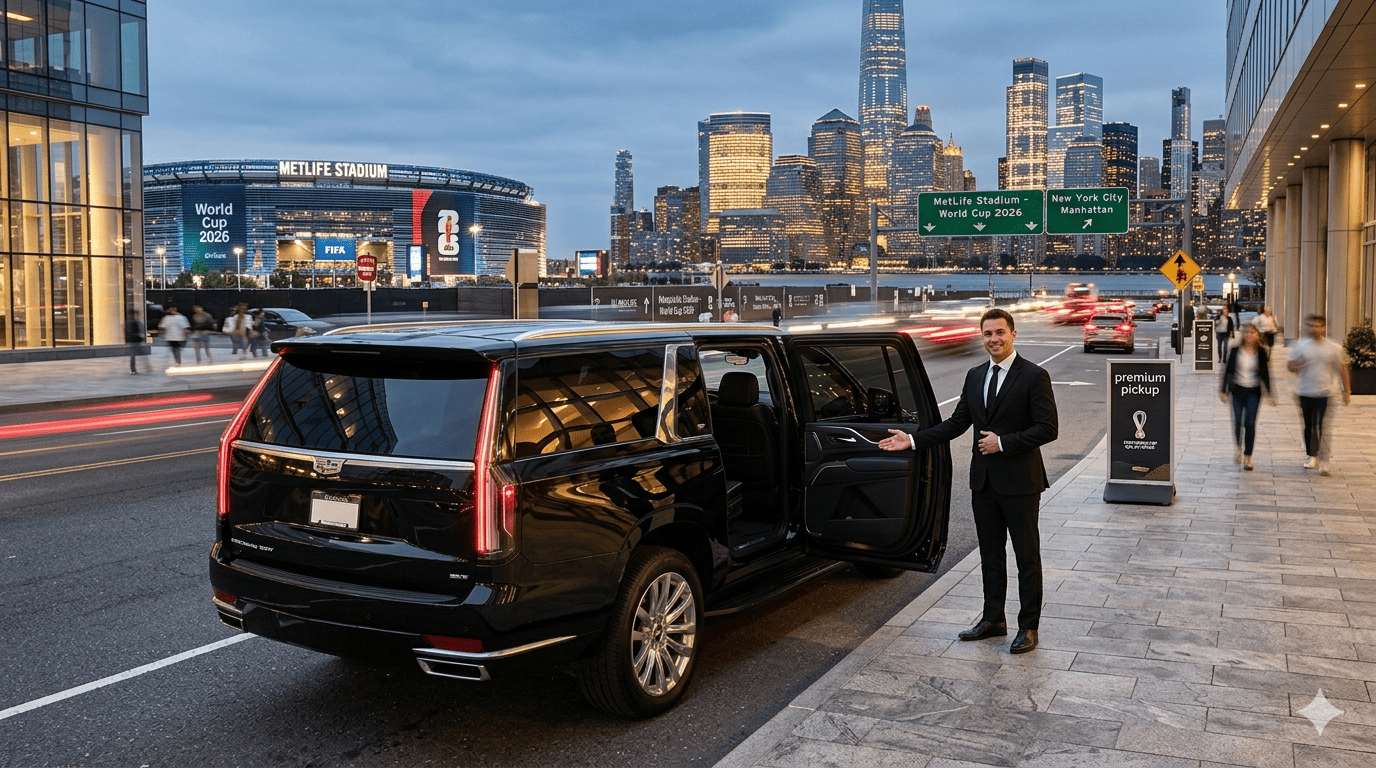
Quick answer: MetLife Stadium is about 9 miles from Midtown Manhattan, but it’s not actually in NYC. It’s in East Rutherford, New Jersey. That distance sounds short — and it is, geographically — but the actual time to get there on a FIFA World Cup 2026 match day will be anywhere from 30 minutes to two hours depending on where you start, when you leave, and what mode of transportation you use.

This guide answers the distance question precisely for every NYC borough, plus surrounding areas. Real distances. Real match-day travel times. Real routing. After 20 years of operating in this market, I can tell you what Google Maps gets wrong about MetLife travel times — and what you’ll actually experience.

If you’d rather just lock in a ride and skip the math, call +1 (917) 277-3371 or book online here.

The Quick Answer

MetLife Stadium location: 1 MetLife Stadium Drive, East Rutherford, NJ 07073

Distance from Manhattan Midtown: ~9 miles Distance from Lower Manhattan: ~10 miles Distance from Brooklyn (Williamsburg): ~14 miles Distance from Queens (Long Island City): ~16 miles Distance from Bronx (Riverdale): ~12 miles

Off-peak travel time from Manhattan: 25-35 minutes Match-day travel time from Manhattan: 45-90 minutes Final Match (July 19) travel time: 60-110 minutes

These are observed numbers, not Google Maps theoretical times.

Why “Distance” Doesn’t Equal “Travel Time”

If you’ve Googled “how far is MetLife from NYC,” Google probably said something like “25 minutes.” That’s based on optimal traffic conditions — meaning 11 AM on a Tuesday with no event. Match-day reality is fundamentally different.

Three things blow up the Google estimate:

1. Lincoln Tunnel Backup

The Lincoln Tunnel handles ~120,000 vehicles per day baseline. On match day, traffic load increases 30-50% in a tight window. The tunnel itself can take 20-40 minutes to cross at peak.

2. Route 3 East Bottleneck

Once vehicles cross into NJ, they all funnel onto Route 3 East toward MetLife. This road wasn’t built for 80,000 fans arriving in a two-hour window. Stop-and-go traffic is normal on match days.

3. Stadium Security Perimeter

On match days, NJ State Police and stadium security activate road closures and credential checks around MetLife. This adds time at multiple checkpoints, especially for Final Match.

Google Maps doesn’t model any of this. The actual time is 2-3x longer than Google’s estimate during peak windows.

Exact Distance and Travel Time From Every NYC Area

Midtown Manhattan

  • Distance: 9 miles
  • Off-peak time: 25-30 minutes
  • Match-day time (3+ hr buffer): 35-50 minutes
  • Match-day time (1-2 hr buffer): 60-90 minutes
  • Final Match day: 60-110 minutes
  • Best route: Lincoln Tunnel → NJ Route 3 East
  • Pro alternative on Final Match day: Holland Tunnel → NJ Turnpike Exit 16W

Lower Manhattan (Tribeca, Soho, Financial District)

  • Distance: 10 miles
  • Off-peak time: 22-28 minutes
  • Match-day time: 40-80 minutes
  • Final Match day: 55-100 minutes
  • Best route: Holland Tunnel → NJ Turnpike Exit 16W
  • Why faster than Midtown: Holland Tunnel handles match-day load better than Lincoln.

Upper Manhattan (UES, UWS, Harlem)

  • Distance: 11-13 miles
  • Off-peak time: 30-35 minutes
  • Match-day time: 45-95 minutes
  • Final Match day: 75-120 minutes
  • Best route: GWB → Route 4 → Route 17 South
  • Pro tip: This route avoids Lincoln Tunnel entirely.

Brooklyn (Williamsburg, DUMBO, Park Slope)

  • Distance: 14-22 miles
  • Off-peak time: 35-45 minutes
  • Match-day time: 60-100 minutes
  • Best route: Williamsburg Bridge → Holland Tunnel
  • Pro tip: For South Brooklyn (Bay Ridge, Coney Island), use Verrazzano-Narrows → Goethals Bridge → NJ Turnpike (skips Manhattan entirely).

Queens (LIC, Astoria, Forest Hills)

  • Distance: 16-22 miles
  • Off-peak time: 35-45 minutes
  • Match-day time: 55-100 minutes
  • Best route: RFK (Triborough) Bridge → Major Deegan → GWB

The Bronx (Riverdale, Pelham)

  • Distance: 12-15 miles
  • Off-peak time: 25-35 minutes
  • Match-day time: 35-70 minutes
  • Best route: Henry Hudson → GWB → Route 4

For full borough-by-borough routing, see our NY metro guide.

Distance From NJ Pickup Locations

If you’re staying NJ-side (which is increasingly popular — see our NJ-side hotels guide):

Hoboken

  • Distance: 12 miles
  • Off-peak time: 20-25 minutes
  • Match-day time: 25-45 minutes
  • Best route: Route 3 West → MetLife

Jersey City

  • Distance: 14 miles
  • Off-peak time: 22-28 minutes
  • Match-day time: 30-50 minutes

Secaucus / East Rutherford

  • Distance: 3-7 miles
  • Off-peak time: 8-12 minutes
  • Match-day time: 15-30 minutes

Newark

  • Distance: 14 miles
  • Off-peak time: 20-25 minutes
  • Match-day time: 25-45 minutes

NJ-side hotels are dramatically faster on match day. For most fans focused on the match itself, this is the smarter call.

Distance From NYC Airports

If you’re flying in same-day:

EWR (Newark Liberty) — Closest

  • Distance: 13 miles
  • Off-peak time: 25-30 minutes
  • Match-day time: 30-55 minutes
  • See our EWR guide for full details

LaGuardia (LGA)

  • Distance: 21 miles
  • Off-peak time: 35-45 minutes
  • Match-day time: 45-80 minutes

JFK

  • Distance: 28 miles
  • Off-peak time: 45-60 minutes
  • Match-day time: 60-110 minutes

Teterboro (TEB, private aviation)

  • Distance: 6 miles
  • Off-peak time: 10-15 minutes
  • Match-day time: 15-35 minutes
  • See our Teterboro guide

For full airport breakdown, see our airport transfer guide.

Why MetLife Stadium Is in NJ (Not NYC)

Common confusion: people assume MetLife Stadium is in NYC because the Giants and Jets are NYC’s NFL teams. They’re not. Both teams play in East Rutherford, NJ, about 9 miles west of Manhattan, across the Hudson River.

For visitors planning World Cup 2026, this matters because:

  1. Your hotel is probably in NY (or Manhattan). The match is in NJ.
  2. You’ll cross the Hudson River (via Lincoln Tunnel, Holland Tunnel, or GWB).
  3. You’ll experience match-day traffic on the river crossing, not just on local roads.
  4. NJ sales tax (6.625%) applies to your dinner near the stadium, vs. NYC’s 8.875%.
  5. Driving from NY to NJ is interstate — different licensing for commercial drivers, different toll structures.

If you’ve never been to MetLife, it can feel deceptively close to Manhattan. The geography is close. The reality on match day is not.

When Travel Times Are Actually 30 Minutes vs. 90 Minutes

Match-day traffic builds in waves. Here’s the pattern:

5+ Hours Before Kickoff

Light traffic. Empty roads. Quick drive. The “Google Maps” estimate is roughly accurate.

3.5-4.5 Hours Before Kickoff

Building traffic but manageable. The sweet spot. ~45-65 minutes typical.

2-3 Hours Before Kickoff

Peak chaos starts. ~70-90 minutes typical.

1-2 Hours Before Kickoff

Worst window. Don’t leave during this time. 90-120 minutes typical.

Less Than 1 Hour Before Kickoff

Risk of missing kickoff. Don’t.

Pro recommendation: Leave 3.5-4 hours before kickoff. You’ll get to the stadium area with time to spare. Eat. Drink. Walk in calmly. Compared to leaving at 5 PM for a 7 PM kickoff and stressing.

For full timing recommendations, see our match schedule guide.

The Different Match Tiers Affect Travel Time

Not all matches are the same. Match-day traffic intensity scales with match importance:

Group Stage Matches (June 13-27)

Normal match-day traffic. Plan for 45-90 minutes Manhattan-to-MetLife. Standard pre-match buildup.

Knockout Matches (Round of 32, Round of 16, Quarterfinal)

Heavier crowds, more international fan travel, slightly worse traffic. Plan for 50-100 minutes.

Final Match (July 19, 2026)

Worst traffic of the tournament. Security perimeter expanded 2-4 miles. Crowds larger than ticketed count (fans gather just to be near). Plan for 60-110 minutes even with early departure.

For Final Match-specific transportation, see our Final Match limo service guide.

Post-Match Distance Is Different Than Pre-Match Distance

Pre-match traffic builds up. Post-match traffic is explosive crash — 82,000+ people exit at roughly the same moment.

Post-Match Time From MetLife Back to Manhattan

  • Final whistle to leaving stadium parking: 45-90 minutes (if driving)
  • Lincoln Tunnel back to Manhattan: 30-60 minutes additional
  • Total time post-match: 75-150 minutes

For Final Match post-match: add 30-60 more minutes. Total can reach 150-220 minutes from final whistle to Manhattan hotel.

The pre-booked chauffeur advantage: Your driver is staged at a pre-arranged post-match return zone. You walk out, walk to them, you’re driving in 10-20 minutes. Total return time: 60-90 minutes — about half of self-drive or transit.

For full pre-game and post-game logistics, see our tailgate and post-game transportation guide.

How to Use This Distance Info to Plan Your Trip

If You’re Booking a Manhattan Hotel

  • Add 45-90 minutes per direction for match-day commute
  • Block 4-5 hours total for the match-day round trip (commute + match + return)
  • Plan post-match dinner 9:30 PM minimum (if 7 PM kickoff)

If You’re Booking an NJ-Side Hotel

  • Add 25-45 minutes per direction for match-day commute
  • Block 3-4 hours total
  • Post-match dinner can be earlier — 9 PM works

If You’re Flying In

  • Best airport: EWR (13 miles, closest)
  • Add 30-55 minutes from airport to MetLife
  • Plan to land 4-5 hours before kickoff

If You’re Doing a 24-Hour Quick Visit

What Travel Times Don’t Tell You

A few things distances don’t capture but matter:

Walking Distance From Drop-Off to Gate

  • Premium parking lot to gate: 10-15 minute walk
  • Standard parking lot to gate: 15-25 minute walk
  • TLC-licensed limo drop-off zone to gate: 2-5 minute walk
  • Standard rideshare drop-off to gate: 10-15 minute walk

In 90°F July heat with a clear bag policy and crowds, this matters.

Security Line Time

Plan 15-30 minutes from arriving at the gate to clearing security and finding your seat.

Post-Match Return Walk

From your seat to your transportation: 15-25 minutes typically.

Frequently Asked Questions (FAQ)

Q: How close is MetLife Stadium to NYC?

A: MetLife Stadium is approximately 9 miles from Midtown Manhattan, located in East Rutherford, New Jersey. Travel time ranges from 25-35 minutes off-peak to 45-90 minutes on World Cup 2026 match days, depending on departure time and route.

Q: How long does it take to get from Manhattan to MetLife Stadium for a World Cup 2026 match?

A: 45-90 minutes match-day, depending on when you leave and which route you use. Off-peak is 25-30 minutes. Final Match (July 19, 2026) is the worst — plan for 60-110 minutes from Midtown Manhattan.

Q: Is MetLife Stadium in New York or New Jersey?

A: New Jersey. MetLife Stadium is located at 1 MetLife Stadium Drive, East Rutherford, NJ 07073 — about 9 miles west of Manhattan, across the Hudson River.

Q: What’s the closest airport to MetLife Stadium for World Cup 2026?

A: Newark Liberty International (EWR) is 13 miles from MetLife — the closest major airport. LaGuardia is 21 miles; JFK is 28 miles. Most match-focused travelers should fly EWR. See our EWR guide.

Q: How far is MetLife Stadium from Brooklyn?

A: 14-22 miles depending on neighborhood. Williamsburg to MetLife is 14 miles, ~60-100 minutes match-day. South Brooklyn (Bay Ridge) is further but can use Verrazzano-Narrows + Goethals Bridge routing to skip Manhattan entirely.

Q: When should I leave Manhattan for a 7 PM World Cup match at MetLife?

A: Local recommendation: leave by 3:30-4 PM. This gets you to the stadium area with time to eat, drink, and walk in calmly without fighting peak traffic (which hits 1-2 hours before kickoff).

Q: Is the Lincoln Tunnel or Holland Tunnel faster on match day?

A: Holland Tunnel is often 20-30 minutes faster on match days, despite being slightly longer geographically. Lincoln Tunnel backs up severely during peak. Most operators recommend Holland for Final Match day specifically.

Q: How long is the post-match drive back to Manhattan?

A: 75-150 minutes from final whistle to your Manhattan hotel (driving). 60-90 minutes with a pre-staged chauffeur. Final Match post-match can take 150-220 minutes (driving) or 90-120 minutes (chauffeur).

Q: Can I walk from MetLife Stadium to Manhattan?

A: No. It’s a 9-mile walk and there’s no pedestrian access. Even attempting it isn’t reasonable.

Q: What’s the best way to get from NYC to MetLife Stadium for a World Cup match?

A: For most travelers, a pre-booked private chauffeur. For solo budget travelers, NJ Transit from Penn Station via Secaucus Junction. Driving works for locals. Uber/Lyft works off-peak only. See our comparison guide.

Plan Your Match Day Around Real Travel Times

Distance is just a number. The real planning is in the travel time on match day. Don’t trust Google Maps for World Cup 2026 — trust experience.

If you’d rather have a chauffeur who knows these times instinctively and just handles it:

Book your match-day chauffeur → 📞 24/7 Live Dispatch: +1 (917) 277-3371
Related Reading

May 18, 2026

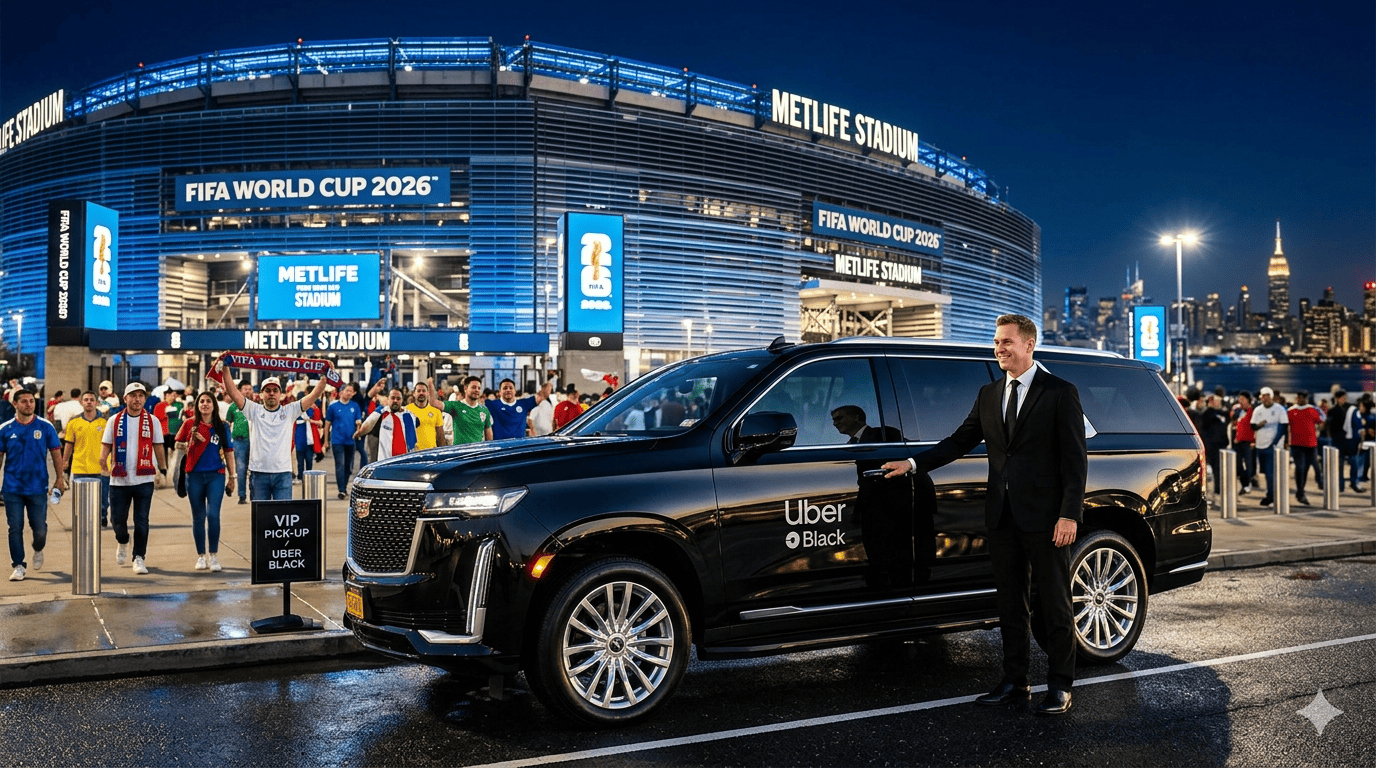
If you’ve been looking at transportation options for a FIFA World Cup 2026 match at MetLife Stadium, Uber Black probably came up. It’s the rideshare premium tier — sleek black sedans, professional-looking drivers, the experience that looks closest to a real chauffeur service. And on the surface, the pricing seems competitive.

The question is whether Uber Black is actually a smart choice for a high-stakes event like World Cup 2026, or whether you’re going to get burned on match day.

This guide answers it directly. After 20 years of operating in the NYC luxury transportation market, I’ve watched thousands of clients try Uber Black for major events. Some get lucky. Most don’t. Here’s the real comparison so you can decide for yourself.

If you’d rather skip ahead and lock a flat-rate ride that’s guaranteed to show up, call +1 (917) 277-3371 or book online here.

The Short Answer

Uber Black is not a smart choice for FIFA World Cup 2026 match-day transportation to MetLife Stadium. Here’s why in one paragraph:

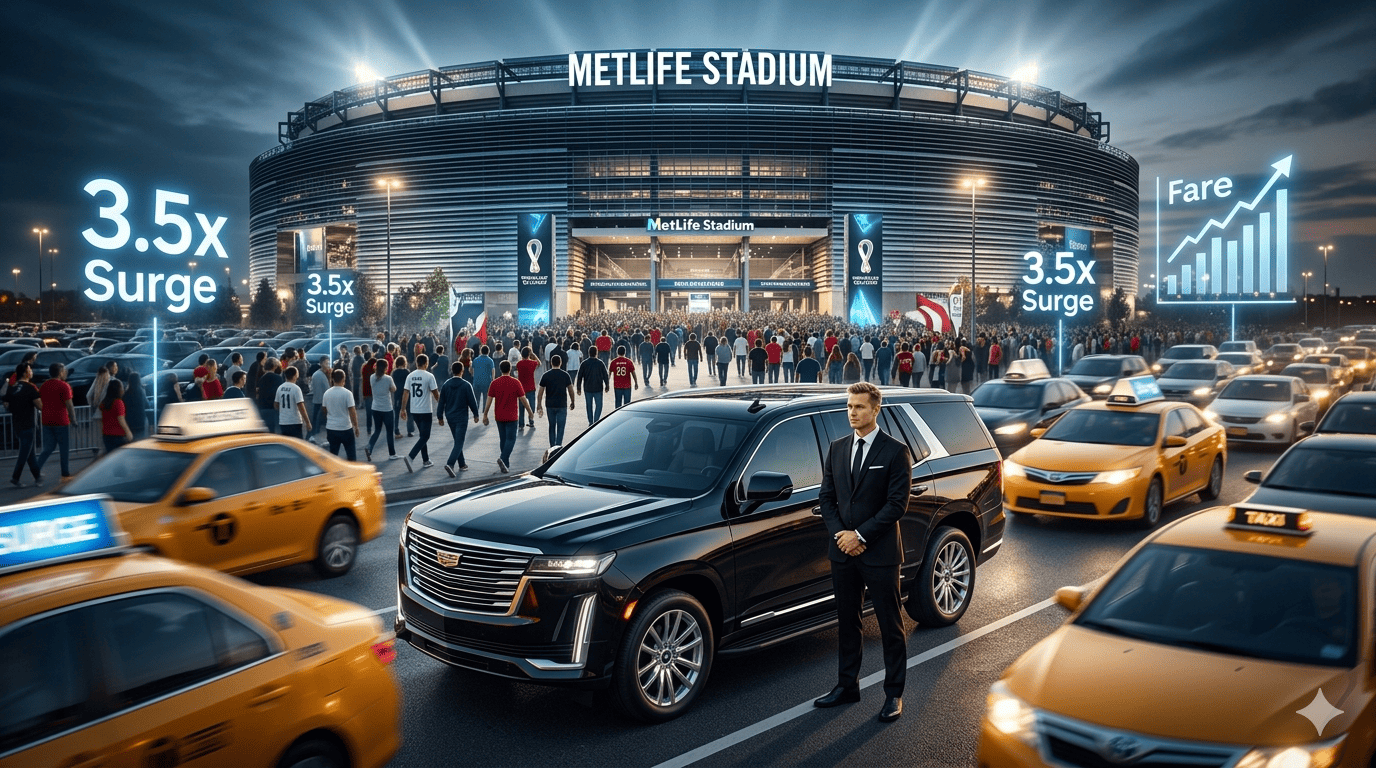
Uber Black uses the same surge-pricing model as Uber X. On World Cup match days, surge will routinely hit 3-5x base fare, putting Uber Black one-way rides from Manhattan at $600-$1,200 at peak. Drivers cancel during peak surge. Post-match pickups from MetLife are notoriously hard to fulfill. And while the vehicles look similar to professional black car services, Uber Black drivers are gig workers operating personal vehicles — not licensed chauffeurs in maintained commercial fleets.

For roughly the same money (often less), you can book a pre-booked black car service with a TLC-licensed professional chauffeur, locked flat-rate pricing, contractual delivery, and pre-staged post-match return. That’s the smarter call for a World Cup match.

The longer answer covers what Uber Black actually is, when it makes sense, when it doesn’t, and how to make the right call.

What Uber Black Actually Is

Before comparing, let’s define it clearly:

Uber Black Basics

  • Premium tier within the Uber rideshare app
  • Black-color sedans or SUVs (Mercedes, BMW, Cadillac, Lincoln)
  • Driver requirements: TLC license (in NYC), 4+ years driving experience, minimum vehicle age
  • Pricing: Higher base rate than Uber X (roughly 1.5-2x), plus surge multiplier
  • Driver compensation: Gig-based — drivers are independent contractors
  • Vehicle ownership: Drivers own or lease their own vehicles

What Uber Black Is Not

  • Not a professional chauffeur service — drivers are gig workers, not employees of an operator
  • Not commercially insured at premium levels — typical drivers carry standard rideshare insurance, not $5M+ commercial liability
  • Not credentialed for premium stadium drop-off zones — operates from standard rideshare pickup areas at MetLife
  • Not contractually guaranteed — driver can cancel, even minutes before pickup

This distinction matters for World Cup match days when everything has to work.

The Surge Pricing Reality

Here’s the math that breaks Uber Black for match days:

Base Uber Black Pricing

Manhattan to MetLife (no surge): $200-$300 one-way.

Surge-Adjusted Pricing for World Cup Match Days

Based on past major MetLife events (NFL playoffs, Taylor Swift, 2024 Copa America Final): – 3x surge: $600-$900 one-way – 4x surge: $800-$1,200 one-way – 5x surge: $1,000-$1,500 one-way

Final Match (July 19, 2026) will see the most extreme surge of the tournament.

Round-Trip Match-Day Math

  • Pre-match Uber Black (surge): $600-$1,200
  • Post-match Uber Black (worse surge + driver reluctance): $600-$1,500
  • Total round trip: $1,200-$2,700

For comparison, a pre-booked Cadillac Escalade ESV (similar vehicle class) with us: – Round trip flat rate: $595-$895 (group stage), $1,195-$1,395 (Final Match) – No surge, ever

Uber Black for match days costs 2-4x what a pre-booked black car costs. The “premium” rideshare tier is the most expensive transportation choice you can make for World Cup.

For the full pricing context, see our pricing guide.

Driver Cancellation Risk

This is the unsexy reality of Uber Black on major events. Driver cancellations spike during surge windows for several reasons:

Why Drivers Cancel

  • They got a better-paying ride first. A driver can accept your request, then accept a higher-surge request, and cancel yours.
  • Post-match pickups stuck them. Drivers who agreed to take you to MetLife then realize they can’t get an easy return ride and cancel.
  • They miscalculated traffic. Match-day traffic to MetLife is brutal; some drivers underestimate and back out.
  • They’re being strategic. Some drivers wait for surge to spike further before committing.

Cancellation Frequency on Major Events

Based on what I’ve heard from clients across hundreds of major MetLife events: – Typical event night cancellation rate: 15-20%Peak Final Match-level events: 25-30%+

That means roughly 1 in 4 World Cup Final Match Uber Black bookings could face a driver cancellation. With no real recourse beyond requesting another driver (who may also cancel).

A pre-booked operator can’t cancel on you. Contract obligation. Different category entirely.

What You’re Actually Paying For

Let’s compare what you get with each option at similar price points:

Uber Black at $600-$1,200 One-Way

  • Driver: Gig worker, may or may not speak English fluently, vehicle and service quality varies
  • Vehicle: 4+ year old sedan, condition variable
  • Insurance: Standard rideshare insurance ($1M coverage typical)
  • Stadium access: Standard rideshare pickup zone (10-15 min walk from gate)
  • Reliability: Subject to surge-induced cancellation
  • Communication: Through app only
  • Pre-match coordination: None
  • Wait time: Short — driver leaves if you’re not at pickup

Pre-Booked Cadillac Escalade ESV With Real Operator (Same Price Range)

  • Chauffeur: TLC + DOT licensed, uniformed, background-checked, trained
  • Vehicle: 1-2 year old luxury SUV, maintained to commercial standards
  • Insurance: $5M+ commercial liability, $2M+ general liability
  • Stadium access: Credentialed close-zone drop-off (2-5 min walk to gate)
  • Reliability: Contractually guaranteed; backup vehicle + chauffeur on standby
  • Communication: Direct chauffeur phone, dispatcher 24/7
  • Pre-match coordination: Pre-match call 24-48 hours ahead
  • Wait time: Generous match-day wait built in

The price is the same. The service is fundamentally different.

What Uber Black Actually Looks Like on Match Day

Here’s the real flow for an Uber Black booking on a World Cup match day:

Pre-Match (3 hours before kickoff)

  • You open the app, request Uber Black
  • Surge pricing displayed: 3.5x
  • One-way cost: $700
  • You accept. Driver assigned in 3-5 minutes.
  • Driver shows up… or doesn’t

En Route

  • Driver knows you’re going to MetLife
  • Traffic on Lincoln Tunnel is bad
  • Your driver doesn’t have stadium credentials, so they route to standard rideshare zone
  • You arrive at the rideshare zone — 15 minute walk to your gate
  • You walk in summer heat

Post-Match

  • Match ends. You walk to the rideshare pickup zone (15 minutes)
  • You open Uber, request a ride
  • Surge pricing: 4-6x
  • One-way back: $900-$1,200
  • “No drivers available” or 30-45 minute wait
  • Or your assigned driver gets stuck in stadium exit traffic and cancels

Realistic Outcome

  • Total cost: $1,400-$2,000+
  • Total transit stress: Major
  • Total wait time: 60-90 minutes at MetLife

When Uber Black Actually Makes Sense

For balance — there are scenarios where Uber Black is a reasonable choice:

Off-Peak Transportation in NYC

For non-match-day trips around the city (hotel to dinner, sightseeing, etc.), Uber Black is fine.

Last-Resort Last-Minute Single Trips

If your pre-booked chauffeur fell through 30 minutes before kickoff and you have no alternative, Uber Black can be a recovery option.

Solo Travelers With High Surge Tolerance

A solo traveler willing to pay whatever surge throws at them, for a one-way trip, with no time pressure.

Trips to Non-Stadium Destinations

Uber Black for hotel → restaurant → hotel works fine. The problem is specifically match-day stadium logistics.

For everything else related to World Cup 2026 at MetLife — pre-book a real operator instead.

The Apples-to-Apples Vehicle Comparison

Common assumption: “Uber Black sends a Mercedes or BMW. That’s the same as a chauffeur.”

The vehicles look similar at the curb. The differences are operational:

Vehicle Quality

  • Uber Black driver-owned vehicle: Some drivers maintain meticulously. Others let it slide. You don’t know until you get in.
  • Operator-owned chauffeur vehicle: Inspected daily, detailed between trips, maintained to commercial standards.

Driver Quality

  • Uber Black driver: Gig worker. May be driving 6-10 hours of personal income work today. Tired, distracted, focused on the next fare.
  • Chauffeur: Employee of operator. Trained, paid hourly + tips, focused on your experience.

Cabin Experience

  • Uber Black: May have water bottles, may not. Phone charger may work, may not. AC reliability varies.
  • Chauffeur vehicle: Bottled water, working chargers, climate-controlled, premium amenities standard.

Insurance

  • Uber Black: Rideshare insurance ($1M coverage typical)
  • Operator chauffeur: $5M+ commercial liability + $2M+ general liability

In an accident, this is significant. Real coverage protects you.

What the Math Looks Like for Different Groups

The Uber Black vs. pre-booked black car comparison shifts dramatically based on group size:

Solo Traveler

  • Uber Black one-way (surge): $600-$1,200
  • Pre-booked Mercedes S-Class round trip: $495-$695
  • Pre-booked wins by $100-$700

Couple

  • 2 Uber Black rides at surge: $1,200-$2,400 round trip
  • Pre-booked Mercedes S-Class round trip: $495-$695
  • Pre-booked wins by $700-$1,700

Group of 4

  • Multiple Uber Black rides at surge: $2,000-$3,500+ total
  • Pre-booked Cadillac Escalade ESV round trip: $595-$795
  • Pre-booked wins by $1,500-$2,500+ AND group stays together

Group of 8-14

  • Uber Black not viable (need multiple vehicles)
  • Pre-booked Sprinter limo round trip: $1,095-$1,795
  • Pre-booked is the only practical option for groups

For larger groups, the math isn’t close. For solo and small groups, it’s still meaningfully better.

What Uber Black Tells You About Your Match-Day Strategy

If you’re already considering Uber Black for World Cup 2026, you’ve already accepted three things:

  1. You’re willing to spend premium transportation pricing — same budget as a real chauffeur
  2. You value comfort and professional service — that’s what the Black tier sells
  3. You want a reliable arrival

Given those criteria, a pre-booked chauffeur fits all three better than Uber Black: – Same or lower premium pricing – Better, more consistent comfort and service – Contractually reliable arrival

The only thing Uber Black offers that a pre-booked chauffeur doesn’t is on-demand same-minute booking. And for a World Cup match scheduled weeks in advance, that’s not a real advantage.

How to Make the Smart Call

Decision framework:

Choose Uber Black If

  • It’s a non-match-day NYC ride
  • You’re solo with high surge tolerance
  • You missed your pre-booked option and need emergency last-minute
  • The trip isn’t to MetLife on match day

Choose Pre-Booked Chauffeur If

  • You’re going to MetLife on a World Cup match day
  • You’re a couple or group
  • You value reliability over flexibility
  • You don’t want to risk surge or cancellation
  • You want pre-staged post-match return

For World Cup 2026 match days, the answer is almost always pre-booked chauffeur. The math doesn’t work for Uber Black on match day at MetLife.

For more comparison with all transportation options, see our full comparison guide.

Real Scenarios From Our Bookings

Scenario 1: Couple Switched From Uber Black

Couple booked Uber Black for outbound to MetLife. Surge hit 4.5x, ride cost $810 one-way. They missed their dinner reservation due to traffic and rideshare zone walking. After the match, no Uber Black available for 35 minutes. They called us at +1 (917) 277-3371 at 9:45 PM and we got them home for $295. Their next match they booked us upfront for both legs at $695 round trip.

Scenario 2: Solo Traveler Booked Uber Black for Final Match

Final Match (July 19, 2026). Solo traveler thought he’d just call Uber Black when needed. Surge during pre-match peak hit 6x. Round trip cost: $2,400. Plus 45-minute wait after the match in the rideshare zone. Total Final Match transportation cost: ~$2,600. A Mercedes S-Class pre-booked for Final Match (with premium surcharge) would have been $895-$1,095.

Scenario 3: Family of 4 Tried Uber Black for Match Day

Family of 4 used Uber Black for the outbound trip (couldn’t fit in one car, so two Uber Black SUVs). Surge cost: $1,800 outbound. After the match: 90-minute wait, then surge cost $2,100 return. Total: $3,900. A pre-booked Cadillac Escalade ESV for the same trip would have been $795 round trip.

Frequently Asked Questions (FAQ)

Q: Is Uber Black worth it for a MetLife World Cup 2026 match?

A: For match-day transportation, generally no. Surge pricing hits 3-5x base fare, making round trips $1,200-$2,700. Driver cancellation rates spike during peak surge. A pre-booked black car service offers similar vehicle quality at $495-$995 round trip with contractual reliability and no surge risk.

Q: How much does Uber Black cost from Manhattan to MetLife Stadium on a World Cup match day?

A: One-way Uber Black with match-day surge typically runs $600-$1,200. Round-trip costs $1,200-$2,700, depending on surge severity. Final Match (July 19, 2026) will see the most extreme surge.

Q: Will Uber Black drivers cancel on me for a World Cup 2026 match?

A: Driver cancellation rates during major MetLife events typically run 15-30%, spiking during peak surge windows. Drivers who initially accept your ride may cancel for higher-surge requests or to avoid post-event stadium traffic.

Q: What’s the difference between Uber Black and a real limo service?

A: Uber Black is rideshare with premium vehicles (drivers are gig workers with personal vehicles, standard rideshare insurance). A real limo/black car service uses TLC + DOT licensed chauffeurs, operator-owned commercial vehicles, $5M+ commercial liability insurance, and contractually guaranteed delivery.

Q: Is Uber Black safer than Uber X?

A: Both use the same rideshare infrastructure. Uber Black requires more experienced drivers and premium vehicles, but both carry standard rideshare insurance. Neither offers the commercial-grade insurance and licensing of a real chauffeur service.

Q: Can Uber Black drop me off close to the gate at MetLife Stadium?

A: No. Uber Black uses standard rideshare pickup/drop-off zones at MetLife — typically a 10-15 minute walk to the gates. Licensed limo and black car services have credentialed close-zone access for World Cup 2026.

Q: Should I book Uber Black for the Final Match on July 19, 2026?

A: Strongly not recommended. Final Match surge will be the most extreme of the tournament. Pre-booked operator transportation is the only reliable option for the Final.

Q: Can I book Uber Black in advance for a World Cup match?

A: Uber’s “scheduled rides” feature lets you book in advance, but surge still applies at the time of pickup. You’re not actually locking pricing — only attempting to lock a driver who may still cancel.

Q: What’s the cheapest reliable alternative to Uber Black for MetLife?

A: For a single traveler: NJ Transit from Penn Station ($10-15 round trip). For couples and groups: pre-booked Mercedes S-Class ($495-$595 round trip) or Cadillac Escalade ESV ($595-$795). Both are dramatically cheaper than surge Uber Black.

Q: How do I get a pre-booked black car service instead of Uber Black?

A: Call our 24/7 dispatch at +1 (917) 277-3371 or request a quote online. Quote provided within 1 hour. Flat-rate pricing locked. Contractually guaranteed delivery.

Don’t Trust Uber Black for Your Match Day

For World Cup 2026 match days at MetLife Stadium, Uber Black is the most expensive transportation choice you can make — and the least reliable. A real pre-booked chauffeur costs the same or less, with dramatically better experience and zero surge risk.

Book a real chauffeur instead → 📞 24/7 Live Dispatch: +1 (917) 277-3371
Related Reading

May 18, 2026

You’re shopping around for transportation to a FIFA World Cup 2026 match. You get a few quotes. Most are clustered in the $500-$800 range for a round-trip Manhattan-to-MetLife. Then one operator quotes $295. Or $185. Half the price of everyone else.

Table of Contents

Your first reaction: “Great, that’s the one.” Your second reaction (if you’ve been around long enough): “Wait, why is this so cheap?”

The second reaction is the smart one. After 20 years in this market, I can tell you exactly why some quotes are dramatically below market — and what’s almost always wrong about them. This isn’t about defending higher pricing. It’s about understanding the real cost structure of a NYC limo operator and recognizing when something’s off.

If you’ve been pricing around and you want to verify legitimate operator pricing, call +1 (917) 277-3371 or get a real quote. We’ll explain exactly what’s in your rate.

The Short Answer

Real NYC chauffeur service has minimum costs that can’t be undercut without sacrificing something. When you see a quote dramatically below the market (30-50% lower than competitors), one of four things is happening:

  1. It’s a broker, not a real operator — they’ll resell your booking and the third party will deliver a worse experience
  2. They’re bait-and-switching — the headline price hides additional fees you’ll discover at booking confirmation
  3. They’re cutting corners somewhere — unlicensed, uninsured, older vehicles, untrained drivers
  4. They’re a scam — collecting deposits with no intention of delivering

Real NYC chauffeur service from a licensed operator with insurance, premium fleet, and trained chauffeurs has a floor pricing. Below that floor, you’re not getting the same thing.

This guide explains exactly what that floor is, why it’s there, and how to spot the difference.

The Real Cost Structure of a NYC Limo Operator

Let me break down what an operator actually has to cover for a Manhattan-to-MetLife round trip with a Mercedes S-Class:

Vehicle Costs

  • Capital cost (depreciation per trip): ~$40-$60
  • Insurance ($5M commercial liability + others): ~$30-$50 per trip
  • Maintenance + tires + cleaning: ~$25-$40 per trip
  • Fuel + tolls: ~$45-$60

Vehicle subtotal: ~$140-$210

Driver Costs

  • Chauffeur wages (8-hour match day): $200-$350
  • Workers compensation insurance: $20-$30
  • Training, background checks, ongoing licensing: $10-$20

Driver subtotal: ~$230-$400

Operator Overhead

  • Dispatch costs (live 24/7): ~$30-$60
  • Booking system, customer service, billing: ~$20-$30
  • Office, admin, business overhead: ~$30-$50
  • TLC licensing, DOT compliance, regulatory: ~$15-$25

Overhead subtotal: ~$95-$165

Total Costs Per Trip

Approximately $465-$775 to deliver a single round-trip Manhattan-to-MetLife match-day service with a Mercedes S-Class.

Our Quote Range

$495-$695 for the same service.

Margin: Roughly 5-15% margin on each booking. Real operator pricing isn’t padding margins to 50-100%. It’s covering the actual cost of delivery.

So when someone quotes you $295 for the same service, ask yourself: what’s not being paid?

What’s Being Cut When Quotes Drop Dramatically

A quote that’s 40% below market is cutting something. Here’s what:

Cut 1: Real Insurance Coverage

Quote at $295 instead of $595 = $300 of margin missing. The easiest place to cut is insurance. Many “cheap” operators carry minimum-required insurance ($300K liability), not the $5M+ commercial liability real operators have.

In an accident, you (the passenger) have minimum coverage. Real operators carry serious insurance for serious situations.

Cut 2: Licensed, Trained Chauffeurs

Cheap quotes often = drivers with personal auto insurance and a TLC for-hire license but no commercial chauffeur training, no background check beyond basic DMV, no executive protection awareness.

You’re getting a guy with a Mercedes. Not a professional chauffeur.

Cut 3: Owned Fleet

Cheap quotes are often brokered. The “operator” doesn’t own the vehicle. They take your $295 and hire whoever will accept the gig. You don’t know who’s showing up, what condition the vehicle is in, or whether the driver speaks English.

Cut 4: Backup Systems

Cheap operators don’t have backup vehicles, backup chauffeurs, or live dispatch. If something goes wrong on match day, you’re calling a voicemail.

Cut 5: Pre-Match Coordination

Cheap operators don’t make pre-match coordination calls. Don’t confirm details. Don’t brief their chauffeur on your specific match.

Cut 6: Stadium Credentials

Cheap operators rarely have the credentials for premium drop-off zones. Their vehicle drops at the general rideshare zone — 15-minute walk from your gate.

Cut 7: Profit Margin (Sometimes)

Some operators genuinely run thin margins as a market-share strategy. But real operators don’t run negative margins to undercut you on price. The math doesn’t work.

What’s Hidden in “Cheap” Quotes

Often the $295 quote isn’t actually $295 once you book. Common hidden fees:

Fuel Surcharge

“Plus $50 fuel surcharge” added at booking confirmation. Real quote now $345.

Tolls Not Included

“Plus tolls — paid by passenger at time of trip.” Real quote now $370+.

Standard Wait Time Not Included

“$50/hour after first hour at stadium.” Real quote climbs $100+.

Hidden Gratuity

“Standard gratuity 20% — added at confirmation.” Real quote now $415+.

Long-Distance Surcharge

“Distance over 10 miles — $50 extra.” Real quote now $465+.

Vehicle Upgrade Fees

“You requested an Escalade but we’re sending S-Class. To get an Escalade is $100 extra.”

By the time the additional fees are added, the “$295 quote” becomes $500-$600 — basically the same as legitimate operators, except you’ve already paid a deposit and the actual delivery is worse.

The Real Sign That a Quote Is Wrong

A few telltale signs:

Sign 1: Headline Rate 30-50% Below Market

Real operator pricing clusters within 20% of each other. If you’re seeing $495-$695 from most operators and one quotes $295, that’s outside the legitimate range.

Sign 2: Quote Is Vague

“$295 — call to confirm.” Real operators give detailed written quotes with specific vehicle, all charges itemized, no ambiguity.

Sign 3: Required Payment in Cash or Crypto

Real operators accept credit cards through real payment processors. Cash-only or crypto-only is designed to be untraceable.

Sign 4: No COI (Certificate of Insurance) Available

Real operators provide a COI on request within 2 business hours. Cheap operators say “we’ll get you that later” or never respond.

Sign 5: Generic Website

Cheap operators often have template websites with generic stock photos. Real operators have specific fleet photos, specific client testimonials, NYC press mentions.

Sign 6: New Business

Their website launched in 2025 for “World Cup 2026 transportation.” That’s a pop-up.

Sign 7: Pressure to Book Immediately

“This rate is only good for the next hour.” Real operators don’t operate this way.

Sign 8: Phone Goes to Voicemail

Real operators have live dispatch. Cheap operators have answering services or voicemail-only contact.

Sign 9: TLC License Number Won’t Verify

Ask for their TLC license number. Cross-check with NYC’s public registry. If it doesn’t match, they’re not real.

Sign 10: No Specific Vehicle Assigned

Real operators tell you exactly what vehicle is coming (make, model, year, license plate). Cheap operators say “we’ll let you know.”

What Cheap Quotes Actually Get You

For full transparency, here’s what often happens with the cheapest operators:

Scenario 1: Bait-and-Switch on Pricing

You book at $295. Receive confirmation showing $495 with additional fees. You’re already partially committed (deposit paid). You either eat the price increase or lose the deposit.

Scenario 2: Wrong Vehicle Shows Up

You booked a Mercedes S-Class. A 2015 Lincoln Town Car shows up. The operator says “this is what we have available.” You’re stuck.

Scenario 3: No-Show

You stand at your hotel at 5 PM for a 7 PM kickoff. Nobody comes. Calls go to voicemail. You scramble for an Uber at surge pricing. You miss part of the match.

Scenario 4: Lower-Quality Vehicle

The vehicle is “premium” by name but old, smelly, with broken AC or seats that don’t recline. You suffer through a 90-minute drive in discomfort.

Scenario 5: Untrained Chauffeur

The driver doesn’t speak English well, doesn’t know NYC routing, doesn’t have a uniform. You feel uncomfortable, you’re embarrassed in front of guests, the experience is lower-quality.

Scenario 6: Vehicle Damage Claim

After the trip, the cheap operator claims you damaged the vehicle and charges your credit card $500-$2,000 for “repairs.” You dispute it, your credit card company says “let me look into it,” and the operator keeps the money.

Scenario 7: Real Scam

You pay a deposit. The operator goes silent. Your credit card is charged. They never deliver. You’re out the money and the match-day transportation.

These aren’t theoretical. These are real scenarios reported by clients who switched to us after getting burned.

Why Real Operators Charge What They Charge

A few honest reasons real operator pricing is what it is:

Vehicle Quality

Real operators run late-model vehicles (1-3 years old). New Mercedes S-Class costs $120K+. New Escalade ESV is $90K+. Sprinter limo conversions are $80K+. Capital costs are real.

Driver Quality

Real chauffeurs earn $25-$45/hour plus tips. That’s $200-$400 for a typical match day. Operators have to pay them or they leave.

Insurance Quality

$5M commercial liability isn’t $50/year. It’s $5,000-$15,000 per vehicle per year. Real coverage costs real money.

Licensing

TLC licensing, DOT compliance, NJ Limousine licenses — all real annual costs.

Dispatch and Operations

24/7 live dispatch isn’t free. Tech infrastructure, customer service, billing systems all cost money.

Overhead

Office, admin, marketing, business operations. Real operators have real businesses.

The “expensive” quote you got from a real operator is covering these real costs. The “cheap” quote you got from someone else isn’t — which is why it’s cheap.

How to Verify a Quote Is Legitimate

If you’re comparing quotes:

Step 1: Verify Licensing

Ask for TLC base number. Cross-check on NYC TLC registry. Real licenses are public record.

Step 2: Verify Insurance

Ask for COI. Should be provided in writing within 2 business hours. Verify limits ($5M+ commercial liability, $2M+ general).

Step 3: Verify Vehicle

Ask: “Specifically what vehicle is assigned to my booking?” Real operators answer immediately.

Step 4: Verify Operator History

Check Google reviews going back multiple years. Check NYC media mentions. Real operators have history.

Step 5: Verify Payment Method

Should accept credit cards through standard processors. Cash-only or crypto-only is a red flag.

Step 6: Verify Contract Terms

Should provide written booking confirmation with specific vehicle, date, time, route, and total cost (no hidden fees).

If any of these fail, the quote isn’t legitimate — regardless of price.

When “Cheaper” Operators Are Actually Legitimate

For balance, real legitimate operators sometimes charge less than premium operators. Reasons:

Smaller Operator With Lower Overhead

A smaller operator with 5 vehicles and 1 dispatcher can charge less than a larger operator with 50 vehicles and 10 dispatchers. Both are legitimate; one has lower overhead.

Volume Discounts

Operators with corporate contracts (consistent business) sometimes offer better pricing because they don’t need to hit margin on every booking.

Older Vehicle Fleet

Operators running 4-6 year old vehicles vs. 1-3 year old vehicles. Both can deliver good service; older fleet is cheaper.

Geographic Specialization

Operators based in NJ vs. NYC sometimes have lower overhead. Both can serve the same routes.

These are legitimate reasons for slightly lower pricing — typically 10-20% below the premium tier, not 40-50% below.

If you find a quote 10-15% below the market with all the legitimate operator markers (license, insurance, fleet ownership, history), it’s probably real. 40-50% below market is rarely real.

Pricing Floor: What Real Quotes Look Like

For your reference, here’s what real, legitimate operator pricing looks like for World Cup 2026:

Service Round-Trip Manhattan to MetLife Real Pricing Range
Mercedes S-Class Group stage $495-$695
Mercedes S-Class Final Match $895-$1,095
Cadillac Escalade ESV Group stage $595-$895
Cadillac Escalade ESV Final Match $1,195-$1,395
Sprinter Limo (14 pax) Group stage $1,095-$1,795
Sprinter Limo (14 pax) Final Match $1,895-$2,995

A legitimate operator quote will fall within these ranges. A quote dramatically below the lower bound is a red flag.

For our full pricing transparency, see our pricing guide.

Why It’s Worth Paying the Real Rate

A few honest reasons paying real pricing is worth it:

Reliability

Your match day depends on this transportation. The risk of no-show, vehicle issues, or driver problems is dramatically lower with real operators.

Insurance Protection

If something goes wrong (accident, injury), real insurance protects you. Cheap operator insurance often doesn’t.

Vehicle Quality

The 90-minute ride to MetLife and back is in a clean, modern, comfortable vehicle. Not a 2015 sedan with broken AC.

Chauffeur Quality

Professional, uniformed, trained chauffeur. Knows routes, handles emergencies, provides real service.

Real Money Matters

For high-stakes events like World Cup, the $200-$400 cost difference between a real operator and a cheap one is small compared to the consequence of failure.

What to Do If You’ve Already Booked a Cheap Quote

If you’ve already paid a deposit to a sketchy operator:

Step 1: Verify Their Legitimacy

Use the verification checklist above. If they don’t pass, your booking is at risk.

Step 2: Document Everything

Save the booking confirmation, payment receipts, all correspondence.

Step 3: Have a Backup Plan

Book a real operator as a backup for your match day. Yes, you’ll spend more, but you won’t be stranded.

Step 4: Dispute the Deposit (If Necessary)

If the operator can’t deliver, dispute the charge with your credit card company.

Step 5: Use a Real Operator Going Forward

Cheap quotes aren’t worth the risk for high-stakes events.

Frequently Asked Questions (FAQ)

Q: Why are some NYC limo quotes so much cheaper than others for World Cup 2026?

A: Quotes dramatically below market (30-50% lower than competitors) almost always mean something is being cut: insurance coverage, chauffeur quality, vehicle quality, fleet ownership, dispatch infrastructure, or operator legitimacy. Real NYC chauffeur service has minimum costs that can’t be undercut without compromising quality.

Q: Is it safe to book a NYC limo with a cheap quote for World Cup 2026?

A: Probably not. Real operators have minimum pricing reflecting actual costs. Quotes 40-50% below market typically come from brokers, unlicensed operators, or scams. Risk of no-show, lower-quality service, or hidden fees is significantly higher.

Q: What’s the floor for legitimate NYC limo pricing for World Cup 2026?

A: Mercedes S-Class round trip Manhattan-MetLife (group stage match): approximately $495-$695. Below the lower bound, scrutinize closely. Final Match pricing is higher: $895-$1,095 for the same vehicle.

Q: How can I tell if a cheap limo quote is a scam?

A: Red flags include: unlicensed operator (no TLC base number), no COI available, cash or crypto-only payment, vague terms, pressure to book immediately, new business with no history, generic website, voicemail-only contact. Multiple red flags = likely scam.

Q: What’s the difference between a real operator and a broker for limo bookings?

A: A real operator owns vehicles, employs chauffeurs, and is contractually obligated to deliver. A broker collects bookings and resells them to third-party operators. Real operators give specific vehicle assignments; brokers can’t. See our companion guide on choosing the right operator.

Q: Why do some operators add hidden fees after the initial quote?

A: Operators who run dramatically below-market headline rates often add fees at confirmation: fuel surcharge, tolls, gratuity, wait time, vehicle upgrade fees. The final price often equals or exceeds legitimate operator quotes. Get a complete written quote with all fees included before booking.

Q: Is paying premium for a NYC limo worth it for World Cup 2026?

A: For most travelers, yes. The $200-$400 difference between premium and cheap operators buys you reliability (no-show risk drops to zero), vehicle quality, professional chauffeurs, insurance protection, and a polished experience. For high-stakes match days, the premium is small relative to the consequence of failure.

Q: How do I verify a NYC limo company is legitimate?

A: Verify TLC license number (cross-check NYC TLC registry), confirm DOT regulation, verify NJ Limousine license, ask for COI (provided within 2 business hours), check Google reviews over multiple years, confirm fleet ownership (specific vehicle assignment), and verify business address/history.

Q: What happens if a cheap limo operator doesn’t show up on match day?

A: They often disappear. Phone calls go to voicemail. Your deposit is gone. You’re stranded. This is why booking with a legitimate licensed operator matters — they’re contractually obligated to deliver, with insurance backing it up.

Q: Are slightly cheaper legitimate operators worth booking?

A: Yes, 10-20% below the premium tier from a legitimate operator is reasonable (smaller overhead, volume discount, etc.). 40-50% below market from unknown operators is rarely legitimate. The key is verifying licensing, insurance, fleet ownership, and reviews — not just the price.

Pay the Real Rate, Get the Real Service

Cheap quotes for NYC limo service during World Cup 2026 are almost always wrong. Real operators have real costs. Real service requires real pricing. The $200-$400 you’d save going with a sketchy operator isn’t worth the risk on match day.

Get a real quote → 📞 24/7 Live Dispatch: +1 (917) 277-3371
Related Reading

May 18, 2026

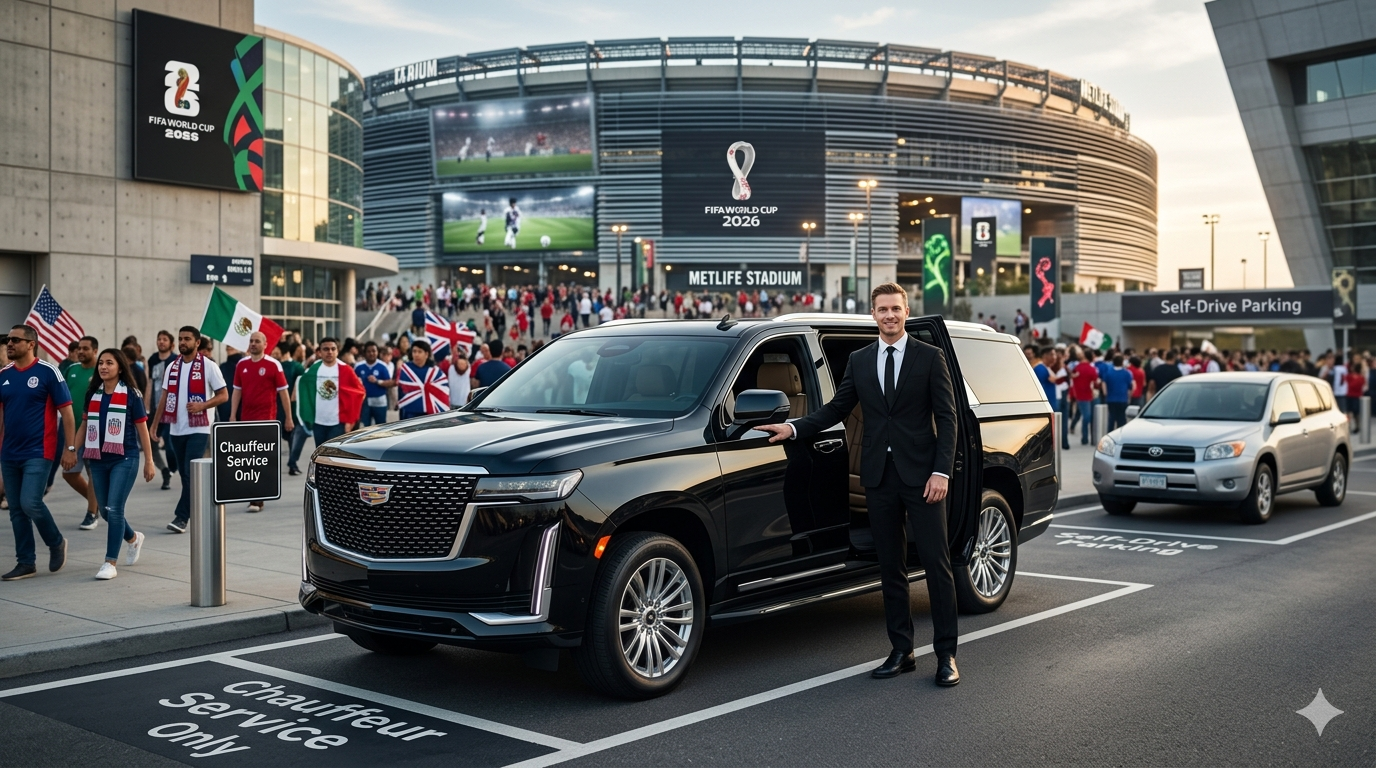
You arrive at JFK or EWR for your FIFA World Cup 2026 trip. The Hertz desk is right there. You look at the price — $89/day. “I’ll just rent a car and drive myself,” you think. “Way cheaper than booking a chauffeur.”

Table of Contents

It sounds smart on paper. It usually isn’t. After 20 years of operating in this market, I’ve seen hundreds of travelers fall into the rental car trap. The headline daily rate is misleading. The actual all-in cost when you factor in everything is much higher than fans realize. And the experience trade-off is brutal.

This guide compares them honestly. Real total costs. Real time savings. Real experience trade-offs. By the end you’ll know exactly which is right for your specific trip.

If after reading you want to book a chauffeur instead, +1 (917) 277-3371 or grab a quote.

The Short Answer

For most FIFA World Cup 2026 trips to NYC, a pre-booked chauffeur is the better option than a rental car. The all-in costs are closer than the headline rates suggest, the time savings of having someone else drive are significant, and the experience trade-off (especially for match days) is one-sided in favor of the chauffeur.

Exceptions where renting a car can make sense: – You’re driving in from outside the NY metro and need a car for your hometown – You’re staying in NJ for a week and want flexibility for daily errands beyond match day – You’re a solo budget traveler willing to absorb the hidden costs and stress

For everyone else — couples, families, groups, international visitors, anyone valuing time and comfort — chauffeur wins on real comparison.

What Each Option Actually Costs

Let’s price out a real scenario: a couple arriving at EWR for a 3-night World Cup 2026 trip.

Renting a Car (Hertz/Enterprise/etc.)

Daily Rental: – Headline rate: $89/day economy, $159/day luxury SUV – World Cup weekend surcharges: +20-40% – Real rate: $107-$223/day

Insurance: – Collision damage waiver: $25-$45/day – Supplemental liability: $15-$25/day – Real total: $40-$70/day

Fuel: – Round trip + match day driving + sightseeing: ~$80-$150 for 3 days

Tolls: – Manhattan + NJ tunnels + bridges: $50-$120 across the trip

Parking: – MetLife match-day parking: $80-$200 – Manhattan hotel valet: $60-$150/night × 3 = $180-$450 – Or commercial parking: $40-$70/day × 3 = $120-$210

Other Costs: – Gas refill at return: $20-$50 – Late return fees if applicable – Damage deductible risk: $500-$2,500

3-Day Rental Total Cost (Couple)

  • Rental: $321-$669 (3 days)
  • Insurance: $120-$210 (3 days)
  • Fuel: $80-$150
  • Tolls: $50-$120
  • Parking: $260-$650
  • Total: $831-$1,799

Chauffeur Alternative (Same Trip)

For a 3-Night Trip: – Airport arrival transfer (EWR to hotel): $215 – Match day round trip (hotel to MetLife): $595-$795 – Optional sightseeing day chauffeur (hourly): $1,400 – Airport departure transfer (hotel to EWR): $215 – Total: $2,425-$2,625

Wait — the chauffeur is more expensive? Yes. But this comparison is incomplete. The chauffeur includes: – All driving (no time burden on you) – All parking (handled) – All fuel and tolls – All stress – All risk

Whereas the rental car requires you to drive, navigate, park, manage tolls, and absorb risk. To make this comparison apples-to-apples, you have to add the hidden costs of driving to the rental side.

The Hidden Costs of Renting a Car

Things that aren’t on the price sheet but cost you real money:

Designated Driver Tax

You can’t drink. Or someone in your group can’t. Even one drink during pre-match festivities = you need to delay driving 1-2 hours. Real opportunity cost in a celebration weekend.

Manhattan Driving Risk

Driving in NYC if you’re not from NYC is genuinely difficult. Aggressive drivers, double-parked cars, jaywalkers, taxis cutting you off. Many out-of-town drivers white-knuckle through Manhattan and find it stressful.

Parking Time Cost

Finding parking in Manhattan eats 15-30 minutes every time you arrive somewhere. Multiply across a 3-day trip.

Match-Day Stress

Driving to MetLife in match-day traffic adds 60-90 minutes per direction. Driving home tired post-match adds risk.

Insurance Confusion

US rental insurance is complicated. Your home country insurance may or may not cover. Your US credit card insurance may or may not be sufficient. Many international visitors over-buy or under-buy, both costing money.

Damage and Wear Risk

Returning a rental car with even minor damage = $200-$2,500 deductible.

Parking Tickets

Easy to get in NYC if you’re not familiar with parking rules. $100-$200 each.

Time Cost of Logistics

You’re managing fuel stops, parking decisions, route planning, navigation. That’s time not spent enjoying your trip.

When you account for all of this, the rental car total cost climbs $200-$500 higher than the headline. Suddenly the gap to a chauffeur narrows or disappears.

When a Rental Car Actually Makes Sense

To be fair, here are the cases where renting is genuinely the right choice:

Case 1: You’re Visiting NYC + Other US Cities

If you’re driving down to DC, Boston, or Philadelphia as part of your trip, a rental car covers all of it. Chauffeur only covers NYC area.

Case 2: You’re Staying in Northern NJ and Want Daily Flexibility

A NJ-based traveler wanting to drive to the Hamptons one day, into Manhattan another, to MetLife for the match. Rental car has flexibility a chauffeur doesn’t.

Case 3: Solo Budget Traveler Willing to Absorb Stress

If a 3-day rental costs you $831 and a 3-day chauffeur package costs $2,425, the $1,594 difference can fund another match ticket or significant hotel upgrade. Some travelers will accept the trade-off.

Case 4: You’re a Confident NYC Driver

If you actually live in or near NYC, you know the roads, you handle the traffic, you’ve driven the route. The trade-offs are less burdensome.

Case 5: You’re Going to Other Host Cities by Car

Driving from NYC to Boston for another World Cup match? Rental car is the right call.

When a Chauffeur Almost Always Wins

For most other scenarios:

Couples or Small Groups (4 or Fewer)

Per-person, chauffeur economics work well. Reliability and comfort matter more than savings.

Anyone Planning to Drink

Pre-match drinks. Match-day beers. Post-match celebration. With a chauffeur, drink freely. With a rental, someone’s sober the whole time.

Families With Kids

Kids + car seats + stroller + match-day stress = chauffeur wins easily.

International Visitors Unfamiliar With NYC

Driving in NYC if you’ve never done it is intimidating. Rental car for international visitors = stress.

Anyone Going to the Final Match

Final Match (July 19, 2026) parking is limited and expensive. Final Match post-exit takes 90-150 minutes. Don’t rent for the Final.

Anyone Who Values Their Time

A chauffeur means you arrive at your destination, get out, and that’s it. Rental means you arrive, find parking, walk back to your destination, deal with hotel valet, etc.

Premium Trip Travelers

If you’re celebrating an anniversary, honeymoon, milestone, or VIP experience — chauffeur is the right call. Rental cars don’t deliver luxury.

Match-Day Specific: Rental Car vs. Chauffeur

The match day is where the comparison really sharpens.

Renting a Car for a Match Day

  • Drive yourself in match-day traffic (45-90 min each way)
  • Pay for premium parking at MetLife ($150-$300)
  • Walk 10-15 minutes from parking lot to gate
  • Can’t drink at the match
  • Sit in 60-90 minute post-match exit traffic
  • Drive back to Manhattan late at night, tired, with hotel valet to deal with

Total experience: stressful, time-consuming, expensive on the back end.

Hiring a Chauffeur for the Same Match Day

  • Get in vehicle at hotel, relax during drive (45-90 min match-day, but you’re chilling)
  • Dropped at credentialed close-zone (2-5 minute walk to gate)
  • Drink as much as you want during the match
  • Walk out, chauffeur is staged, you go
  • Arrive at hotel relaxed

Total experience: enjoyable, time-saving, no driving stress.

For the match-specific comparison, see our pre-game/post-game piece.

The Time Math

Here’s how time breaks down for a typical match day from a Manhattan hotel:

Renting a Car (Your Time Spent)

  • Drive to MetLife: 90 min (you’re driving)
  • Find parking: 15-30 min
  • Walk to gate: 15 min
  • Match: 2 hours (you’re watching)
  • Walk back to car: 20 min
  • Exit lot wait: 60-90 min
  • Drive back: 60-90 min
  • Find Manhattan parking + valet: 15-30 min
  • Total time you’re “working” or “navigating”: ~5 hours

Hiring a Chauffeur (Your Time Spent)

  • Vehicle arrives at hotel: you’re ready
  • Drive to MetLife: 90 min (you’re chilling)
  • Drop at gate: 2 min
  • Match: 2 hours (you’re watching)
  • Walk to chauffeur: 10 min
  • Drive home: 60 min (you’re chilling)
  • Drop at hotel: 2 min
  • Total time you’re “working” or “navigating”: ~10 minutes

You get 4.5 hours of your match day back by hiring a chauffeur. Worth $500-$1,000 in opportunity cost or pure relaxation value.

Real Scenarios Compared

Three real comparisons for a couple’s 3-day World Cup trip:

Scenario 1: Solo Traveler, Hartford Driver, Single Match

  • Rent a car: $400-$700 all-in (low-effort drive, can pre-pay parking, drive home from match)
  • Chauffeur: $1,200-$1,600 (airport + match + airport)

For this scenario, rental wins on cost. Trade-off is the experience downsides.

Scenario 2: Couple From London, Single Match, 3-Night Trip

  • Rent a car: $1,200-$1,500 all-in (high cost due to insurance, valet, MetLife parking, post-match risk)
  • Chauffeur multi-day package: $1,800-$2,500 (full white-glove)

For this scenario, chauffeur is only $300-$1,000 more — and the experience difference for international visitors is enormous.

Scenario 3: Family of 4 (Two Kids), Single Match, 4-Night Trip

  • Rent a car: $1,500-$2,500 all-in (larger vehicle, kids’ costs, valet, parking)
  • Chauffeur multi-day package: $2,500-$3,500 (Cadillac Escalade ESV)

For families, the chauffeur premium is justified by stress reduction and kid-friendly logistics.

Scenario 4: Group of 6 Adults, Two Matches, 5-Night Trip

  • Rent two vehicles or one large vehicle: $1,800-$3,000 all-in
  • Chauffeur Sprinter multi-day package: $4,500-$6,500

For groups, per-person, rental cars get close. Chauffeur wins on experience and group cohesion.

Common Mistakes With Rental Cars for World Cup Trips

A few things that consistently burn travelers:

Mistake 1: Booking the Lowest Daily Rate

Some travelers book the $35/day economy rental, not realizing they’ll end up in a tiny car for a long trip. Upgrade to mid-size at least, or larger SUV for families. Rental “deals” are often regrets.

Mistake 2: Skipping Insurance

The collision damage waiver feels expensive. Skipping it means you’re on the hook for the deductible (often $1,000-$2,500). For NYC driving where minor damage is common, take the insurance.

Mistake 3: Returning Late

Late return fees compound fast. Build in buffer for the airport drop-off.

Mistake 4: Hotel Valet Surprise

Not realizing that Manhattan hotels charge $60-$150/night for valet parking. Budget for this.

Mistake 5: Match-Day Parking Without Pre-Buying

Showing up at MetLife on match day hoping to find parking. Don’t.

Mistake 6: Drinking and Driving

Pre-match cocktails. Match-day beers. Post-match celebration. With a rental car, someone has to skip the celebration. With a chauffeur, no one does.

What Real Travelers Tell Us

When we ask clients who switched from renting to chauffeurs why they made the switch, the answers cluster:

  • “I underestimated how much time I’d spend on driving and parking.”
  • “My partner and I argued about who would drive.”
  • “I was exhausted after the match and didn’t want to drive home.”
  • “NYC parking stressed me out.”
  • “My insurance situation was confusing as an international visitor.”
  • “The hidden costs added up to more than I expected.”

These are real-world friction points the rental car decision creates. Chauffeurs solve all of them.

How to Decide

Real decision framework:

Choose Rental Car If

  • You’re solo and budget-tight
  • You’re staying outside NYC and need a daily car
  • You’re driving to multiple host cities
  • You’re a confident NYC driver
  • You’re willing to absorb stress trade-offs

Choose Chauffeur If

  • You’re a couple, family, or group
  • You value your time
  • You want to drink during the celebration
  • You’re an international visitor unfamiliar with NYC
  • You’re going to the Final Match
  • You’re celebrating a milestone (honeymoon, anniversary)
  • You want a premium experience

For most World Cup 2026 NYC trips, chauffeur is the call.

Frequently Asked Questions (FAQ)

Q: Should I rent a car or hire a chauffeur for FIFA World Cup 2026 NYC?

A: For most travelers — chauffeur. The all-in cost gap is smaller than headline rental rates suggest once you factor in insurance, valet parking, MetLife match-day parking, fuel, tolls, and stress. For groups of 2+, the per-person economics often favor the chauffeur. For experience, chauffeur wins overall.

Q: What’s the real total cost of renting a car for a World Cup 2026 NYC trip?

A: For a 3-day trip (couple), expect $831-$1,799 total when factoring in rental rate, insurance, fuel, tolls, MetLife parking, and Manhattan hotel valet. Most travelers underestimate this by $300-$700.

Q: How much more does a chauffeur cost than a rental car?

A: For a 3-day couple’s trip: rental ~$831-$1,799 total vs. chauffeur ~$2,425-$2,625 total. Difference: ~$600-$1,800. The chauffeur premium pays for time savings, drinking freedom, and stress elimination — worth it for most travelers.

Q: Is renting a car a good idea for World Cup 2026 international visitors?

A: Generally no. Driving in NYC if you’ve never done it is challenging. Insurance can be confusing for international visitors. Chauffeur eliminates all of this complexity. See our international fans guide.

Q: Can I rent a car and drive to MetLife Stadium on match day?

A: Yes, but you’ll need pre-paid parking ($80-$350 depending on match tier), you’ll face match-day traffic (60-90 min each way), and post-match exit takes 60-90 minutes. Most travelers find it more stressful than they expected.

Q: Should I rent a car for the Final Match (July 19, 2026)?

A: Strongly not recommended. Final Match parking is expensive ($200-$350) and limited. Final Match post-exit takes 90-150 minutes. The Final is the worst match-day for rental car logistics.

Q: How does the per-person cost of a rental car compare to a chauffeur for families?

A: For a family of 4, rental car total cost ~$1,500-$2,500 (3 days) = $375-$625/person. Chauffeur multi-day package ~$2,500-$3,500 = $625-$875/person. Slightly higher per-person for chauffeur, but eliminates kid-management stress and gives parents real freedom.

Q: Can I rent a car only for match day and use other transportation otherwise?

A: Yes, but match-day rentals add complexity. Better strategy: rent for the whole trip if you need a car at all, or skip the rental and use chauffeur + other options. Mixing is rarely the right answer.

Q: What’s the easiest way to compare rental vs. chauffeur for my specific trip?

A: Build a real total cost for each: rental rate × days + insurance + fuel + tolls + match parking + hotel valet for rental. Chauffeur package quote for the same trip. Then compare the experience (you drive vs. you’re driven). For most travelers, the math is closer than expected and the experience tips it to the chauffeur.

Q: Is renting a car ever cheaper per person than booking a Sprinter limo for a group? A: For groups of 6+, rental car logistics get complicated (two vehicles, multiple drivers, lots of parking). A single Sprinter limo at $1,095-$1,495 round trip = $80-$110/person, often cheaper than renting + insuring + parking two vehicles. See our group transportation guide.

Make the Smart Call

For most World Cup 2026 NYC trips, the chauffeur is the smarter choice. The all-in cost is closer than you think, the time savings are real, and the experience trade-off favors the chauffeur for almost every traveler profile.

Compare chauffeur quotes → 📞 24/7 Dispatch: +1 (917) 277-3371

Related Reading

May 15, 2026

If you’ve been Googling “how to get to MetLife Stadium” you’ve probably noticed something. Almost all the advice you’ve read is generic. “Take NJ Transit.” “Book a car.” “Avoid traffic.” Most of it was written by SEO content writers who’ve never actually been to MetLife on an event day. They write what sounds reasonable, not what actually works.

Table of Contents

This guide is different. After 20 years of running passengers to and from MetLife for Super Bowls, NFL games, concerts, Wrestlemanias, and major matches, I can tell you what actually works — the local knowledge that only comes from doing this thousands of times.

These are the things experienced NYC locals know that out-of-town visitors miss. Real routing tips, real timing windows, real shortcuts. The advice that gets you to MetLife on time, gets you home without wasting two hours of your night, and saves you actual money.

If after reading you want a local chauffeur who already knows all of this and just handles it for you, +1 (917) 277-3371 or book here.

What Locals Know That Travel Blogs Get Wrong

Let me start with what’s wrong in most generic advice:

Wrong: “Take NJ Transit From Penn Station”

Yes, NJ Transit exists. Yes, it runs dedicated match-day service. But generic advice doesn’t mention the 90-minute post-match platform wait at Secaucus. Doesn’t mention that Penn Station NJ Transit ticket lines are 15-20 minutes during peak. Doesn’t tell you that NJ Transit shuts down before some late dinners end.

NJ Transit works for some travelers. It’s not the universal answer.

Wrong: “Book Uber or Lyft”

Generic advice says “use rideshare.” Locals know that rideshare surge at MetLife on match day hits $400-$1,200 and drivers cancel routinely. See our piece on Uber surge.

Wrong: “Drive Yourself and Park”

Generic advice says “park at MetLife.” Locals know that premium parking is sold months in advance, general parking lots are 10-15 minute walks to the gates, post-match exit takes 60-90 minutes, and the Lincoln Tunnel back to Manhattan post-match is brutal. See our parking guide.

Wrong: “Leave Three Hours Before Kickoff”

Generic advice says “build in buffer.” Locals know that the worst traffic window is actually 1-2 hours before kickoff — leave 3.5-4 hours before kickoff and you actually beat the traffic.

Wrong: “It’s Just 9 Miles from Manhattan, So 25 Minutes”

Google Maps says 25 minutes. Locals know that match-day traffic turns 25 minutes into 60-90 minutes.

The pattern: generic advice describes what theoretically works. Local advice describes what actually works after you’ve seen the system fail 100 times.

What Locals Actually Recommend

Here’s the real local knowledge:

Local Tip 1: Leave Earlier Than You Think Necessary

The match-day traffic curve at MetLife has a counterintuitive shape:

  • 5+ hours before kickoff: Light traffic. Empty Lincoln Tunnel. Quick drive.
  • 5-4.5 hours before kickoff: Building traffic but still manageable. The sweet spot.
  • 2-3 hours before kickoff: Peak chaos. Lincoln Tunnel locked. Route 3 East solid.
  • 1-2 hours before kickoff: Worst of the worst. Don’t leave during this window.
  • Less than 1 hour before kickoff: Genuine risk of missing kickoff.

The local wisdom: leave 3.5-4 hours before kickoff. Earlier is better than later. Get to the stadium area, find a restaurant or sports bar for the last hour, walk in calmly.

Local Tip 2: Choose Your Tunnel Strategically

The three tunnel/bridge options aren’t equal on match days:

  • Lincoln Tunnel: Shortest geographically, worst on match days. Avoid during peak.
  • Holland Tunnel: Often 20-30 minutes faster than Lincoln on match days. The pro’s choice.
  • GWB: Longer drive but skips Manhattan tunnel traffic entirely. Great if pickup is in Upper Manhattan, Bronx, or Westchester.

Most generic advice says “take Lincoln Tunnel.” Locals say “if it’s match day, take Holland.”

Local Tip 3: Verrazzano-Goethals Route From Brooklyn

If you’re in Brooklyn, the generic advice says cross through Manhattan to Lincoln Tunnel. Locals know:

Verrazzano-Narrows Bridge → Goethals Bridge → NJ Turnpike → MetLife skips Manhattan entirely. From Bay Ridge or Bensonhurst, this is dramatically faster on match days. Most Brooklyn rideshare drivers don’t know this route. Our chauffeurs do.

Local Tip 4: Mario Cuomo Bridge Route From Westchester

From Westchester County, the obvious route is GWB → Route 4. But on Final Match day, GWB will be locked. Local pro move:

Mario Cuomo Bridge → Garden State Parkway → Route 17 completely avoids GWB. Often 30-45 minutes faster on bad days.

Local Tip 5: Pre-Stadium Bar Strategy

Generic advice says “arrive at the stadium 90 minutes before kickoff.” Locals know:

  • The stadium concourse pre-match is packed
  • Concession lines are 20-30 minutes
  • Bathroom lines are 15-20 minutes
  • Pre-game ceremonies start 30-45 minutes before kickoff

Local move: Drop your group at a bar or restaurant near MetLife (Park & Orchard in East Rutherford, Hoboken bars, or even a tailgate lot if you have parking) for the last hour. Walk in 30-40 minutes before kickoff. You’re calm, fed, and ready.

Local Tip 6: Tailgate Parking, Not Stadium Parking

If you’re going to drive, the local move is to park at a tailgate lot (where you can actually tailgate properly) rather than the closer-but-stricter premium lots. Tailgate lots are typically $40-$80 vs. $200+ for premium, plus you actually get the tailgate experience.

Local Tip 7: Pre-Match Dining Choices

Most travel blogs send you to chain restaurants. Locals know the real spots:

  • Park & Orchard (East Rutherford) — Closest real restaurant to MetLife, takes reservations
  • Anthony David’s (Hoboken) — Italian, 25 minutes from stadium, pre-match favorite
  • Robongi (Hoboken) — Japanese, faster service
  • The Olive Branch (Hoboken) — Mediterranean, group-friendly

These are the spots locals recommend for pre-match dining when you don’t want to fight Manhattan traffic.

For a full restaurants guide, see our pre/post-match dining content.

Local Tip 8: Post-Match Stadium Exit Hack

Generic advice: “Walk to your car after the match.” Locals know:

  • Walking out with the crowd takes 30+ minutes
  • Standing right at the gate as it opens means waiting an extra 15-20 minutes

Local move: Stay in your seats for the post-match ceremony (10-15 min). By the time you walk out, the worst crush has cleared. You’ll save 20-30 minutes of crowd time.

Local Tip 9: Pre-Staged Chauffeur Return Zones

Generic advice doesn’t mention this because most travel blogs don’t know it exists. Locals know:

MetLife has designated chauffeur return zones where pre-booked private vehicles stage during the match. Your chauffeur is waiting in a reserved spot, you walk out, you walk straight to them.

Rideshare can’t access these zones. Self-drive can’t use them. Only credentialed chauffeurs do. This single thing saves you 45-60 minutes of post-match scramble.

Local Tip 10: Don’t Trust Live Apps During the Match

Apps showing “traffic” data are useful — but during peak match-day, they’re dated by 20-30 minutes. Your chauffeur knows current conditions from live dispatch + experience. Trust the chauffeur over your phone.

Local Tip 11: The 4 PM Departure Trick

If your match kicks off at 7 PM, you’d think a 4 PM departure is overkill. Locals know:

  • 4:00 PM: Light traffic. 50-minute drive.
  • 5:00 PM: Peak inbound traffic begins. 80-minute drive.

By leaving at 4 PM, you arrive at MetLife by 4:50. Tailgate, dinner, drinks for two hours, walk in calmly. Compared to leaving at 5:30 and stressing through Lincoln Tunnel at 6:30.

Local Tip 12: Pre-Booking Beats Pre-Buying

For both parking and chauffeur service: pre-booking with a real operator beats trying to figure it out closer to match day. Locals book early. Tourists book late. The result is locals get the good vehicles and good pricing; tourists pay surge.

Local Tip 13: Sunday Match Day Math

Saturday matches: normal traffic patterns. Sunday matches: Different. Sunday traffic in Manhattan is lighter. Sunday MetLife matches actually have slightly easier transit than Saturday matches.

If you have a choice of weekend matches, Sunday is often easier.

Local Tip 14: Avoiding Stadium Bag Confusion

Locals know MetLife’s bag policy strictly enforces 12″ x 6″ x 12″ clear bags. Bring the wrong bag and you’re walking back to your vehicle. Locals: ditch the backpack before you leave the hotel.

For full match-day stadium guidance, see our first-time MetLife guide.

Local Tip 15: Hotel Concierge Pre-Briefing

Locals know that Manhattan luxury hotel concierges have established relationships with limo operators. They can sometimes book transportation faster or with better rates than direct booking. For luxury Manhattan hotels (Mandarin Oriental, Baccarat, Edition), ask your concierge for transportation recommendations.

What NYC Locals Specifically Avoid

Real talk on what locals don’t do:

Avoid: Rideshare Surge Pricing on Match Day

Locals know this is broken. They don’t even try. See our piece on why Uber is so expensive.

Avoid: Driving on Match Day From Manhattan

Locals know the math doesn’t work. The hidden costs and time costs are real.

Avoid: NJ Transit From Penn at Peak Times

NJ Transit works for some travelers. Locals know to avoid Penn Station NJ Transit at peak inbound (1-2 hours before kickoff) — lines are brutal. If you’re using NJ Transit, go earlier.

Avoid: Cheap “Limo” Quotes From Unknown Operators

Locals know that real chauffeur service starts at certain pricing levels. Below that, you’re getting brokered to whoever has a vehicle, not a real operator.

Avoid: Stadium Concession Food Before the Match

Locals eat real food before walking into the stadium. Don’t go in hungry.

Avoid: Tailgating Without a Plan

Locals know tailgating works only with proper parking pass + planning. Showing up hoping to wing it doesn’t work for World Cup-tier events.

What Differentiates a NYC Local Operator From a Travel Blog

To make this concrete, here’s what we as a NYC-based operator know that no travel blog can know:

Real-Time Stadium Operations

  • Which gates flow best for premium drop-off
  • Which lots have fastest entry
  • Where construction or road closures are happening
  • How match-day security perimeter changes by match

Driver-Level Knowledge

  • Real travel times observed across hundreds of matches
  • Specific routes that work for specific neighborhoods
  • Backup routing when primary routes are blocked
  • Communication with stadium traffic management

Match-Day Operational Patterns

  • When traffic spikes start
  • When they peak
  • When they normalize
  • Difference between Saturday and Sunday matches

Local Restaurant Relationships

  • Which pre-match restaurants accept reservations
  • Which post-match restaurants stay open late
  • Which spots welcome large groups
  • Where the actual food and service is

Hotel-Side Knowledge

  • Which Manhattan hotels coordinate well with our pickups
  • Concierge relationships
  • Hotel valet capacity
  • Driveway accessibility

This isn’t bragging — it’s the explanation of why operator content beats travel blog content. The depth is fundamentally different.

How to Apply Local Knowledge Without a Chauffeur

If you don’t want to book a chauffeur, you can still apply local knowledge:

If You’re Driving:

  • Leave by 4 PM for a 7 PM match
  • Use Holland Tunnel or GWB instead of Lincoln Tunnel on match day
  • Pre-pay premium parking if available
  • Have a non-drinking driver who knows the area
  • Plan to wait 60-90 minutes for parking lot exit post-match

If You’re Taking NJ Transit:

  • Go to Penn Station 30+ minutes before your match-day train (lines)
  • Don’t arrive at peak inbound (1-2 hours before kickoff)
  • Plan for 60-150 minute post-match wait

If You’re Using Rideshare:

  • Don’t, for match-day. Use a different option.

If You’re Walking From Hotel:

  • You can’t. MetLife isn’t walkable.

If Your Plan Goes Wrong:

The Bottom-Line Local Recommendation

If you ask 100 NYC locals “what’s the best way to get to MetLife Stadium for a World Cup match in 2026?” the most common answer will be one of these:

  1. Pre-book a private chauffeur (most common for premium travelers)
  2. NJ Transit if you’re solo and patient (for budget travelers)
  3. Drive yourself if you live in northern NJ (for locals)

What you won’t hear from a local: “Just take Uber.”

For most travelers — especially those coming from out of town for World Cup — a pre-booked chauffeur is what locals do, what locals recommend, and what works.

Frequently Asked Questions (FAQ)

Q: What do NYC locals actually recommend for getting to MetLife Stadium for World Cup 2026?

A: Most locals recommend a pre-booked private chauffeur for premium travelers, NJ Transit for budget travelers, or driving for locals living within 10 miles of MetLife. Locals strongly advise against relying on Uber/Lyft for match days due to extreme surge pricing.

Q: What’s the biggest mistake travel blogs make about MetLife transportation?

A: Most travel blogs underestimate match-day traffic, post-match exit time, and rideshare surge — and don’t account for hidden costs of driving. They give generic advice that works in theory but not in match-day reality.

Q: When should I actually leave Manhattan for a World Cup match at MetLife?

A: Local recommendation: leave 3.5-4 hours before kickoff for standard matches and 4.5 hours before for Final Match. The 1-2 hour pre-kickoff window is peak chaos and you’ll arrive stressed at best, late at worst.

Q: Which tunnel is best for a Manhattan-to-MetLife match-day trip?

A: Locals favor Holland Tunnel over Lincoln Tunnel on match days. Holland tends to flow 20-30 minutes faster during peak windows. GWB is the alternative if you’re in Upper Manhattan or going via Mario Cuomo Bridge from Westchester.

Q: What’s a “pre-staged chauffeur return zone” at MetLife?

A: Designated areas where pre-booked private chauffeur vehicles park during the match. Your chauffeur is there when the match ends. Rideshare doesn’t have access to these zones. It’s a major local advantage — saves 45-60 minutes post-match.

Q: Do NYC locals use Uber for MetLife match days?

A: No. Locals know rideshare surge pricing at MetLife is brutal ($400-$1,200+ at peak) and drivers routinely cancel pre and post-match. Locals use chauffeurs, NJ Transit, or drive themselves — never default to Uber for match days.

Q: What pre-match restaurants do NYC locals recommend near MetLife Stadium?

A: Park & Orchard in East Rutherford is the closest real restaurant. Hoboken offers Anthony David’s, Robongi, and The Olive Branch as group-friendly pre-match dining. Locals avoid Manhattan pre-match dining if they’re driving — too much traffic risk.

Q: How do locals avoid Lincoln Tunnel traffic on World Cup match days?

A: Three options: leave 3+ hours before kickoff, take Holland Tunnel instead of Lincoln, or use GWB → Route 4 → Route 17 routing from Upper Manhattan / Westchester. Mario Cuomo Bridge → Garden State Parkway is the Westchester pro route.

Q: What’s the best way to leave MetLife Stadium after a World Cup match?

A: Local pros: stay in your seats for post-match ceremony (10-15 min), then walk out as crowds thin. Have a pre-staged chauffeur in a credentialed return zone. Skip self-driving (60-90 min exit wait) and rideshare (90+ min wait or extreme surge).

Q: Should I trust travel blogger advice or local operator advice for MetLife World Cup 2026?

A: Local operator advice. We move people through MetLife thousands of times — we know what actually works. Travel bloggers write what sounds reasonable. The difference is real on match day.

Get the Local Knowledge Without Doing the Research

You can apply all the local tips above on your own, or you can book a chauffeur who already knows them and just handles the entire match day for you.

Book a local chauffeur → 📞 24/7 Local Dispatch: +1 (917) 277-3371

Related Reading

May 15, 2026

You’re sitting at your computer pricing out transportation for a FIFA World Cup 2026 match. The chauffeur quote came in at $595 round trip. That seems expensive, and your first instinct is “I’ll just drive myself — it’s cheaper.”

Table of Contents

Is it though?

Most fans who decide to drive themselves to MetLife only calculate the obvious costs: gas and parking. They forget the toll system. They don’t think about hotel valet. They ignore the fact that someone has to be the designated driver. They underestimate post-match exit time. And they don’t factor in that they’re going to spend three hours of their match day fighting traffic in a Honda Civic instead of relaxing.

This guide does the actual math. After 20 years of operating in this market, I’ve watched fans burn money and time on the drive-yourself strategy and walk away wishing they’d booked a chauffeur. Here are the real numbers — the ones that matter.

If the math convinces you, book a chauffeur here or call +1 (917) 277-3371.

The Short Answer

For a couple driving themselves from a Manhattan hotel to MetLife Stadium for a World Cup 2026 match, the real total cost is approximately $300-$500 — once you factor in gas, tolls, parking, hotel valet, lost time, no-drinking constraint, and post-match driving stress.

A pre-booked Cadillac Escalade ESV chauffeur is $595-$795 round trip. For solo travelers, driving is cheaper. For couples, the cost gap is small enough that comfort wins. For groups of 3+, the chauffeur is genuinely cheaper and better.

The longer answer covers exactly what the $300-$500 driving cost breaks down to, what you’re sacrificing, and when each option makes sense.

The Obvious Costs (What Everyone Calculates)

These are the costs most people think about when they price out driving:

Gas

Round-trip Manhattan to MetLife: ~18 miles each way = 36 miles round trip. For a typical car (25 mpg), that’s ~$10-$15 in gas at current NYC fuel prices.

Tolls

  • Lincoln Tunnel (entering NJ): ~$16
  • Possible NJ Turnpike toll (if using turnpike routing): ~$3-$5
  • George Washington Bridge (if returning via GWB): ~$16
  • Round trip total: $20-$32 depending on route

Stadium Parking

  • Premium parking (closest to stadium): $150-$300 for World Cup matches (limited and mostly pre-allocated)
  • General parking: $60-$100 for group stage, $100-$200 for knockout matches, $200-$350 for Final Match
  • Off-site shuttle parking: $35-$60 (plus shuttle time)

Sub-total of obvious costs (couple, group-stage match): ~$90-$150

That’s the number most fans see in their head. “I’ll just drive — it’s $100.” Reasonable conclusion. But it’s incomplete.

The Hidden Costs (What Driving Actually Costs)

Now let’s add what gets missed:

Hotel Valet Parking

If you’re staying at a Manhattan hotel during World Cup weekend, you need somewhere to park your car overnight. Most luxury hotels charge for valet parking: $60-$150 per night.

For a 2-night Manhattan stay where you have your car: $120-$300 in valet alone. Even longer stays compound this. If you’re driving in just for the match, you need somewhere to park in Manhattan, which means a hotel garage or commercial lot.

The Designated Driver Tax

You can’t drink. Or at least, the designated driver can’t. For a couple, this means either: – One person doesn’t drink during a celebration day – You spend extra on rideshare home if you decide to drink anyway ($300-$500 surge)

The “designated driver tax” is real money. Even if you say “I’ll just have one,” every drink slows your reaction time. Most fans driving home from match days are technically below the legal limit but not actually optimal. It’s an unspoken cost of driving.

Cost of not drinking at a celebration: subjective, but $50-$150 in lost beverage value, plus the experience cost.

Time Cost of Match-Day Traffic

Average drive Manhattan to MetLife on a match day: 60-90 minutes each way. Off-peak baseline: 25-30 minutes.

Match-day delay: 60-120 minutes round trip.

If your time is worth even $50/hour, that’s $50-$100 of opportunity cost. For higher earners, multiply.

Post-Match Exit Time

After the final whistle, MetLife parking lots queue out for 45-90 minutes. You’ll be sitting in your car, listening to AM radio, waiting to exit while your friends in chauffeured vehicles are already at dinner.

Post-match cost: 60-90 minutes of your life, plus the frustration.

Stress and Fatigue

Driving on match day is exhausting. NJ traffic. Tunnel congestion. Stadium-area confusion. Post-match driving home tired and emotionally drained.

Cost: Hard to quantify, but real.

Toll Booth Wait Times

Lincoln Tunnel and GWB toll booths back up during peak times. Easy E-ZPass is faster, but cash lanes can add 15-30 minutes.

Stadium Walk From Parking

General parking is 10-15 minutes from the gates. In July heat with crowds. Carry anything? Add time.

Re-Entering Stadium Lot

If you tailgated in your car, you can leave and re-enter, but lot access is sometimes restricted by time. Plan accordingly.

After-Hours Repair Risk

Driving home late at night fatigued, especially through tunnel traffic, increases accident risk. Insurance deductible if anything happens: $500-$2,500.

The Full Driving Cost Calculation

Here’s what driving actually costs for a typical couple from a Manhattan hotel to a World Cup match:

Direct Costs

Item Cost
Gas $15
Tolls (Lincoln + return) $25
Premium parking at MetLife $200 (avg)
Hotel valet parking (1 night) $80
Direct cost subtotal $320

Indirect Costs

Item Cost
Designated driver constraint (lost drink value) $50
Match-day traffic time (90 min × $50/hr) $75
Post-match exit time (60 min × $50/hr) $50
Stress / fatigue factor $25
Indirect cost subtotal $200

Total Real Cost of Driving (Couple, Group-Stage Match): ~$520

Compared To

Pre-booked Cadillac Escalade ESV round trip: $595-$795

The pure-dollar gap is $75-$275 in favor of driving — but you sacrifice all the experience benefits of the chauffeur.

When Driving Actually Wins on Cost

Some scenarios where driving genuinely is cheaper:

Solo Traveler, Group-Stage Match

  • Driving cost: ~$300-400 (no second person to share)
  • Chauffeur cost: $495 (Mercedes S-Class round trip)
  • Net savings driving: $100-$200
  • Trade-off: No drinking, traffic stress, exit wait

For solo budget travelers, driving makes sense — if you’re willing to accept the trade-offs.

Local Living Within 10 Miles

  • No tunnel tolls
  • Quick drive home post-match
  • Standard parking
  • Familiar route

For locals, driving often wins.

Pre-Paid Premium Stadium Parking + Designated Driver Role

  • If someone in your group already volunteered to be designated driver and you’ve pre-paid premium parking, the marginal cost of driving is low.

When Driving Loses on Cost (And Experience)

Most scenarios where driving fails:

Couple With One Person Who Wants to Drink

Drinking + driving = bad math. Either you don’t drink (expensive in experience), or someone gets home risky, or you spend extra on rideshare home (which is surge-priced post-match).

Family With Kids

Driving with kids on match day = stress maxed. Car seats, naps, post-match exit with cranky kids. Chauffeur is dramatically better here. See our family transportation guide.

Group of 4+

Per-person economics flip. Splitting an Escalade ESV at $595 across 4 people = $149/person. Driving with parking = $80-$200/person depending on how many cars you bring. Plus everyone has to be a designated driver.

Anyone Staying at a Manhattan Hotel With Valet

Hotel valet for 2 nights = $120-$300. Suddenly the math is close.

International Visitors Unfamiliar With NJ Roads

Renting a car + driving NJ Turnpike traffic + finding stadium parking = stress. Chauffeur eliminates all of it.

Final Match Attendees (July 19, 2026)

Final Match parking will be $200-$350 if available at all. Final Match post-match exit will take 90-150 minutes. Don’t drive to the Final.

For Final Match planning specifically, see our Final Match limo service guide.

Hidden Driving Costs That Surprise Fans

A few hidden costs that catch fans off-guard:

Stadium Bag Restrictions While Driving

You parked at MetLife and brought a backpack assuming you could leave it in the car. Then security tells you about MetLife’s clear bag policy. You can leave bags in the car, but you have to walk back to the lot. Adds time.

NJ Speed Camera Risk

NJ has more speed cameras than NYC. Driving home tired late at night, going 10 over the limit on NJ Turnpike = $80-$150 ticket. Not enormous, but adds up.

Out-of-Pocket Charges Some Drivers Miss

  • Stadium parking surcharges for late entry
  • Cancellation fees if you don’t show up
  • Pre-paid parking not refundable
  • Extra tolls if you take a wrong exit

Insurance Implications

Your personal auto insurance may not cover commercial/event-related driving fully. For most people this doesn’t matter, but for some it does. Worth checking.

Hidden Chauffeur Benefits the Cost Comparison Misses

Conversely, chauffeur cost includes things driving doesn’t:

Everything’s Included

  • Vehicle fuel
  • All tolls
  • Wait time (including the match itself)
  • Bottled water
  • WiFi
  • Phone chargers
  • Climate control

Time Recovery

The 60-120 minutes you’d spend in traffic, you spend resting, talking, or even napping. Worth real money for high-stress lives.

Drink Freely

Pre-game, during, post-match — drink without designated driver math.

Pre-Staged Post-Match Return

No exit wait. Walk out, walk to your chauffeur, drive home.

Premium Drop-Off Zones

Credentialed close-zone drop-off saves the 10-15 minute walk from general parking.

Stress Management

No traffic anxiety. No parking anxiety. No designated driver anxiety. Just match day.

A Real Cost Calculator By Match Type

Quick decision math:

Solo Traveler, Group-Stage Match

  • Drive: ~$400
  • Chauffeur (S-Class): $495
  • Difference: $95 chauffeur premium

Couple, Group-Stage Match

  • Drive: ~$520 (couple, accounting for valet, time, etc.)
  • Chauffeur (Escalade ESV): $595-$795
  • Difference: $75-$275 chauffeur premium

Group of 4, Group-Stage Match

  • Drive (2 cars + 2 parkings + tolls + valet): ~$700
  • Chauffeur (Escalade ESV): $595-$795 = ~$150-$199/person
  • Difference: Chauffeur is ~$100 cheaper AND better experience

Final Match Couple

  • Drive: ~$800+ (premium parking, longer exit, more stress)
  • Chauffeur (Escalade ESV Final Match premium): $1,195-$1,395
  • Difference: $400 chauffeur premium for dramatically better Final Match experience

Group of 14, Group-Stage Match (Sprinter Limo)

  • Drive in 3+ vehicles: ~$1,000-$1,500 split across cars
  • Chauffeur (Sprinter limo): $1,095-$1,495 = ~$80-$110/person
  • Difference: Chauffeur is roughly equivalent and dramatically better

For full pricing details across vehicles, see our pricing guide.

When You Should Actually Drive

I’m not anti-driving for everyone. Real cases where it works:

  • Solo budget traveler within an hour of MetLife — drive
  • Already-purchased premium parking + non-drinker — drive
  • Local family with multiple kids and own minivan — drive
  • Pre-existing parking pass and won’t be drinking — drive

For most others, the math is close enough that the experience tips it to the chauffeur.

How to Make a Driving Trip Work (If You Do Drive)

If you’ve decided to drive, a few tips:

Buy Parking Ahead of Time

Don’t show up trying to find parking. Pre-pay online. See our parking guide.

Choose Premium Parking If You Can

$200 for premium lot is worth it for closer walk + faster exit.

Have an Emergency Plan

What if your car breaks down? What if traffic is brutal? Have a backup transportation plan.

Designate the Driver Early

Don’t argue about who drives 30 minutes before the match. Decide who drives early and respect that choice.

Charge Up

Phone charged. Backup power bank in the car. You’ll need it.

Pack Snacks and Water

Inside the stadium you can’t bring much. In the car you can. Hydrate. Snack.

Plan Tailgate Timing

If tailgating, plan when you leave the lot for the gate. Don’t be in tailgate mode 30 minutes before kickoff.

Cash for Tips

Tip stadium parking attendants if they helped. Tip lot bathroom attendants. Small cash.

Sober Up Plan

Don’t drink heavily and drive home. Have a backup plan: rideshare home and Uber back tomorrow, or stay overnight nearby.

Frequently Asked Questions (FAQ)

Q: What’s the real total cost of driving to MetLife Stadium for FIFA World Cup 2026?

A: For a couple from a Manhattan hotel, approximately $300-$500 total including gas, tolls, premium parking, hotel valet, and indirect costs (designated driver, time, stress). Compared to a pre-booked Cadillac Escalade ESV at $595-$795 round trip, the cost gap is smaller than fans expect.

Q: How much is parking at MetLife Stadium for a World Cup 2026 match?

A: Premium parking ranges $150-$300 for World Cup matches. General parking is $60-$200 depending on match tier. Final Match parking is $200-$350 if available at all. Off-site shuttle parking is cheaper but adds time.

Q: Is it cheaper to drive yourself or hire a chauffeur for a World Cup 2026 match?

A: For solo travelers, driving is typically $100-$200 cheaper. For couples, the gap is smaller ($75-$275). For groups of 4+, a chauffeur is actually cheaper per person plus you avoid the designated driver constraint and post-match exit wait.

Q: What hidden costs do most fans forget when calculating driving?

A: Hotel valet parking ($60-$150/night), tolls (~$25 round trip), designated driver constraint (no drinking), match-day traffic time, post-match exit wait (45-90 minutes), and stress/fatigue. These add 30-50% to the perceived driving cost.

Q: Can I drink alcohol and drive home from a World Cup match at MetLife?

A: Legally no — and even one drink slows reaction time. Either you don’t drink (loss of experience), one person commits to driving sober, or you pay for rideshare home (which will be surge-priced post-match).

Q: How long does it take to leave the MetLife Stadium parking lot after a World Cup match?

A: 45-90 minutes for standard matches with a pre-booked chauffeur, 60-90 minutes for self-parking, and 90-150 minutes after Final Match. Pre-staged chauffeur pickup is the only way to bypass this.

Q: Should I drive to a Final Match (July 19, 2026)?

A: Strongly not recommended. Final Match parking will be expensive ($200-$350) and limited. Final Match post-match exit takes 90-150 minutes. The math overwhelmingly favors a chauffeur for the Final.

Q: What’s the per-person cost of driving for a family of 4?

A: Driving with parking and valet ~$700 total = ~$175/person. A chauffeured Cadillac Escalade ESV at $595-$795 is ~$150-$199/person. Roughly comparable, with the chauffeur winning on experience and convenience.

Q: Can I save money by parking at an off-site lot?

A: Off-site lots save $25-$50 vs. on-site MetLife parking. But shuttle waits add 30-60 minutes to your day. For most travelers, the savings isn’t worth the time. For tight-budget solo travelers, off-site can work.

Q: How does driving compare to other World Cup 2026 transportation options?

A: Driving is competitive with rideshare (which surges) and slightly cheaper than NJ Transit + chauffeur combinations on per-person basis. For experience, pre-booked chauffeur wins overall. For pure dollars, driving wins for solo budget travelers. See our limo vs. Uber vs. NJ Transit guide for the full comparison.

Make the Smarter Choice

The real cost of driving to MetLife Stadium is significantly higher than the $80-$100 number most fans assume. Once you factor in all the hidden costs and trade-offs, a pre-booked chauffeur is more competitive than it first appears.

Book your chauffeur → 📞 24/7 Dispatch: +1 (917) 277-3371

Related Reading

May 15, 2026

You opened the Uber app to check what a ride from your Manhattan hotel to MetLife Stadium would cost on a World Cup match day, and the screen showed $487. Or $612. Or $834. You stared at it for a second, assumed something was wrong, refreshed — and the number went up.

Table of Contents

This is the surge. It’s not glitching. It’s the algorithm doing exactly what it was designed to do — and on FIFA World Cup 2026 match days, it’s going to be worse than anything you’ve experienced before.

I’ve watched rideshare pricing on every major event at MetLife for the past decade. Super Bowls. NFL playoffs. Wrestlemanias. Taylor Swift. Beyoncé. The 2024 Copa America final. World Cup 2026 is going to be the most extreme surge environment any of these have seen. Here’s why, what to expect, and what locals actually do about it.

If you’ve already decided rideshare isn’t the play, call +1 (917) 277-3371 or book a flat-rate ride here.

The Quick Answer

Uber pricing on World Cup 2026 match days at MetLife Stadium will spike to 3-8x the normal rate because rideshare apps use real-time supply-demand algorithms. When 80,000+ fans all need rides at the same moment (1-2 hours before kickoff and immediately post-match), demand massively outstrips driver supply. The app raises prices until either more drivers come online or fewer riders accept the price.

Expected ranges based on past major MetLife events: – Uber X: $80-$120 base → $240-$600 surgeUber Black: $200-$300 base → $600-$1,200+ surgeLyft Lux: Similar to Uber Black

Post-match surge is typically worse than pre-match — even fewer drivers want a ride out of MetLife at 11 PM in stadium-exit traffic.

The smarter alternative for most fans: a pre-booked private chauffeur at flat rate. Same Mercedes S-Class quality as Uber Black, no surge, contractually guaranteed. $395-$595 round trip vs. potentially $1,200+ for round-trip Uber Black.

What Surge Pricing Actually Is

Uber’s pricing model has two components:

  1. Base Fare A standard fare calculated from time + distance. Off-peak, this is what you pay. Manhattan to MetLife at 2 PM on a Tuesday: $80-$120 for Uber X.
  2. Multiplier (Surge) A real-time multiplier the algorithm applies based on local supply-demand imbalance. When riders outnumber available drivers, the multiplier goes up. Common multipliers during major events: 2x, 3x, 4x, 5x, 6x, sometimes higher.

At 5x surge, a $100 base ride becomes a $500 ride. At 6x, it’s $600. The app shows you the final price before you book — so you see the surge, you just can’t avoid it.

Why World Cup 2026 Match-Day Surge Will Be Extreme

Three factors converge on match days:

Factor 1: 80,000+ Simultaneous Demand

For a MetLife match, 80,000 fans need transportation in a roughly 4-hour window. Some come from Manhattan, some from NJ, some from JFK or EWR. The crush is real. Rideshare can’t possibly supply enough drivers.

Factor 2: Driver Reluctance to Work MetLife

Many NYC rideshare drivers refuse MetLife pickups during major events. Why? – Post-match stadium traffic locks them in for 90+ minutes – They can’t get back to NYC easily – They lose money sitting in exit queues – Match-day surge attracts a few drivers, but not enough

So the supply side stays artificially low even as demand spikes.

Factor 3: Algorithm-Driven Price Discovery

When supply can’t meet demand, the algorithm raises prices until either: – More drivers see the high fare and come online, OR – Fewer riders accept the price

For World Cup match days, neither happens fast enough. Prices keep climbing.

Factor 4: International Fan Travel Pulse

Unlike NFL games (where most fans are regional), World Cup attracts international fans flying in. They tend to arrive in concentrated windows. They book Uber/Lyft from airports → hotels → matches all in tight time windows. This concentrates demand even more.

Real Past-Event Surge Data

Here’s what we’ve observed at past major MetLife events (these are real numbers from clients who showed me screenshots):

2024 Copa America Final

  • Pre-match Uber Black, Manhattan to MetLife: $685
  • Post-match Uber X, MetLife to Manhattan: $480 + 45-min driver wait
  • Mid-match attempts to book: “No drivers available” for 90+ minutes

Taylor Swift Eras Tour (3 MetLife shows in 2023)

  • Pre-event Uber Black: $620-$780
  • Post-event Uber X surge: Hit $400 for 30+ minutes

NFL Conference Championship 2024

  • Pre-game Uber X from Midtown: $285 at peak
  • Post-game surge: Sustained 4-5x for 90 minutes

Wrestlemania at MetLife

  • Pre-event surges: 3-5x consistently
  • Post-event: 5-7x sustained

The pattern is consistent. World Cup will follow the same curve, scaled larger.

When Surge Hits Hardest

If you absolutely must use rideshare, timing matters:

Worst Surge Windows

  • 1-2 hours before kickoff: Peak inbound demand
  • 30-60 minutes after final whistle: Peak outbound demand
  • Final Match (July 19, 2026): Worst surge of the tournament

Lower Surge Windows

  • 4+ hours before kickoff: Fewer riders, lower surge
  • 2+ hours after final whistle: Crowd has thinned, surge drops
  • Match end + 90 min: Surge starts normalizing, but you’ve waited 90+ minutes in the cold/heat

The “let me wait until surge drops” strategy means standing outside MetLife for 60-120 minutes. Not a great use of your match day.

What Locals Actually Do

NYC locals who’ve been to enough MetLife events know the rideshare trap. Here’s what they actually do for World Cup-tier events:

Strategy 1: Pre-Booked Private Chauffeur (Most Popular)

Lock a flat-rate vehicle days or weeks in advance. No surge possible. Real chauffeur. Comfortable vehicle. Pre-staged post-match return.

Strategy 2: NJ Transit (Budget Option)

Take the dedicated NJ Transit shuttle from Penn Station via Secaucus Junction. Cheap, reliable, but crowded. See our Penn Station to MetLife guide for the full comparison.

Strategy 3: Drive Yourself With Pre-Paid Parking

Works if you live close and have parking. See our parking guide for the realities.

What Locals Don’t Do

  • Plan to call an Uber on match day without a backup
  • Trust that surge “won’t be that bad”
  • Wait at MetLife after the match hoping for a normal rideshare fare

The Real Math: Surge Uber vs. Pre-Booked Chauffeur

Let’s do the comparison clearly:

Round-Trip Uber Black, Manhattan to MetLife, Match Day

  • Pre-match: $200 base × 3-4x surge = $600-$800 one-way
  • Post-match: $200 base × 3-5x surge = $600-$1,000 one-way
  • Total round trip: $1,200-$1,800
  • Reliability: Driver cancellation risk both ways
  • Convenience: Standard rideshare pickup zones (far from terminal/stadium)
  • Comfort: Standard rideshare vehicle (variable)

Pre-Booked Cadillac Escalade ESV With LimoServiceInNYC

  • Round trip flat rate: $595-$795
  • Reliability: Contractually guaranteed
  • Convenience: Credentialed close-zone drop-off
  • Comfort: Premium SUV, climate-controlled, refreshments

The math is brutal against rideshare. You save $400-$1,000 per match day. And you get a dramatically better experience.

For more on the full pricing math, see our pricing guide.

Why Uber Can’t Solve This Problem

Uber knows the surge problem exists. They’ve tried various interventions over the years (driver bonuses, dedicated event-day pricing, partnerships with venues). None of it works for an event like World Cup 2026. Three structural reasons:

Reason 1: Driver Economics

Even with surge bonuses, drivers earning $300/hour pre-match make $0/hour stuck in post-match exit traffic. Net hourly earnings often work out worse than non-event days.

Reason 2: TLC Licensing

Many premium NYC rideshare vehicles are TLC-licensed but don’t have specialized stadium credentials. They can’t access closer drop-off zones that licensed limo operators can.

Reason 3: Algorithm Limitations

The surge algorithm is reactive. It can’t pre-allocate drivers for events. By the time it raises prices to attract drivers, the event window is already over.

This is a structural problem with the rideshare model for major events. It’s not going to improve for World Cup 2026.

What Uber Drivers Say (When You Ask Them)

I’ve talked to many NYC rideshare drivers about MetLife event days. Their honest answer:

“I avoid MetLife event days. I make more money driving in Manhattan during the same hours.”

The surge attracts a few drivers, but most NYC rideshare drivers stay in Manhattan during MetLife events. They know the post-event traffic locks them in for hours. They lose more in opportunity cost than they gain in surge premium.

This is why even with massive surge, drivers don’t flock to MetLife. Supply stays artificially low. Surge stays high.

The Counter-Argument: When Uber Actually Works

For balance, here’s when rideshare can make sense:

Off-Peak Times (Non-Match Days)

Uber works fine during the tournament for non-match-day trips. Hotel to dinner, dinner to bar, all normal pricing.

Solo Travelers With Risk Tolerance

A solo traveler willing to risk a $500 surge on match day (vs. paying $295 for a chauffeur) might find Uber acceptable.

Last-Minute Trips Within NYC

For a quick Manhattan-only trip, Uber is competitive. For MetLife match-day trips, it isn’t.

Round-Trip Strategy Where You Hold a Driver

If you book Uber Black for the outbound trip only, then have a different transportation plan for the return, you absorb only one surge hit. Still expensive, but cuts the risk.

For full comparison vs. all alternatives, see our limo vs Uber vs NJ Transit guide.

Why a Pre-Booked Chauffeur Is the Right Move for Most People

Three real reasons:

1. Predictable Cost

Flat rate locked at booking. No surprises. Budget knows exactly what it’ll be.

2. Guaranteed Service

Contract obligates the operator to deliver. Driver cancellation isn’t a thing. Vehicle issues are handled with backup. You get there.

3. Better Vehicle and Service

Mercedes S-Class chauffeur service for $495-$595 round trip is comparable to (or better than) Uber Black at $600-$800 one-way. Professional uniformed chauffeur. Quiet, premium ride. Pre-staged post-match return.

How to Avoid Uber Surge Without Spending More

If you want to skip Uber surge entirely:

Option 1: Pre-Book a Chauffeur (Recommended)

Lock a flat-rate ride days or weeks ahead. Total cost typically $395-$895 round trip — competitive with rideshare even before surge.

Option 2: Take NJ Transit (Cheapest)

Penn Station to Secaucus Junction to MetLife Stadium. Round trip ~$10-15. Crowded post-match.

Option 3: Drive and Pre-Pay Parking

If you live close. See our parking guide.

Option 4: Combine NJ Transit + Chauffeur

NJ Transit there, chauffeur for the post-match return when surge is worst. Splits the cost intelligently.

Option 5: Skip the Match and Watch at a Sports Bar

Sometimes the smartest move. See our sports bars guide for related content.

Quick Calculator: Is Uber Worth It For Your Match?

Quick decision tree:

Group size 1-2 + budget tight + risk tolerant: Uber acceptable but plan for surge.

Group size 3-4: Pre-booked chauffeur (Cadillac Escalade ESV) is cheaper per person AND more reliable.

Group size 5+: Chauffeur is dramatically cheaper per person.

Final Match attendees: Don’t use Uber. Surge will be brutal and unpredictable.

Anyone with kids or luggage: Pre-booked chauffeur, full stop.

International visitors unfamiliar with NYC: Pre-booked chauffeur.

Frequently Asked Questions (FAQ)

Q: Why is Uber so expensive on World Cup 2026 match days at MetLife Stadium?

A: Uber uses real-time supply-demand pricing. On match days, 80,000+ fans need rides at the same moment while driver supply stays artificially low (many drivers avoid MetLife events due to post-event traffic). The algorithm raises prices until supply meets demand — typically 3-8x base fare for World Cup match days.

Q: How much will Uber cost for a World Cup 2026 match at MetLife?

A: Based on past major MetLife events, expect: Uber X $240-$600 one-way (surge), Uber Black $600-$1,200+ one-way (surge). Final Match (July 19, 2026) will have the most extreme surge of the tournament.

Q: When does Uber surge hit hardest on match days?

A: Peak surge windows: 1-2 hours before kickoff and 30-60 minutes after the final whistle. Surge moderates 4+ hours before or 90+ minutes after the match, but the wait time becomes the new problem.

Q: Is Uber cheaper than a limo for World Cup 2026 matches?

A: For one-way trips at certain times, occasionally. For round-trip match-day transportation, a pre-booked chauffeur ($395-$895 round trip) is almost always cheaper than surge-priced Uber Black ($1,200-$1,800 round trip).

Q: Why don’t more Uber drivers work MetLife match days?

A: Drivers who go to MetLife get stuck in 60-90 minute post-event exit traffic, losing more in opportunity cost than they gain in surge premium. Most NYC rideshare drivers stay in Manhattan during major MetLife events.

Q: Can I avoid Uber surge by waiting until after the match?

A: You can wait, but you’ll wait 60-120 minutes for surge to drop. Most fans find this worse than booking an alternative upfront.

Q: Should I book Uber Black for a Final Match (July 19, 2026)?

A: Strongly not recommended. Final Match surge will be the most extreme of the tournament. A pre-booked chauffeur is the only reliable option for the Final.

Q: What’s the cheapest reliable alternative to Uber for World Cup matches?

A: NJ Transit from Penn Station via Secaucus Junction is the cheapest option (~$10-15 round trip per person) and reliable, though crowded post-match. For groups of 2+, a pre-booked chauffeur becomes competitive on per-person cost.

Q: Will Uber Black surge be different than regular Uber X surge?

A: Yes. Uber Black surge is typically higher in absolute dollars (higher base × similar surge multiplier), but availability is also better (fewer competing riders for premium tier). Still subject to surge dynamics.

Q: How do I avoid Uber surge during World Cup 2026 in NYC?

A: Pre-book a flat-rate chauffeur service. Book it days or weeks ahead. The rate is locked, the service is guaranteed, and there’s no surge. Total cost is typically lower than surge Uber for round-trip match-day transportation.

Skip the Surge

Uber surge for World Cup 2026 match days is going to be the worst rideshare environment NYC has ever seen. The smarter move is a flat-rate, pre-booked chauffeur.

Lock your flat-rate ride → 📞 24/7 Live Dispatch: +1 (917) 277-3371
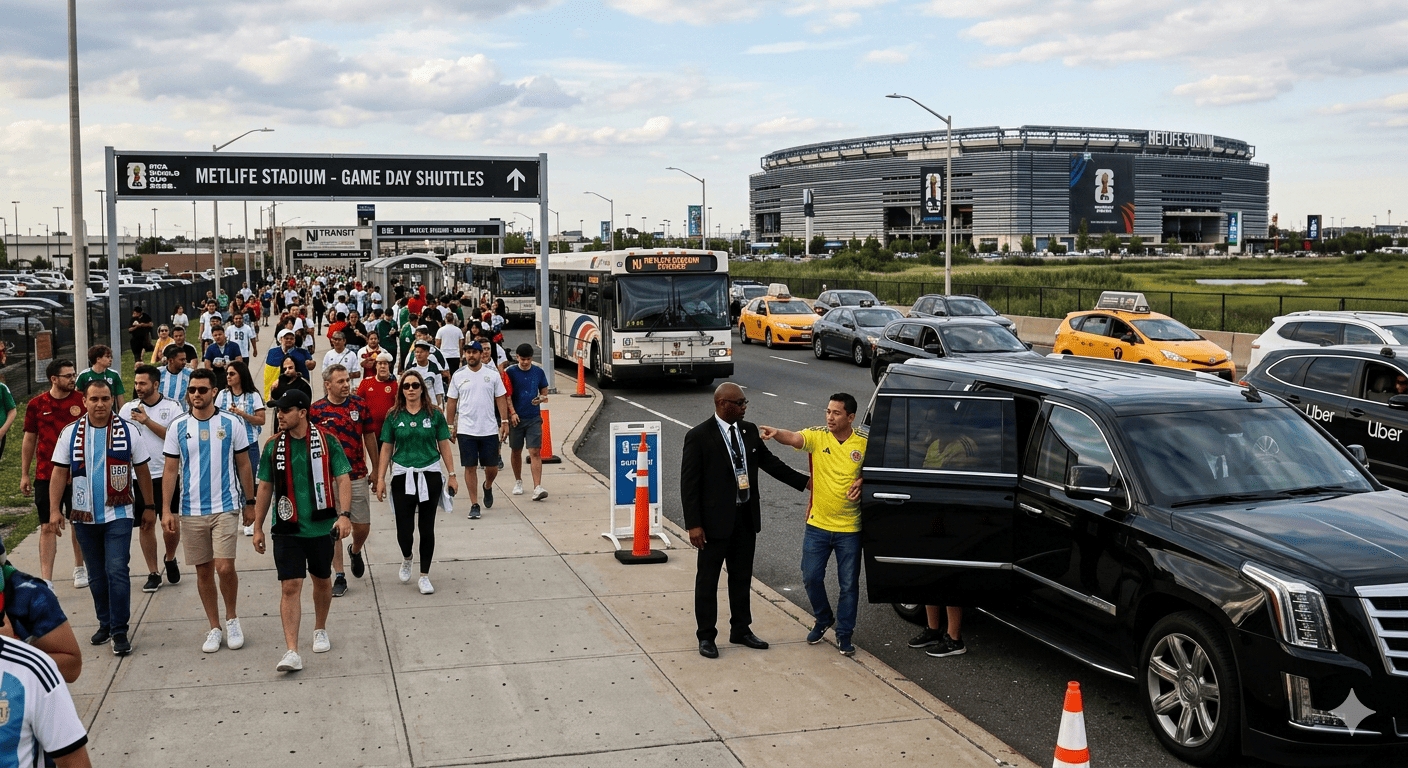
Related Reading

May 13, 2026

If you’re booking transportation for a FIFA World Cup 2026 match at MetLife Stadium, you’ve probably noticed something confusing: operators use the terms “limo,” “black car service,” and “chauffeur service” almost interchangeably — but they don’t actually mean the same thing. Some companies sell you a “limo” and show up in a stretch Cadillac. Others sell you a “limo” and show up in a black SUV. Others quote “chauffeur service” and you have no idea what vehicle to expect.

Table of Contents

This guide clears it up. After 20 years operating in this market, I can tell you the real definitions of each term, when each is the right call, and how to make sure you’re booking what you think you’re booking.

If you’d rather skip ahead and find out which one’s right for your World Cup 2026 trip, +1 (917) 277-3371 or request a quote.

The Short Answer

  • Limo (limousine): A larger, stretched vehicle — typically a stretch sedan or a Sprinter limo with party-style interior. Designed for groups.
  • Black car service: An executive sedan or SUV (Mercedes S-Class, Cadillac Escalade ESV) with a professional driver. Designed for individuals and small groups.
  • Chauffeur service: The professional driver who comes with either of the above. The chauffeur is the person, not the vehicle.

In NYC, “black car service” and “chauffeur service” are often used interchangeably to mean “professional executive sedan/SUV with a driver.” “Limo service” means something larger — a stretch limo, party limo, or Sprinter limo.

The longer answer covers what you’re actually paying for, when each fits, and how to book the right one.

Defining Each Term Clearly

Limo / Limousine

What it is: A vehicle with extended capacity or party-style interior. The defining feature is size — limos are bigger than standard sedans or SUVs.

Common Configurations:Stretch sedan: Lincoln or Cadillac sedan extended with additional rear seating (6-10 passengers) – Stretch SUV: Cadillac Escalade extended (10-14 passengers) – Sprinter limo: Mercedes Sprinter van with luxury wrap-around interior (12-14 passengers) – Party bus / motor coach: Larger limo with multiple seating areas (20-56 passengers)

Best for: Groups, celebrations, bachelor parties, weddings, group match-day transportation. See our group transportation guide.

What “limo” doesn’t mean in NYC industry usage: – A regular sedan with a driver (that’s black car service) – A regular SUV with a driver (also black car service) – A driver alone (that’s chauffeur service)

Black Car Service

What it is: Premium sedan or SUV with a professional driver. The “black” comes from the traditional black color of executive vehicles, though some vehicles are silver, white, or other colors.

Common Vehicles:Mercedes S-Class executive sedan — 1-3 passengers – BMW 7 SeriesCadillac Escalade ESV / Lincoln Navigator — 1-6 passengers – Mercedes-Maybach S-Class — premium 1-3 passengers

Best for: Individual or small-group transportation. Hotel-to-stadium, airport transfers, executive trips. See our black car service guide.

What “black car service” doesn’t mean: – A taxi (different licensing, different vehicles) – A rideshare (different model, different pricing, different reliability) – A regular town car from any company (real black car service includes TLC license, professional chauffeur, premium vehicle)

Chauffeur Service

What it is: The professional driver who operates the vehicle. Specifically, a uniformed, licensed, trained driver who provides high-end service.

What Makes Chauffeur Service Different From Just a Driver:Licensed: TLC-licensed, DOT-regulated – Uniformed: Suit and tie standard – Trained: Background-checked, drug-tested, defensive driving certified – Experienced: Years of commercial passenger transport – Service-oriented: Opens doors, handles luggage, addresses passengers by name

Best for: Any situation where you want a real professional, not just someone driving a car. Comes standard with both limo and black car bookings.

What “chauffeur” means specifically: – Not just a driver – Not a rideshare driver (regardless of vehicle) – A trained, licensed, professional service provider

The Three Common Vehicle Configurations

Each term aligns roughly with these configurations:

Executive Sedan (Black Car Service)

  • Mercedes S-Class, BMW 7 Series, Lincoln Continental
  • 1-3 passengers
  • Quiet, private, premium interior
  • Best for: solo travelers, couples, executives
  • Use case: hotel-to-stadium, airport transfers

Luxury SUV (Black Car Service)

  • Cadillac Escalade ESV, Lincoln Navigator, Mercedes G-Class
  • 4-6 passengers
  • Climate-controlled, premium SUV interior
  • Best for: small families, executives with luggage, small groups
  • Use case: family transportation, group of 4-6, premium hotel pickups

Sprinter Limo (Limousine Service)

  • Mercedes Sprinter with stretched interior
  • 12-14 passengers
  • Party-style interior with leather, lighting, audio
  • Best for: groups, bachelor parties, family groups, corporate hospitality
  • Use case: group transportation to MetLife, mobile pre-game, fan delegations

How NYC Operators Use Each Term

Real talk on industry usage:

Some Operators Use “Limo” for Everything

You’ll see “limo service” advertised that turns out to be a Mercedes S-Class. This is loose usage. They’re really offering black car service but using the more popular keyword.

Some Operators Use “Black Car” for Everything

Conversely, some operators use “black car service” as their main brand name, even when they offer Sprinter limos and motor coaches. They differentiate by vehicle class, not by service name.

Most Modern Operators Differentiate

Premium operators specify the exact vehicle in your booking, so the term used in marketing matters less. “Black car service” with a Mercedes S-Class is unambiguous, regardless of what the website calls it.

“Chauffeur Service” Is Increasingly Used as the Umbrella Term

Some operators rebrand all of their services under “chauffeur service” — meaning “professional driver with premium vehicle, regardless of vehicle type.” This is the most modern usage.

Which One Should You Book?

Practical guide by your situation:

Solo Traveler or Couple

Book: Black car service / Mercedes S-Class Why: Right-sized, executive, quiet, less expensive than larger vehicles.

Family of 4-6

Book: Black car service / Cadillac Escalade ESV Why: Comfortable for family, fits car seats and strollers, climate-zoned.

Group of 8-14 Friends

Book: Limo service / Sprinter limo Why: Group cohesion, vehicle as part of the experience, party-style interior.

Bachelor Party or Celebration Group

Book: Limo service / Sprinter limo (or stretch limo for smaller groups) Why: Celebration vehicle, mobile pre-game space, photogenic.

Wedding Day

Book: Combination — premium black car (Maybach or Rolls-Royce) for bride/groom + Sprinter limo for bridal party Why: Different vehicles for different roles in the wedding day.

Corporate Hospitality / Multi-Vehicle Group

Book: Multiple vehicles — Mercedes S-Class for executives, Sprinter limos for clients, motor coach for large groups Why: Match vehicle to passenger role.

Senior Couple or Travelers With Mobility Needs

Book: Black car service / Cadillac Escalade ESV (low entry) or ADA-accessible vehicle Why: Easier ingress, comfortable seating, accommodates mobility devices.

For specific vehicle recommendations, see our complete pricing guide.

What Each Costs (Real Numbers)

Real pricing for World Cup 2026 transportation (round-trip Manhattan to MetLife, group-stage match):

Black Car Service Prices

Vehicle Round-Trip Flat Rate
Mercedes S-Class $495-$595
Cadillac Escalade ESV $595-$795
Lincoln Navigator $595-$795
Maybach S-Class $895-$1,495
BMW 7 Series $545-$695

Limo Service Prices

Vehicle Round-Trip Flat Rate
Stretch limousine (6-10 pax) $795-$995
Sprinter limo (12-14 pax) $1,095-$1,495
Party bus (20-32 pax) $1,495-$2,495
Motor coach (32-56 pax) $2,795-$3,995

Per-Passenger Cost Comparison

  • Mercedes S-Class for 2 people: $250-$300/person
  • Cadillac Escalade ESV for 4 people: $150-$200/person
  • Sprinter limo for 14 people: $80-$110/person
  • Motor coach for 50 people: $55-$80/person

For group bookings, per-person economics improve dramatically with larger vehicles.

Common Misconceptions

Misconception 1: “A Limo Is Always a Stretch”

Not always. Stretch limos are one type. Sprinter limos are another. Even Mercedes Sprinters not extended can be called “limos” loosely. The defining feature is “professional driver with premium interior” — the exact configuration varies.

Misconception 2: “Black Car Means Black”

The color comes from tradition but modern fleets use various colors. The “black” refers to the service tier, not literal color.

Misconception 3: “Chauffeur Means Stretch Vehicle”

No. The chauffeur is the driver, not the vehicle. Chauffeurs drive Mercedes S-Class and Sprinter limos equally — they’re the professional providing the service.

Misconception 4: “Limo, Black Car, and Chauffeur Are All the Same Thing”

They’re related but distinct. Limo = vehicle category. Black car = vehicle category. Chauffeur = the driver.

Misconception 5: “Rideshare Black Cars Are the Same as Real Black Car Service”

Uber Black is a tier of rideshare. Real black car service has TLC licensing, premium vehicles, trained chauffeurs, flat-rate pricing, and contractual delivery. Uber Black has different licensing and is technically rideshare with premium-priced vehicles.

What to Specify When You Book

To avoid confusion, your booking conversation should include:

Vehicle Class

“Mercedes S-Class executive sedan” or “Cadillac Escalade ESV” or “Sprinter limo for 14 passengers”

Service Type

“Black car service” or “Limo service” — basically describes what kind of vehicle you want

Specific Make/Model

For high-stakes bookings (wedding, anniversary, special occasion), confirm the specific make and model.

Passenger Count

“3 passengers” or “12 passengers including 2 children”

Special Requests

“Champagne service, mood lighting, branded welcome” or “child seats for ages 4 and 7”

When you book this clearly, there’s no confusion at confirmation.

What Makes a “Real” Premium Service?

The defining qualities of premium operator service, regardless of whether you call it limo, black car, or chauffeur service:

Vehicle Quality

  • Late-model (current or 1-2 years old)
  • Inspected, cleaned, detailed
  • Premium interior (leather, climate zones, WiFi)
  • Owned by the operator (not brokered)

Chauffeur Quality

  • Licensed (TLC, DOT)
  • Trained (defensive driving, executive protection awareness)
  • Uniformed (suit + tie)
  • Background-checked
  • Experienced

Service Quality

  • Pre-booking professional communication
  • Flat-rate pricing (no surge)
  • Pre-match coordination call
  • Real-time tracking
  • 24/7 dispatcher channel
  • Backup vehicle protocol
  • Direct chauffeur contact

If you get all of these, you’ve got real premium service. Whether you call it limo, black car, or chauffeur service doesn’t change the experience.

When Should I Use Each?

Decision flowchart by trip:

“I’m Going From My Hotel to MetLife and Back, Solo or Couple”

Book: Black car service / Mercedes S-Class

“I’m Bringing My Family of 4-6 to MetLife”

Book: Black car service / Cadillac Escalade ESV

“I’m With 10 Friends Going to MetLife”

Book: Limo service / Sprinter limo

“I’m Hosting Corporate Clients at MetLife”

Book: Mixed — black car for executives + Sprinter for clients

“It’s My Bachelor Party Weekend”

Book: Sprinter limo for daily group movement

“I’m a UHNW Individual Going to a Final Match”

Book: Maybach S-Class executive sedan

For specific vehicle recommendations, see our pricing guide.

Frequently Asked Questions (FAQ)

Q: What’s the difference between a limo, a black car, and a chauffeur service?

A: A limo is a larger, stretched or party-style vehicle (stretch sedan, Sprinter limo, party bus) designed for groups of 6-56. A black car is an executive sedan or SUV (Mercedes S-Class, Cadillac Escalade ESV) for individuals or small groups of 1-6. A chauffeur service refers to the professional driver — typically TLC-licensed, uniformed, trained — who operates either type of vehicle.

Q: Is Uber Black the same as black car service?

A: No. Uber Black is a rideshare tier offering premium-priced rides through the Uber app. Real black car service uses different licensing (TLC commercial), different vehicles (specifically employed fleet), trained chauffeurs (not gig drivers), flat-rate pricing (no surge), and contractual reliability. They’re related but distinct service categories.

Q: When should I book a limo vs. a black car for World Cup 2026?

A: Book a black car (Mercedes S-Class or Cadillac Escalade ESV) for solo, couple, or family travel (1-6 passengers). Book a limo (Sprinter limo, stretch limousine) for groups of 8-14 or celebration occasions where the vehicle is part of the experience.

Q: Is a Sprinter limo the same as a regular Sprinter van?

A: No. A Sprinter limo is a Mercedes Sprinter chassis upfitted with luxury interior — wrap-around leather, mood lighting, premium audio, climate zones, often an onboard bar. A regular Sprinter van is a cargo or shuttle vehicle without these upgrades. Pricing is dramatically different.

Q: Can I get a Maybach instead of a Mercedes S-Class for my World Cup 2026 booking?

A: Yes, with advance notice. Mercedes-Maybach S-Class is a premium tier above Mercedes S-Class. Pricing is $895-$1,495 round trip vs. $495-$595 for S-Class. Limited fleet — availability is constrained for Final Match weekend.

Q: What’s the most popular vehicle for World Cup 2026 transportation?

A: For solo/couples, the Mercedes S-Class. For small groups (4-6), the Cadillac Escalade ESV. For groups of 8-14, the Sprinter limo. Each fits a specific traveler profile.

Q: Can I book a stretch limo for a small group of 4?

A: You can, but it’s typically overkill. A stretch limo seats 6-10 — bookings for 4 in a stretch are less common than 4 in an Escalade ESV. Choose stretch limo for the celebration aesthetic, not the capacity.

Q: Are black car drivers and chauffeurs the same thing?

A: In NYC industry usage, yes — most operators use these terms interchangeably for their professional drivers. A “chauffeur” in this context is a licensed, uniformed, trained driver providing premium service. The role doesn’t change based on which vehicle they’re driving.

Q: Do limo services include a chauffeur?

A: Yes, always. A “limo” without a chauffeur is a “limo rental” (you drive yourself), which is uncommon for World Cup transportation. All our limo bookings include a professional chauffeur.

Q: Which service tier is right for a Final Match (July 19, 2026)?

A: For couples, Maybach S-Class or Mercedes S-Class. For families, Cadillac Escalade ESV. For groups, Sprinter limo. For VIP suite holders, premium tier (Maybach, Rolls-Royce). Final Match weekend pricing carries 25-50% premium across all tiers.

Book the Right Service for Your World Cup Trip

Now that the terminology is clear, the next step is matching the right vehicle to your specific trip. We can help — call our team or get a quote.

Book the right service → 📞 24/7 Dispatch: +1 (917) 277-3371

Related Reading

May 13, 2026

If you’ve been using Uber and Lyft for years, you’re used to seeing your driver on a map — exactly where they are, how far away, and how many minutes until arrival. When you switch to a traditional limo or chauffeur service, this is one of the first questions people ask: can I do the same thing? Can I track my limo?

The short answer is yes. Most modern NYC limo operators offer real-time chauffeur tracking that works essentially the same as rideshare. But the implementation and capabilities vary widely between operators. Here’s what tracking actually looks like with a professional operator, what you should expect, and where the experience differs from rideshare.

After 20 years operating in NYC, I’ve watched this expectation evolve. Today’s clients want the visibility they get from Uber, and they should be able to get it from any premium operator. Here’s what you should expect from yours.

If you’d rather see this for yourself, book a quote and we’ll show you the tracking interface when we send your confirmation. Or call +1 (917) 277-3371.

What Real-Time Limo Tracking Actually Looks Like

Modern licensed NYC limo operators typically offer some combination of the following:

1. SMS / Text Updates

You receive text messages at key moments: – “Your chauffeur is en route, arriving in 60 minutes” – “Your chauffeur is 15 minutes away” – “Your chauffeur has arrived at [hotel name]”

These are automated, sent through dispatch systems, and feel similar to rideshare notifications.

2. Map Tracking (Web or App)

A link sent to your phone opens a map showing: – Your chauffeur’s real-time location – ETA to your pickup point – Vehicle make, model, and license plate – Chauffeur name and photo

This is the closest analog to Uber’s experience and what most modern operators provide.

3. Direct Chauffeur Contact

You’re given a phone number where you can text or call your chauffeur directly: – Send updates (“running 5 minutes late”) – Confirm pickup details – Ask questions – Verify identity at pickup

4. Dispatcher Channel

You can also reach the operator’s dispatcher 24/7 for: – Booking changes – Pickup point modifications – Emergencies – General questions

How Our Tracking Works (Specifically)

For our bookings, here’s what tracking actually looks like:

T-24 Hours Before Pickup

Email and SMS confirmation with: – Chauffeur’s name, photo, and direct phone number – Vehicle make, model, year, license plate – Tracking link (accessible from your phone) – Pickup time, location, route plan

T-60 Minutes Before Pickup

SMS notification: “Your chauffeur is en route. ETA at your hotel: 60 minutes.”

T-30 Minutes Before Pickup

SMS notification: “Chauffeur 30 minutes out.”

T-15 Minutes Before Pickup

SMS notification: “Chauffeur 15 minutes out.”

T-5 Minutes Before Pickup

SMS notification: “Chauffeur arriving in 5 minutes.”

Pickup Moment

SMS notification: “Your chauffeur has arrived at [hotel name].” Plus arrival photo or location pin on the tracking link.

During Transit (Optional)

You can track real-time location through the tracking link. Useful for: – Confirming progress to MetLife – Sharing ETA with people meeting you there – General awareness

Post-Trip

Email and SMS receipt with trip details, plus rating prompt.

Throughout

You have direct chauffeur phone number and dispatcher channel. You can text or call anytime.

How This Compares to Uber

Side-by-side, here’s the comparison:

Feature Uber Premium Limo Operator
Real-time location tracking Yes Yes
ETA updates Yes Yes
Driver/Chauffeur name + photo Yes Yes
Direct contact with driver Yes (in-app) Yes (direct phone)
Vehicle info pre-pickup Yes Yes
60-min advance notification No Yes
Dispatcher live channel No Yes
Pre-booking coordination call No Yes
Cancellation by driver Common Rare to never
Surge pricing Yes No

The real-time tracking feature is essentially the same. The differences are in the depth of advance communication and the reliability guarantees.

Where Tracking Differs Between Limo Operators

Not all operators offer the same tracking quality. The differences:

Real Operators With Modern Dispatch

  • Real-time GPS tracking via dispatch system
  • Custom SMS notifications
  • Web-based tracking interface
  • Direct chauffeur communication
  • Pre-match call confirmation

Smaller / Older Operators

  • May offer basic SMS updates but no real-time map
  • Direct chauffeur contact only
  • No advance notification system
  • Less polished communication

Broker / Pop-Up Operators

  • Often nothing beyond a confirmation email
  • Tracking depends on whichever third-party operator they assign
  • Limited advance notification
  • Direct contact uncertain

Apps That Bundle Operators

  • Tracking depends on whether the app integrates with the operator’s GPS
  • Variable quality
  • Less consistent than direct booking

For confidence, look for operators who specifically describe their tracking and notification systems on their booking page.

When You’d Actually Want to Track

A few real scenarios where tracking matters:

Scenario 1: Match Day Pre-Pickup

You’re nervous about whether the chauffeur is going to show up on time. Tracking confirms they’re en route, you can see they’ll arrive before your booking time, and your anxiety drops.

Scenario 2: Airport Arrival

Your flight is delayed by 90 minutes. The chauffeur’s tracking adjusts automatically (we monitor your flight). You see they’re rebriefed and will be at baggage claim when you actually land.

Scenario 3: Group Coordination

You’re traveling with 4 colleagues. You can share the tracking link in your group chat so everyone knows when the vehicle arrives at the hotel.

Scenario 4: Tight Schedule

You have a 7 PM kickoff and you’re nervous about timing. Tracking shows the vehicle is on the route and tells you everything’s fine.

Scenario 5: Post-Match Pickup

You’re walking out of MetLife at 9:30 PM. You can see your chauffeur is parked in the pre-staged return zone, waiting. You walk straight to them.

Scenario 6: Late-Night Reassurance

Your booking is for 11 PM departure from a late dinner. You can confirm the chauffeur is on the way, no need to call dispatch.

What Tracking Does NOT Tell You

A few things tracking doesn’t show:

Traffic Reroute Reasoning

You see the chauffeur’s location, not why they took a particular route. They might be avoiding a traffic incident. Trust their routing.

Stadium Drop-Off Zone Specifics

Tracking shows you’re approaching MetLife. It doesn’t show you which gate is your assigned drop-off. The chauffeur knows.

Internal Dispatcher Communication

You don’t see the dispatcher’s behind-the-scenes coordination. That’s a feature, not a bug — it’s the operational layer doing its work.

Backup Vehicle Substitution Process

If a backup vehicle is deployed (rare), the tracking link should automatically update to the new vehicle. Some operators handle this seamlessly; some don’t.

How Often Should I Check My Tracking?

A few honest tips:

Pre-Pickup

Check every 15-30 minutes leading up to your pickup. Reassurance, not obsession. If you see your chauffeur is 15 minutes away, you don’t need to check again until they’re closer.

During Transit to MetLife

Once you’re in the vehicle, you don’t really need to track. Trust the chauffeur.

During the Match

Don’t check tracking during the match. Your chauffeur is parked in the staging zone and waiting. You’ll get a SMS at appropriate moments.

Post-Match Walk to Vehicle

Once the final whistle blows, check tracking to confirm the chauffeur is at the staging zone. Walk to the meeting point. Get in.

Return Trip

Same as outbound — let the chauffeur drive. Tracking is for your peace of mind, not for second-guessing routing.

What’s the Best Way to Stay Calm About Pickup?

Real talk on managing pickup anxiety:

Use the Tracking, But Don’t Obsess

Check at the milestones: 60 min, 30 min, 15 min, arrival. Don’t check every 2 minutes — it’s not useful.

Trust the Notifications

If you get the 60-minute SMS, the chauffeur is on the way. If you get the 30-minute SMS, you’re 30 minutes from departure. Believe what you read.

Confirm at Booking

Make sure your pre-match coordination call covers: – What time the chauffeur arrives – Where they’ll be parked (driveway vs. street) – What signage or vehicle identifier they’ll display – Your assigned chauffeur’s name and phone

Have Direct Chauffeur Contact

A direct phone number for the chauffeur eliminates the worst form of anxiety — “I don’t know who’s coming, where they are, or how to reach them.”

Know the Backup Plan

Confirm with your operator: what happens if the chauffeur is late or has an emergency? Knowing the backup plan reduces anxiety.

What If My Operator Doesn’t Offer Tracking?

A few scenarios:

They Have Tracking But Didn’t Send It

Email or text dispatch and ask for the tracking link. Most operators have it but only send it on request.

They Have Older Tech

Some smaller/older operators rely on SMS-only updates with no map tracking. This works, but it requires more direct chauffeur communication.

They Don’t Have It At All

For mid-size and larger NYC operators, this is rare in 2026. If your operator has no real-time tracking, that’s a signal of an older / smaller setup. Not necessarily a no-show risk, but indicates less modern operational standards.

You Booked a Broker

Brokers can’t provide real-time tracking because they don’t own the vehicles. Tracking depends on the third-party operator they assign. If you booked a broker, expect limited tracking visibility.

Frequently Asked Questions (FAQ)

Q: Can you track a limo in real time like an Uber for World Cup 2026?

A: Yes. Modern NYC limo operators offer real-time chauffeur tracking via SMS notifications and web-based tracking links. You can see your chauffeur’s location, ETA, vehicle details, and contact them directly — similar to rideshare experience.

Q: How does limo tracking compare to Uber tracking?

A: The core feature is the same: real-time GPS location of your driver. Premium operators add features Uber doesn’t have: 60-minute advance notifications, pre-match coordination calls, dispatcher direct contact, and zero cancellation risk.

Q: Do I need an app to track my limo for World Cup 2026?

A: No. Most operators send a web-based tracking link via SMS that you open in your phone’s browser. No app download required. Some operators have apps, but they’re optional.

Q: How do I get tracking for my limo booking?

A: Tracking is typically activated 24-60 minutes before your pickup time. You’ll receive an SMS with the tracking link. Some operators send tracking at booking confirmation. Confirm with your operator at booking that they offer real-time tracking.

Q: Can I see my chauffeur’s name and photo before pickup?

A: Yes, with premium operators. You receive chauffeur details (name, photo, phone number, license plate) at confirmation (typically 24-30 days before for advance bookings, 24-48 hours before for last-minute bookings).

Q: What if my chauffeur is late and tracking shows it?

A: Contact your dispatcher immediately. Real operators have backup vehicles and chauffeurs. If your chauffeur is genuinely delayed, a substitute deploys within 30-60 minutes. The tracking visibility lets you catch the issue early.

Q: Can I track a Sprinter limo or group vehicle the same way?

A: Yes. Real-time tracking works for any vehicle in our fleet — Mercedes S-Class, Cadillac Escalade ESV, Sprinter limos, motor coaches, all of them. The tracking link doesn’t care about vehicle size.

Q: Does tracking work during the match while my chauffeur waits?

A: Yes, but typically not useful during the match. The chauffeur is parked at the pre-staged return zone. You’ll get a notification when you walk out, and the chauffeur is ready.

Q: What if my flight is delayed and I’m tracking my pickup?

A: We track your flight automatically. The chauffeur’s tracking and ETA adjust without any action from you. If your flight is 90 minutes delayed, the chauffeur shows up 90 minutes later.

Q: Is real-time tracking standard with all NYC limo operators?

A: Most mid-size and larger operators offer it. Smaller operators may have SMS-only updates without a map view. Brokers often don’t offer tracking at all. When booking, ask: “Will I have real-time tracking?”

Track Your World Cup Match Day With Confidence

Modern limo tracking gives you the rideshare confidence with the operator-grade reliability and quality. You see your chauffeur. You know when they’re coming. You don’t worry.

Book with real-time tracking → 📞 Questions? Call +1 (917) 277-3371

Related Reading

May 12, 2026

You’ve decided you want a chauffeur for World Cup 2026. Now you have to pick the right company. There are dozens of options on Google. Some look legitimate, some look sketchy, some look identical to each other. The price quotes vary by hundreds of dollars. The reviews are confusing. And the stakes are high — you’re trusting someone with your World Cup match day.

Table of Contents

This guide walks through exactly how to evaluate NYC limo operators and pick the right one. Real questions to ask. Real red flags. Real comparison criteria. After 20 years operating in this market, I’ve seen every kind of operator and every kind of mistake clients make in choosing one.

If you’d rather skip ahead and lock with us, +1 (917) 277-3371 or book here. Otherwise, settle in — this is the comprehensive guide.

The 7 Real Criteria for Choosing an NYC Limo Operator

Forget price for a moment. Price matters, but it’s not the first thing to evaluate. Here’s the actual hierarchy that should drive your decision:

Criterion 1: Are They Actually Licensed and Real?

Criterion 2: Do They Own Their Fleet?

Criterion 3: How’s Their Real Operational Reliability?

Criterion 4: How Do They Handle Backup and Contingency?

Criterion 5: What’s the Quality of Communication?

Criterion 6: Are They Insured Properly?

Criterion 7: What Does the Total Cost Actually Look Like?

Price comes in at #7 because if any of #1-#6 fail, the price doesn’t matter.

Let’s go through each.

Criterion 1: Licensing — Are They Real?

NYC has strict licensing requirements for commercial passenger transport. A legitimate operator carries multiple credentials:

  • TLC (NYC Taxi & Limousine Commission) license — required to pick up passengers in NYC
  • DOT (Department of Transportation) regulation — federal commercial passenger oversight
  • NJ Limousine License — required to pick up passengers in New Jersey (for MetLife transportation)
  • ICC / MC authority — for interstate movement (NY to NJ is interstate)
  • Real business registration — corporate EIN, real address, real history

What to Ask

  • “What’s your TLC base number?”
  • “Are you DOT regulated?”
  • “Can you provide a Certificate of Insurance (COI)?”
  • “What’s your NJ Limousine License number?”

Red Flags

  • Vague or no answer to license questions
  • “We work with TLC drivers” (translation: brokering)
  • License numbers that don’t match TLC’s public registry
  • Pop-up websites with no business history

How to Verify

  • Search NYC TLC’s public license registry
  • Check Better Business Bureau
  • Look up DOT carrier number on FMCSA registry
  • Verify on Google reviews and check for years of operating history

Criterion 2: Do They Own Their Fleet?

This is the single biggest separator between real operators and brokers.

Real Operators

  • Own their vehicles
  • Employ their chauffeurs directly
  • Can tell you the make, model, year of your assigned vehicle
  • Can show you their fleet (photos, walkthroughs)
  • Have multi-vehicle redundancy in each class

Brokers / Lead Generators

  • Don’t own vehicles
  • Resell your booking to third-party operators
  • Can’t tell you specifics about your vehicle
  • Vague about fleet details
  • Hide behind generic website language

How to Test

Ask: “What specific vehicle will be assigned to my booking on [date]?”

Real operator answer: “It’ll be a 2024 Cadillac Escalade ESV, Sport Platinum trim. License plate [number].”

Broker answer: “We’ll send you the details closer to the date.”

The first response is real. The second is concerning.

Criterion 3: Operational Reliability

A real operator has years of operational history. You can verify this in several ways:

Look For

  • Google reviews going back multiple years (not just recent reviews)
  • NYC media mentions (Time Out, amNewYork, NJ.com, etc.)
  • Established website (years old, not just launched for World Cup)
  • Operational case studies (described their work for past major events)
  • Customer logos / partnerships (corporate clients, hotels)

Red Flags

  • All reviews from the past 3 months
  • Generic five-star reviews with no detail
  • Website launched in 2025
  • No NYC press history
  • No corporate client references

How to Test

Read 20+ reviews on Google. Look for patterns — what do customers consistently praise? What do they criticize? Pay attention to specifics, not just ratings.

Criterion 4: Backup and Contingency

A real operator has a plan if something goes wrong. Here’s what to ask:

Specific Questions

  • “What happens if my chauffeur calls out sick the morning of my match?”
  • “What if my booked vehicle has a mechanical issue an hour before pickup?”
  • “What happens if there’s a major traffic event between my hotel and MetLife?”
  • “What’s your protocol if I miss my pickup window?”

Real Operator Answers

  • Backup chauffeur deployed within 30-60 minutes
  • Backup vehicle available within 30-60 minutes
  • Live traffic monitoring and dynamic routing
  • Standard 15-30 minute grace period before vehicle moves on

Broker / Pop-Up Answers

  • Vague “we’ll handle it” responses
  • No specifics about backup process
  • “Call us if there’s a problem”

The questions reveal everything.

Criterion 5: Communication Quality

How an operator communicates before you book predicts how they’ll perform on match day.

Real Operator Communication

  • Live phone dispatch (calls answered in 5-15 seconds)
  • Quote provided in writing within 1-2 hours during business days
  • Pre-match coordination call (T-7 to T-24 hours)
  • 60-minute confirmation text on match day
  • Direct chauffeur contact provided

Broker / Pop-Up Communication

  • Phone calls go to voicemail
  • Email-only contact
  • Vague written quotes (often via PDF email)
  • No pre-match call
  • No direct chauffeur access

How to Test

Call them at booking. Note response time, professionalism, and depth of knowledge.

Criterion 6: Insurance Coverage

Commercial passenger transport requires significant insurance. Real operators carry:

  • $5M+ commercial auto liability per occurrence
  • $2M+ general liability
  • Workers compensation for chauffeurs
  • Umbrella policy for excess coverage
  • Certificate of Insurance (COI) available on demand

What to Ask

  • “What’s your commercial liability limit?”
  • “Can you provide a COI within 2 business hours?”
  • “Are your chauffeurs covered by workers compensation?”
  • “Do you have an umbrella policy?”

Red Flags

  • “Don’t worry about it”
  • “We have insurance” (without specifics)
  • “Insurance isn’t included in your rate”
  • Can’t provide COI

Insurance matters because if anything goes wrong (accident, injury, vehicle damage), proper coverage protects you. Without it, lawsuits are your responsibility.

Criterion 7: The Total Cost

Now we get to price. By this point, you’ve narrowed your operator shortlist to 2-3 legitimate options. Now compare costs.

What to Compare

  • Flat-rate price (not hourly unless specifically using that model)
  • What’s included (tolls, gratuity, wait time, water, WiFi)
  • What’s excluded (fuel surcharge, additional time charges, premium amenities)
  • Final total including all add-ons

Apples-to-Apples Comparison

Make sure you’re comparing the same: – Vehicle class (Mercedes S-Class vs. Cadillac Escalade ESV is meaningfully different) – Same pickup and drop-off locations – Same date – Same match (group stage vs. Final has 25-50% pricing difference) – Same wait time included

Pricing Red Flags

  • Quote dramatically below market (40%+ less than competitors)
  • Vague pricing without specific vehicle assignment
  • Hidden fees revealed only at confirmation
  • Cash-only pricing
  • Pressure to book immediately with limited-time pricing

For full pricing context, see our pricing guide.

How to Compare Three Operators Side-by-Side

Here’s a simple comparison framework. For each operator on your shortlist, gather:

Verification Checklist

Item Operator A Operator B Operator C
TLC License Verified ✓/✗ ✓/✗ ✓/✗
NJ Limousine License ✓/✗ ✓/✗ ✓/✗
DOT Regulated ✓/✗ ✓/✗ ✓/✗
Owns Fleet (Not Broker) ✓/✗ ✓/✗ ✓/✗
Years of NYC Operating History # # #
Google Review Rating 4.X 4.X 4.X
Live Dispatch Response Time X min X min X min
COI Available on Demand ✓/✗ ✓/✗ ✓/✗
Backup Vehicle Process ✓/✗ ✓/✗ ✓/✗
Pre-Match Coordination Call ✓/✗ ✓/✗ ✓/✗
Flat-Rate Price for Same Trip $X $X $X

The operator with the most checks wins. Price is the tiebreaker, not the lead criterion.

When Cheaper Isn’t Better (And When It Is)

A few real scenarios:

When the Cheapest Operator Is Probably Wrong

  • The lowest-priced quote is 30%+ below the others
  • They can’t provide TLC license or COI
  • Their website is new
  • They want crypto/cash payment
  • They pressure you to book immediately

If you spot 3+ of these, walk away. You’re looking at a no-show waiting to happen.

When the Cheapest Operator Could Be Right

  • All operators have similar credentials and history
  • Reviews are comparable
  • The price difference is within 15-20% of the median
  • They have a real explanation for the lower price (smaller operator, less overhead, etc.)

In this scenario, picking the cheaper one is reasonable.

When Paying More Makes Sense

  • Premium operator with deep operational history
  • Better backup process
  • Higher insurance limits
  • Better communication
  • Direct fleet ownership of premium vehicles

For high-stakes match days (Final, knockout rounds), paying 10-20% more for a premium operator usually pays off.

What Reviews Actually Tell You

Reading 20+ reviews on Google is more valuable than reading one operator’s “About Us” page. Here’s what to look for:

Green Flags in Reviews

  • Specific praise for chauffeur professionalism by name
  • Mentions of specific match days or major events handled
  • Comments about pre-match coordination
  • Compliments on communication quality
  • Praise for handling problems (rerouting, accommodating changes)
  • Multi-year operating history visible in review dates

Red Flags in Reviews

  • Consistent complaints about delays or no-shows
  • Generic complaints about service quality
  • Reviews from only the last 6 months
  • All five-star reviews with no specifics
  • Operator responses that are defensive or aggressive
  • Operator responses that are vague

Average Rating Math

  • 5+ stars across 100+ reviews = excellent
  • 2-4.5 stars across 50+ reviews = solid
  • 0-4.2 stars = mixed (read more)
  • Below 4.0 = concerning

Final Decision Framework

Here’s the actual decision process I recommend:

Step 1: Identify 3-5 Candidate Operators

  • Search “limo service NYC World Cup” or similar
  • Look at Google rankings, not paid ads
  • Look at established websites
  • Check for NYC press mentions

Step 2: Verify Credentials

  • Confirm TLC license
  • Confirm DOT regulation
  • Verify business history

Step 3: Read Reviews

  • Spend 20+ minutes reading Google reviews
  • Look for patterns and specifics
  • Check operator responses to negative reviews

Step 4: Request Quotes

  • Send identical request to your top 3 candidates
  • Note response time and professionalism
  • Compare written quotes side-by-side

Step 5: Ask the Hard Questions

  • Backup process
  • Vehicle assignment specifics
  • COI availability
  • Pre-match coordination process

Step 6: Make the Decision

  • Don’t pick on price alone
  • Don’t pick on website quality alone
  • Pick on the totality of evidence

Step 7: Book

  • Get a written contract
  • Get specific vehicle assignment
  • Lock with deposit
  • Schedule the pre-match coordination call

Why We Match These Criteria

For transparency, here’s how LimoServiceInNYC.com performs on each:

  • TLC Licensed: Yes, with verifiable license number
  • NJ Limousine Licensed: Yes
  • DOT Regulated: Yes
  • Years of NYC Operating History: 20+ years
  • Fleet Ownership: Yes, all vehicles owned, all chauffeurs employed directly
  • Live Dispatch: Yes, 24/7
  • Insurance: $5M+ commercial liability + $2M general + workers comp
  • COI on Demand: Within 2 business hours
  • Backup Process: Backup vehicle and chauffeur per every 3 primary bookings
  • Pre-Match Coordination: Standard for all bookings
  • Google Reviews: Available for verification

This is what a real operator looks like. We’re not the only one in NYC who meets these standards, but we’re solidly in the top tier.

Frequently Asked Questions (FAQ)

Q: How do I choose the right NYC limo company for FIFA World Cup 2026?

A: Use a multi-criteria framework: verify TLC + NJ + DOT licensing, confirm fleet ownership (vs. broker reselling), check years of operating history, read 20+ Google reviews, request specific vehicle assignment, confirm backup process, verify insurance (COI), and compare flat-rate pricing. Don’t pick on price alone.

Q: How do I tell if a limo company is a broker or a real operator?

A: Ask: “What specific vehicle will be assigned to my booking?” Real operators answer immediately with make, model, year. Brokers say “we’ll send details later.” Real operators have live dispatch; brokers send to voicemail. Real operators have years of operational history; brokers often have newer websites.

Q: What questions should I ask before booking a NYC limo for World Cup 2026?

A: TLC license number, COI availability, specific vehicle assignment, backup process, years of operating history, Google review track record, what’s included in the flat rate, pre-match coordination protocol, cancellation policy, and gratuity expectations.

Q: How can I verify if a NYC limo operator is licensed?

A: Check NYC TLC’s public license registry at the NYC TLC website. Verify DOT carrier registration through FMCSA. Cross-check with Better Business Bureau and Google reviews. Real operators provide license numbers without hesitation.

Q: Is the cheapest limo company always the best?

A: No. Dramatically below-market pricing (30%+ less than competitors) often signals problems: brokerage rather than operation, hidden fees, or low-quality service. Pricing 15-20% below the median is reasonable; below that, scrutinize carefully.

Q: What’s the most important thing to check before booking?

A: Whether the operator owns its fleet directly (real operator) or brokers your booking to third parties. This single distinction determines whether your booking is contractually backed or dependent on a third party who might not deliver.

Q: How long should I spend researching limo operators?

A: 30-60 minutes for verification across 3-5 candidate operators. Don’t book the first operator you see. Don’t book on price alone. The wrong choice creates real problems on match day.

Q: Should I read Google reviews before booking?

A: Yes. Spend 15-20 minutes reading at least 20 reviews. Look for specifics about World Cup, NFL, or major event handling. Pay attention to operator responses to negative reviews — defensive responses are concerning.

Q: What’s a Certificate of Insurance (COI)?

A: A document showing the operator’s commercial liability and general liability coverage. Standard for corporate bookings. Real operators provide it within 2 business hours of request. The absence of a COI is a red flag.

Q: How should I compare three different limo quotes for the same trip?

A: Compare on the same vehicle class, same date, same pickup/drop-off, and same wait time included. Confirm what’s in the flat rate (tolls, gratuity, water, etc.). Compare on multiple criteria (license, fleet ownership, reviews, communication), not just price.

The Right Operator for World Cup 2026

After 20 years in this market, I can tell you the operators who get it right are consistent across these criteria. Real licensing. Real fleet. Real backup. Real communication. Real insurance. We meet all of these standards, and we’re not the only ones — but we are firmly in the operator tier, not the broker tier.

If you’ve decided to book with us, lock it in:

Get a quote → 📞 24/7 Live Dispatch: +1 (917) 277-3371
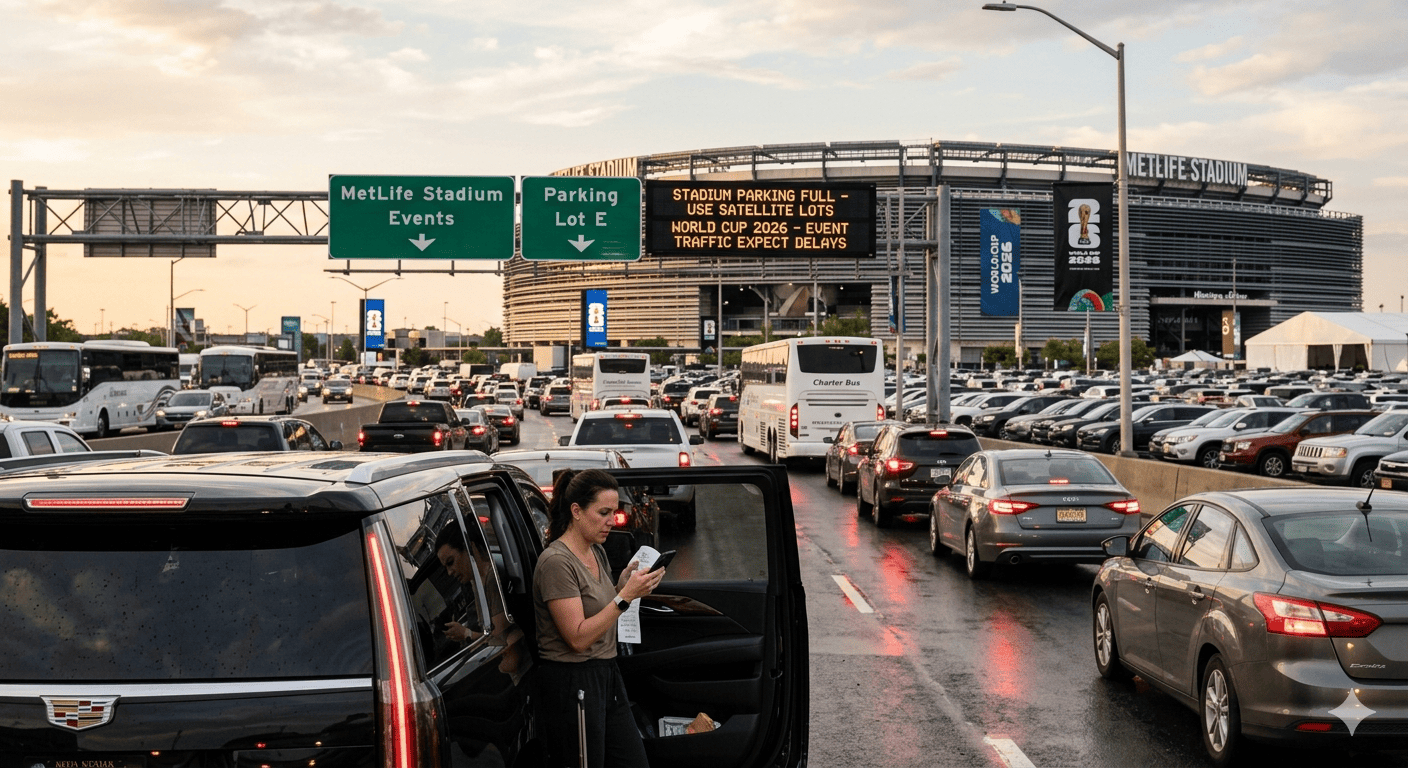
If you’re still comparing, that’s smart. Take 30 minutes to verify the criteria above on whoever you book with. Whoever wins your business should pass these checks.

Related Reading